


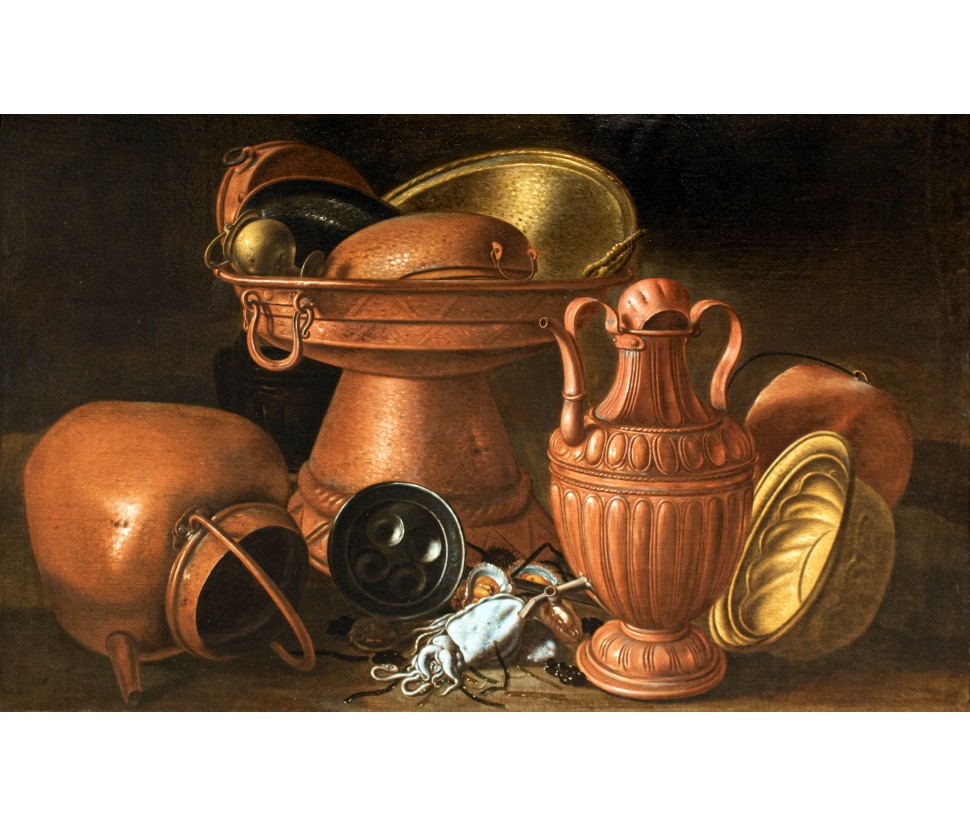
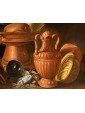
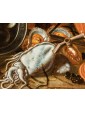
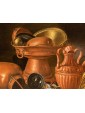
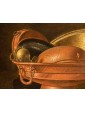
Still life with copper dishes, cuttlefish and oysters
Oil on canvas, cm 102 x 152
Frame cm 122 x 172
Joseph Ruoppolo (c. 1630 - 1710)
Still life with copper dishes, cuttlefish and oysters
Oil on canvas, cm 102 x 152
Frame cm 122 x 172
Joseph Ruoppolo (c. 1630 - 1710)
Joseph Ruoppolo (c. 1630 - 1710)
Still life with copper dishes, cuttlefish and oysters
Oil on canvas, cm 102 x 152
Frame cm 122 x 172
The absolute paternity of this painting, even unsigned, to Giuseppe Ruoppolo, is to be found in the pendant, indeed signed and now dispersed. The two canvases were preserved until the seventies in the collection of the antiquarian Algranti, then divided through different market events. Both illustrate a huge shelf of branches spectacularly arranged, illuminated by elastic rays that inflate the bodies of the specimens.
The refined predilection of Ruoppolo for copper veils left a written trace Bernardo De Dominici, valuable biographer, testifying that the artist "also painted in imitation of his Uncle Gio. Battista cose di rame" (Lives of painters, sculptors and architects from Naples, III, Naples 1743, p. 299). The reference to Ruoppolo’s uncle is a fundamental documentary support in the reconstruction of Giuseppe’s artistic story. It is known to the sources only that he died in 1710 eighty years old, from which data shows that he was born in 1630, and that the monogram "GRU", with which one time used to recognize the homonymous monogramer, is actually referring to Joseph, that in the painting Interior of kitchen with branches and vettovaglie (already in Naples in the collection Dalla Vecchia), had placed such a signature. The artist was apprenticed to his almost contemporary uncle (1629-1693), who was the main proponent of Neapolitan Baroque naturamorphism, in turn a pupil of Paolo Porpora and a contemporary of Salvator Rosa. Unlike his uncle, however, Giuseppe produced works similar to the naturamorphism of the early seventeenth century, commemorating the beginnings of Neapolitan production. The artist was influenced by Luca Forte, who had been part of the workshop of Aniello Falcone, and whose nature was initially marked by a revivalistic caravaggismo.
The production of still life in Ruoppolo ranged from pantagruelic sets of first fruits to minute handfuls of the most immediate fruits on earth, such as zucchini, tomatoes and flowers. A Nature with flower pot, now in private collection, is signed "Giuseppe Rop" on the vase; but there are no more extended signatures, for example in a second Still Life with melons and apricots in private collection, where the artist’s name appears on a blunt stone in the right corner of the painting. The present renews the compostably crowded compositions equal to the Fruit and flower pot in a landscape of the Museum of Nevers, signed, as well as the Grapes, peaches, melon, figs, plums and flowers of the Museum of Nantes, also signed. Oysters and sea fruits had already appeared in the Red Crab still life at the Museum of Fine Arts in Budapest, very close to the ways of Elena Recco.
With Ars Antiqua it is possible to defer all amounts up to € 5,000 at ZERO RATE, for a total of 12 INSTALLMENTS.
Ex. Tot. € 4.500 = monthly instalment € 375 for 12 months.
Ex. Tot. € 3.600 = Monthly payment € 720 for 5 months.
For amounts over €5,000 or for a longer delay in payment (over 12 instalments), we can provide a personalized payment.
Contact us directly to get the best quote.
Live TV
- SUNDAY 19.00 - 23.00 Dig.terr. 126 - 821 Sky
- Streaming on our website www.arsantiquasrl.com and on our social networks Facebook and Youtube
