


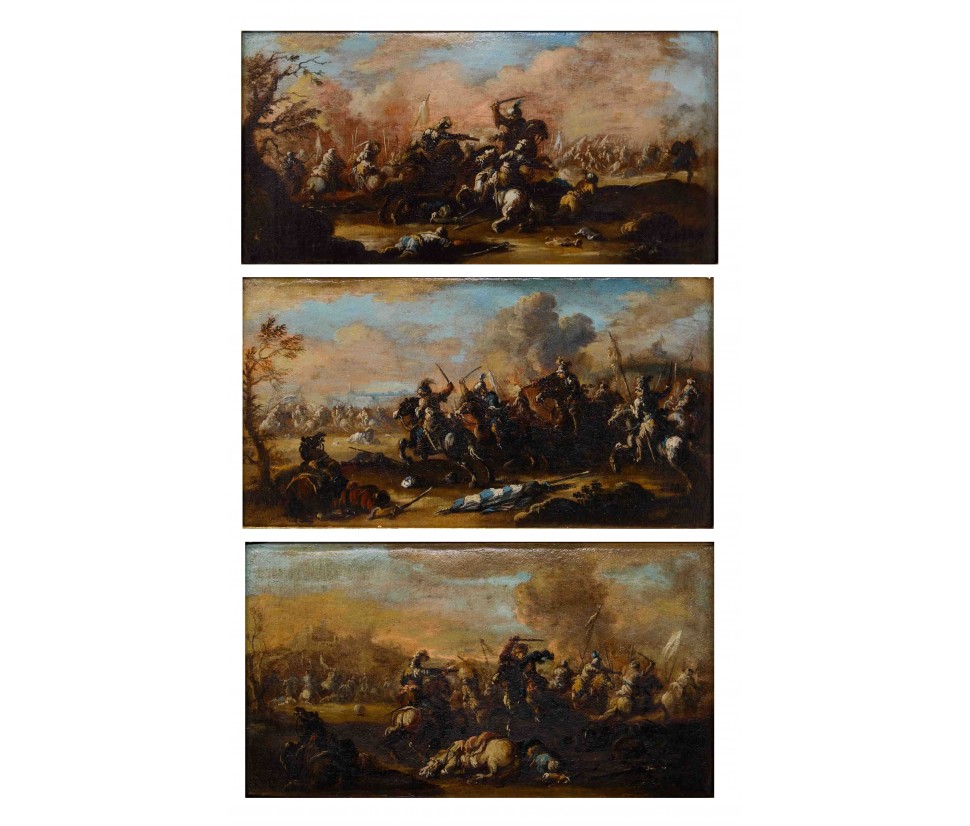
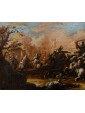
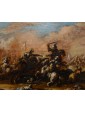
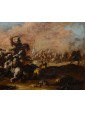
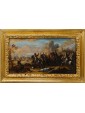
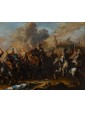
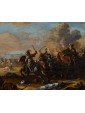
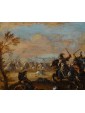
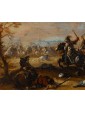
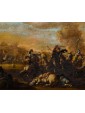
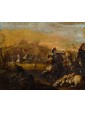
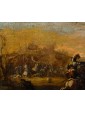
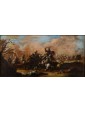
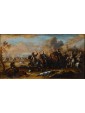
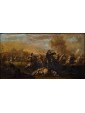
Battle Scenes
(3) Oil on canvas, 17.5 x 36 cm each
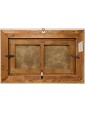
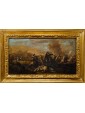
Frame: 30 x 47 cm
Ciccio (Francesco) Graziani (Active in Naples, 17th – 18th Century)
Battle Scenes
(3) Oil on canvas, 17.5 x 36 cm each
Frame: 30 x 47 cm
Ciccio (Francesco) Graziani (Active in Naples, 17th – 18th Century)
Ciccio (Francesco) Graziani (Active in Naples, 17th – 18th Century)
Battle Scenes
(3) Oil on canvas, 17.5 x 36 cm each
Frame: 30 x 47 cm
The genre of battle painting was widely diffused in 17th and 18th-century Neapolitan art. Among the Parthenopean nobility, it was highly fashionable to adorn the walls of representative reception halls with battle scenes depicting individual acts of heroism or complex combat. These works exalted patriotism and martial prowess—virtues with which the nobility sought to identify themselves.
Neapolitan battle paintings are often distinguished by a "virile" palette and a vivid, marked brushstroke. Intense reds and deep blues create a tactile sense of the harshness of combat and the animosity of the contenders. The skirmishes are represented with great ferocity; the shouts of pain and rage from the rivals seem to transcend the surface of the canvas, making the moans of the wounded and dying almost audible. Furious melees, hatred pouring from furrowed faces, knights in pursuit, armored warriors atop fiery steeds, and the dead and wounded are often framed by dark gray, rain-heavy clouds. These skies seem to participate in the grim atmosphere that permeates the entire scene.
The three battle scenes offered here are to be included in the extensive catalog of the Neapolitan painter "Ciccio Graziani" (also known as "Ciccio Napoletano"), the nickname by which the artist Francesco Graziani is best known. Graziani's corpus is characterized by numerous small-format canvases animated by small figures that, thanks to their vibrant coloring, stand out against the bluish tones of the background.
As seen in the present works, his style is marked by a fluidity and vigor of touch. The compositions are crowded and kinetic, with characters delineated by a rapid, nervous, almost "curled" line, invigorated by effective luministic highlights. The figures of soldiers and horses are merely sketched, while the sky—with leaden veins and hazy red tones—hangs heavily over the combat, acting as an active element in the tumultuous unfolding of events.
Information regarding Ciccio Napoletano remains sparse. While his exact birth year is unknown, the fully Rococo taste of his painting places him at the turn of the century. Likely active in Naples and Rome, he was born in Capua, as suggested by certain inventories where he is nicknamed "Ciccio da Capua."
Regarding his training, the historian Lanzi (1808) mentions a certain "Graziani" among the pupils of Jacques Courtois (known as il Borgognone), who may be identified as Francesco. Among the few certain facts is his Roman residency in the 1680s; in 1686, paintings of horses, marines, and battles by Graziani are listed in the Barberini family inventories. It is in this last genre that he excelled, being remembered by subsequent sources as a talented "battaglista" (battle painter).
Reconstructing his complete catalog remains difficult. For instance, two Battles in the Galleria Pallavicini in Rome—cited as by "il Napolitano" in a 1708 inventory and as "Gratiani" in 1713—were attributed to Francesco Graziani by Federico Zeri. However, some contemporary scholars now refer them to Pietro Graziani. De Dominici does not specify whether Pietro was Francesco's son or merely a relative; while Pietro’s biographical dates are also unknown, he was certainly younger and also a specialist in battle scenes.
Italy only: with Ars Antiqua it is possible to defer all amounts up to a maximum € 7,500 at ZERO RATE, for a total of 15 INSTALLMENTS.
Unpardoned. Vault. € 4,500 = Monthly instalment € 300 for 15 months.
Unpardoned. Vault. € 3,600 = Monthly instalment € 720 for 5 months.
For amounts greater than €7,500 or for a longer period of time (over 15 installments), we can provide a personalized payment.
Contact us directly to get the best quote.
LIVE TV
– SUNDAY 17.00 – 21.00 Dig.terr. 126 - Sky 824
– Streaming on our site www.arsantiquasrl.com and on our social networks Facebook and Youtube
All the works proposed by Ars Antiqua are sold accompanied by a certificate of authenticity in accordance with the law and an accurate in-depth sheet.
It is possible to see the works directly at the showroom gallery in Milan, in via Pisacane 55 and 57.
We personally organize transport and deliveries of the works, both for Italy and abroad.
