


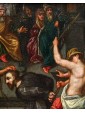
Christ before Caiaphas
Oil on copper, cm 16 x 13
With frame, cm 24,5 x 21
Copper plate from the workshop of Peeter Stas
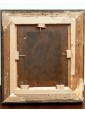
Markings on the back
Antwerp painter, first decade of the 17th century
Christ before Caiaphas
Oil on copper, cm 16 x 13
With frame, cm 24,5 x 21
Copper plate from the workshop of Peeter Stas
Markings on the back
Antwerp painter, first decade of the 17th century
Antwerp painter, first decade of the 17th century
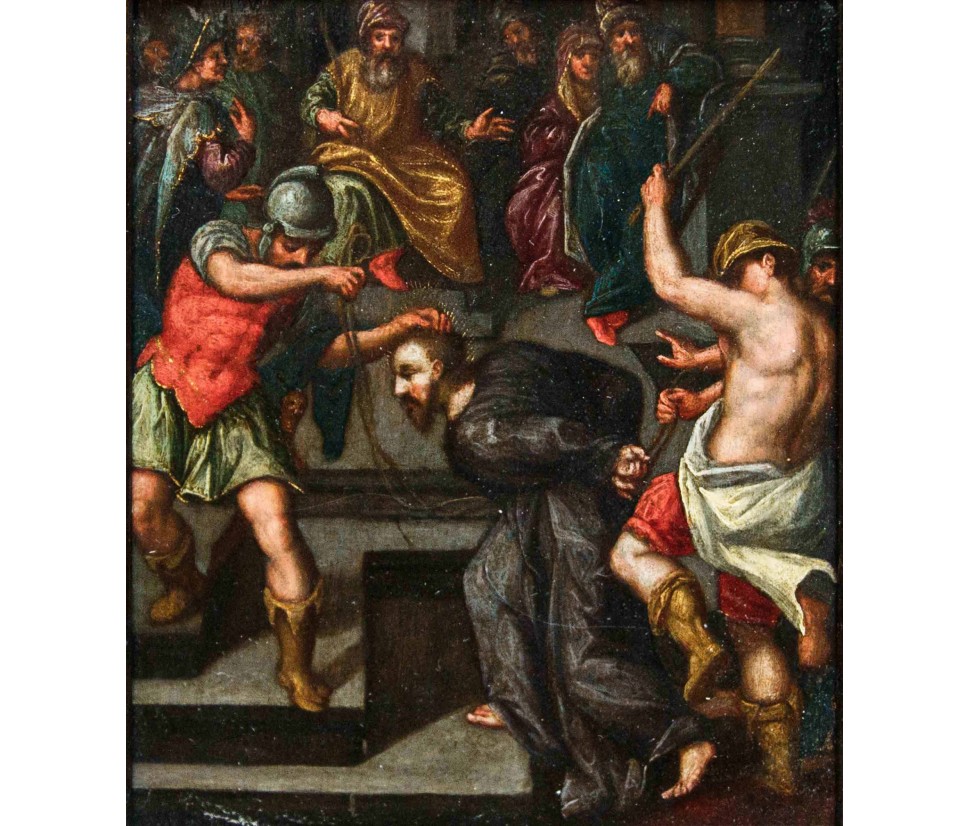
Christ before Caiaphas
Oil on copper, cm 16 x 13 – With frame, cm 24,5 x 21
Copper plate from the workshop of Peeter Stas
Markings on the back
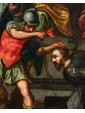
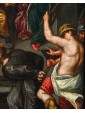
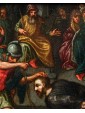
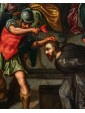
The work illustrates one of the most dramatically tense moments of the Passion: Jesus' nighttime trial at the home of the High Priest Caiaphas, as recounted in the Gospel of Matthew (26:57-68). After his arrest in Gethsemane, Christ is brought before the Sanhedrin to be judged. The sacred text emphasizes the contrast between the feverish agitation of the accusers, seeking “false testimony,” and the dignified silence of Jesus, who breaks his reserve only to confirm his messianic nature: “You have said so; indeed, I tell you, from now on you will see the Son of Man seated at the right hand of Power.” In this precious oil on copper, the artist translates the excitement of the Gospel story through a dynamic and compressed composition. The figure of Christ, the spiritual center of gravity of the scene, is captured at the moment of maximum humiliation: pushed and held by the hair by henchmen in classical robes, he embodies the image of the “Suffering Servant.” His dark robe and bowed head contrast with the theatrical gestures of Caiaphas, who sits high on his throne, a symbol of earthly authority that questions the Truth without recognizing it. The painting faithfully follows verse 67 of the Gospel of Matthew: “Then they spat in his face and slapped him; others beat him with sticks”. The model for this composition is the etching by Dirck Volkertsz Coornhert, based on the invention of Maarten van Heemskerck, the artist who, more than any other, was able to adapt the muscular and architectural language of the Roman Renaissance to Flanders. Famous is the 1545 series of engravings called The Fall and Salvation of Humanity through the Life and Passion of Christ: consisting of 30 plates (etchings and engravings), the series is not limited to the Passion, but narrates the entire arc of Christian redemption, beginning with Original Sin and passing through the salient moments of Jesus' life, culminating in his death and resurrection. Peter Stas' workshop specialized in hammering copper plates for painters. During the 17th century, a considerable part of the paintings produced in Antwerp were sold and exported to the Iberian Peninsula. Documentary sources attest to impressive numbers: the cargo records of some ships, which have survived to this day, testify to the shipment of large quantities of paintings, most of which were executed on copper. This medium was particularly suitable for export, as it allowed for smaller formats than wooden panels and was at the same time more resistant to long sea voyages and bad weather. In 1602, there were twenty-five master copper engravers registered in the Antwerp guild of blacksmiths. In 1584, blacksmiths protested against the imposition of a 5% tax on all goods exported to the northern regions of Zeeland and Holland. Many craftsmen threatened to move to other cities, prompting the authorities to reach a compromise: the administration agreed to abolish the tax on condition that blacksmiths affixed an identifying mark to works intended for export. Another, equally important reason for introducing the marks was the need to combat the proliferation of workshops that were not registered with the guild and were therefore illegal, operating both within the city and abroad and creating a form of unfair competition. The marks provided protection for both the craftsman and the painter who decorated the plate, offering protection against fraud, counterfeiting, and unauthorized copies, while at the same time ensuring a higher standard of quality for buyers. They also played an essential role in export markets, as they made it possible to clearly identify the manufacturer of the copper plates. Among the works marked with Peter Stas' symbol, the oldest known today dates back to 1587, while most of the production is concentrated in the first decade of the 17th century. A study published in 1998 and dedicated to the copper works produced by Peter Stas' workshop reports that a total of seventy-nine works bearing the complete monogram, consisting of the workshop symbol associated with the hand mark, have survived to this day. This study proposes a chronology of production and a cataloguing of the works, ordered according to the size of the symbols stamped on the back of the plates. Following the criteria of this study, the work in question can be dated to the first decade of the 17th century, more precisely between 1602 and 1605
Italy only: with Ars Antiqua it is possible to defer all amounts up to a maximum € 7,500 at ZERO RATE, for a total of 15 INSTALLMENTS.
Unpardoned. Vault. € 4,500 = Monthly instalment € 300 for 15 months.
Unpardoned. Vault. € 3,600 = Monthly instalment € 720 for 5 months.
For amounts greater than €7,500 or for a longer period of time (over 15 installments), we can provide a personalized payment.
Contact us directly to get the best quote.
LIVE TV
– SUNDAY 17.00 – 21.00 Dig.terr. 126 - Sky 824
– Streaming on our site www.arsantiquasrl.com and on our social networks Facebook and Youtube
All the works proposed by Ars Antiqua are sold accompanied by a certificate of authenticity in accordance with the law and an accurate in-depth sheet.
It is possible to see the works directly at the showroom gallery in Milan, in via Pisacane 55 and 57.
We personally organize transport and deliveries of the works, both for Italy and abroad.
