


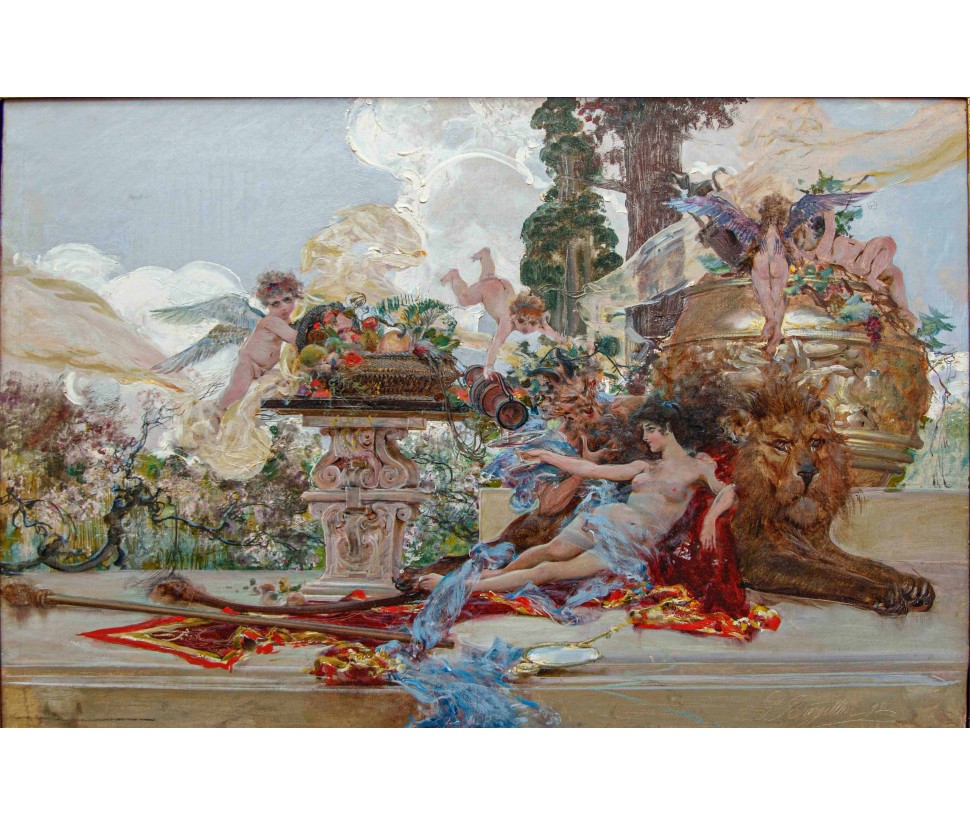
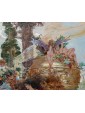
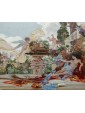
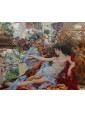
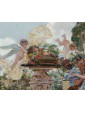
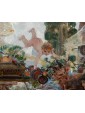
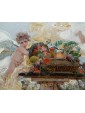
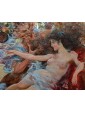
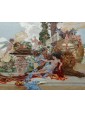
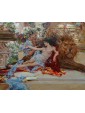
Ariadne with a Satyr, 1892
Oil on canvas, 54 x 81 cm
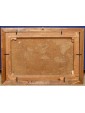
With frame, 65 x 90 cm
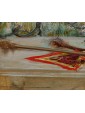
Signature and date at the bottom right
Giulio Bargellini (Florence, 1869 - Rome, 1936)
Ariadne with a Satyr, 1892
Oil on canvas, 54 x 81 cm
With frame, 65 x 90 cm
Signature and date at the bottom right
Giulio Bargellini (Florence, 1869 - Rome, 1936)
Giulio Bargellini (Florence, 1869 - Rome, 1936)
Ariadne with a Satyr, 1892
Oil on canvas, 54 x 81 cm
With frame, 65 x 90 cm
Signature and date at the bottom right
Giulio Bargellini distinguished himself within the Italian artistic landscape at the turn of the 20th century as a painter, mosaicist, and decorator. Originally from Florence, he completed his studies at the Institute of Fine Arts under the tutelage of Augusto Burchi, with whom he collaborated on the decorations of Palazzo Strozzi, Palazzo Bastogi, and Palazzo Budini Gattai. He also studied under the sculptor Augusto Passaglia, from whom he acquired a refined mastery of carving techniques. Subsequently, the artist refined his training under Francesco Vinea, a proponent of an elegant style akin to that of Meissonier. It was Vinea who introduced Bargellini to the art dealer Giovanni Hautmann; the latter maintained close ties with Anglo-Saxon collectors fascinated by the "antique" taste of Lawrence Alma-Tadema, leading to numerous commissions for the young painter in that specific style. Early acclaim arrived in 1895 when he won the Pensionato Artistico Nazionale with the work The Return of the Shipwrecked (currently held at the National Art Gallery of New South Wales, Sydney) and with Pygmalion (National Gallery of Modern Art, Rome). His subsequent relocation to the capital marked a decisive shift toward mural decoration. In Rome, Bargellini quickly integrated into the intellectual and artistic milieu, establishing pivotal relationships with figures such as Cesare Maccari—for whom he became a collaborator—Domenico Morelli, Francesco Paolo Michetti, and the architect Marcello Piacentini. Within this context, the artist developed a distinctive style that sought to synthesize the linear purity of the Tuscan Renaissance masters with contemporary Verismo trends and, later, with Symbolist and Secessionist influences. This is evident in canvases such as The Resurrection and Savonarola, both housed at the National Gallery of Modern Art in Rome. However, Bargellini’s most significant contribution lies in his grand public decorations, where he successfully balanced the era’s celebratory rhetoric with impeccable technical execution. Within the Vittoriano complex, he executed the renowned mosaic lunettes for the Propylaea of Unity, depicting the Allegories of Law, Valor, Peace, and Union. His collaboration with the architect Armando Brasini also led to the cartoons for the crypt mosaics (1934), most notably the austere Dying Christ. Rome preserves numerous examples of his decorative output: from the Bank of Italy, where his frescoes in the Boardroom solemnly celebrate the bank’s economic and institutional functions, to the Palace of Justice, the Viminale, and the headquarters of the National Insurance Institute (INA). Parallel to state commissions, Bargellini was highly active in private and religious architecture both in Italy and abroad. In the sacred sphere, he distinguished himself with works in the chapel of Villa Targioni in Calenzano and Palazzo Lovatelli in Livorno. His international reputation was further solidified by the mosaics executed for the War Memorial in Tripoli and the facade of the Church of All Nations at Gethsemane in Jerusalem, where his sacred figures stand out against visually striking gold grounds. Appointed Chair of Decoration at the Academy of Fine Arts in 1912 and a member of prestigious institutions such as the Accademia di San Luca and the Art Club of London, Bargellini dedicated his final years to a monumental undertaking: the decoration of the Messina Cathedral. This commission, inherited from Giulio Aristide Sartorio, remained unfinished due to his sudden death in Rome on March 10, 1936. The work presented here, depicting the beautiful Ariadne with a Satyr (signed and dated 1892), belongs to Bargellini’s profound exploration of a more "idyllic" and mythological style of painting. It marks a departure from the cold rhetoric of ministerial mosaics toward a sophisticated and vibrant aestheticism. In this production, the Florentine artist aligns himself with a European atmosphere where the lessons of Symbolism—disseminated by the Viennese Secession—merge with a taste for the antique. He found in Lawrence Alma-Tadema and Gustav Klimt two polar yet complementary points of reference. On one hand, the dialogue with Alma-Tadema’s work is evident in the reconstruction of an idealized, "marmoreal" yet vivid classical antiquity, where myth is no longer a heroic narrative but a scene of luxurious daily life. Bargellini dwells on the rendering of materials—veined marbles, transparent fabrics, and the play of sunlight on architectural surfaces—populating his scenes with reclining, dreaming female figures often accompanied by tamed lions or satyrs (e.g., Eternal Idiom, Ulysses, Woman and Mandolin). Conversely, Bargellini does not limit himself to a formal archaeological classicism; he permeates his compositions with a modern sensibility that looks directly toward the Viennese Secession. This manifests in a new conception of space and line: Renaissance perspective gives way to more two-dimensional compositions, where nude bodies merge with dense backgrounds of flowers, fruit garlands, and floral details that seem to weave an ornamental tapestry. The brushwork becomes more "broken" and nervous, almost Pointillist, creating a luminous "dust" effect that recalls the dreamlike atmosphere of Klimt’s works (e.g., Spring or Woman with Apple and Putto).
For Italy only: with Ars Antiqua it is possible to defer all amounts up to a maximum € 7,500 at ZERO RATE, for a total of 15 INSTALLMENTS.
Unpardoned. Vault. € 4,500 = Monthly instalment € 300 for 15 months.
Unpardoned. Vault. € 3,600 = Monthly instalment € 720 for 5 months.
For amounts greater than €7,500 or for a longer period of time (over 15 installments), we can provide a personalized payment.
Contact us directly to get the best quote.
LIVE TV
– SUNDAY 17.00 – 21.00 Dig.terr. 126 - Sky 824
– Streaming on our site www.arsantiquasrl.com and on our social networks Facebook and Youtube
All the works proposed by Ars Antiqua are sold accompanied by a certificate of authenticity in accordance with the law and an accurate in-depth sheet.
It is possible to see the works directly at the showroom gallery in Milan, in via Pisacane 55 and 57.
We personally organize transport and deliveries of the works, both for Italy and abroad.
