


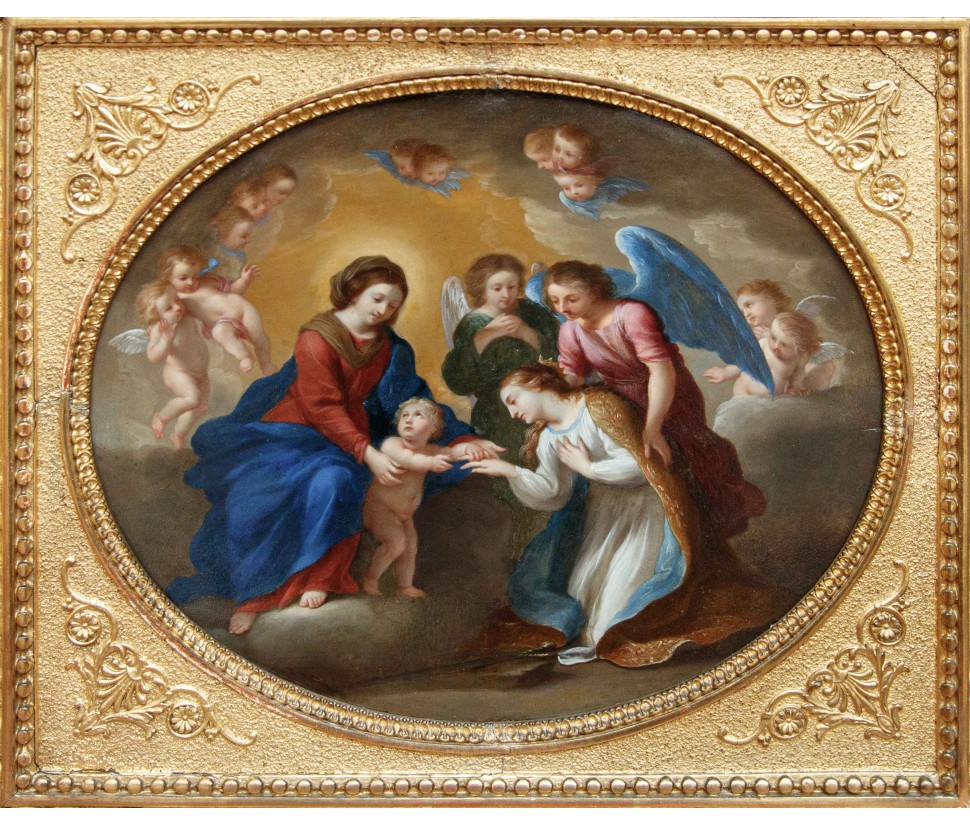
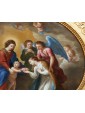
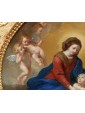
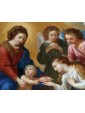
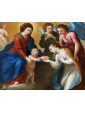
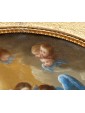
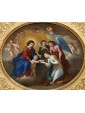
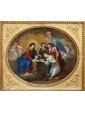
The Mystic Marriage of Saint Catherine
Oil on oval copper, 25 x 31 cm
with frame: 40 x 46 cm
Louis Cousin, known as Luigi Gentile (Ninove, 1606–Brussel, 1667)
The Mystic Marriage of Saint Catherine
Oil on oval copper, 25 x 31 cm
with frame: 40 x 46 cm
Louis Cousin, known as Luigi Gentile (Ninove, 1606–Brussel, 1667)
Louis Cousin, known as Luigi Gentile (Ninove, 1606–Brussel, 1667)
The Mystic Marriage of Saint Catherine
Oil on oval copper, 25 x 31 cm
With frame, 40 x 46 cm
Louis Cousin is better known as Luigi Gentile or Luigi Primo Gentile, a nickname bestowed upon him due to his "refined appearance". Following his initial training in Paris, he moved to Rome in 1626, where he joined the Schildersbent, a mutual assistance society for Dutch and Flemish artists. In Rome, Gentile was a protégé of the sculptor François Duquesnoy, who enjoyed great prestige in the city. His peers also recognized his significant merits, inducting him into the Virtuosi del Pantheon and electing him to two terms as Principe of the Accademia di San Luca between 1651 and 1653. In 1646, he worked for Pope Innocent X Pamphili. According to Roman documentation, the painter produced no fewer than twenty-seven paintings for the Pontiff—notably during the same period in which Diego Velázquez was present at the papal court to execute his famous portrait during his second Roman stay. Examples of these papal commissions include the Annunciation in the Museum of the Order of St. John, London (featuring a frame by Francesco Perone based on a design by Alessandro Algardi) and the Presentation of Jesus in the Temple (Convent of the Carmelites, Alba de Tormes, Salamanca). His Portrait of Don Giacomo di Barthos (Galleria Nazionale d'Arte Antica, Rome) is dated 1652. It was likely during this period that he participated, alongside compatriots and the most celebrated artists of the day—such as Pietro da Cortona and Carlo Maratta—in the decoration of Antonio degli Effetti’s studiolo, contributing a painting on copper (as yet unidentified) representing Neptune and Amphitrite. Further examples of his portraiture include the Portrait of an Anconitan Gentleman and Lady in the Walters Art Museum, Baltimore, which represent the pinnacle of the artist's Marche period. The extensive series of works executed for the Moncada family suggests a potential Sicilian sojourn, during which the painter appears to have been engaged in commissions of an encomiastic nature; these are miniaturized pictorial modelletti painted on copper, intended as precursors to tapestry translations. By June 1661, however, he was registered in the Brussels guild. According to Passeri (1772, p. 244), he worked for the King of Spain as both a painter and a tapestry designer, and executed several paintings for Archduke Leopold Wilhelm of Austria (the Venus and Adonis now in the Kunsthistorisches Museum, Vienna, originates from the Archduke's collection). The copper under consideration is a consistent addition to the Flemish master’s corpus of small-format paintings. The work reveals an indisputable stylistic and technical affinity with the Annunciation executed for Pope Innocent X, echoing its minute and vibrant brushwork. Furthermore, the painting offers precise parallels with several autograph compositions, starting with the formal references found in the Allegory of the Rivers (Neptune and the Water Cycle) in the Pushkin Museum. Particularly significant is the comparison with the Nativity in the Church of the Capuchins in Pesaro, from which the physiognomy of the angelic figure appears to be derived with almost literal precision. Chromatically, the execution is distinguished by the brilliance of the reds and blues—characteristic elements of "Gentile's" palette. This coloristic register finds resonance in other mature works, such as the Virgin Presenting the Child to Saint Anthony (Basilica of San Marco al Campidoglio, Rome) and the Samaritan Woman at the Well (private collection), confirming the attribution and placing the painting within the artist's highest period of production.
Italy only: with Ars Antiqua it is possible to defer all amounts up to a maximum € 7,500 at ZERO RATE, for a total of 15 INSTALLMENTS.
Unpardoned. Vault. € 4,500 = Monthly instalment € 300 for 15 months.
Unpardoned. Vault. € 3,600 = Monthly instalment € 720 for 5 months.
For amounts greater than €7,500 or for a longer period of time (over 15 installments), we can provide a personalized payment.
Contact us directly to get the best quote.
LIVE TV
– SUNDAY 17.00 – 21.00 Dig.terr. 126 - Sky 824
– Streaming on our site www.arsantiquasrl.com and on our social networks Facebook and Youtube
All the works proposed by Ars Antiqua are sold accompanied by a certificate of authenticity in accordance with the law and an accurate in-depth sheet.
It is possible to see the works directly at the showroom gallery in Milan, in via Pisacane 55 and 57.
We personally organize transport and deliveries of the works, both for Italy and abroad.
