


The Anointing at Bethany
Oil on canvas, 76 x 114 cm
In a coeval carved wood frame, 103 x 140 cm
Venetian painter from the 17th century
The Anointing at Bethany
Oil on canvas, 76 x 114 cm
In a coeval carved wood frame, 103 x 140 cm
Venetian painter from the 17th century
Venetian painter from the 17th century
The Anointing at Bethany
Oil on canvas, 76 x 114 cm
In a coeval carved wood frame, 103 x 140 cm
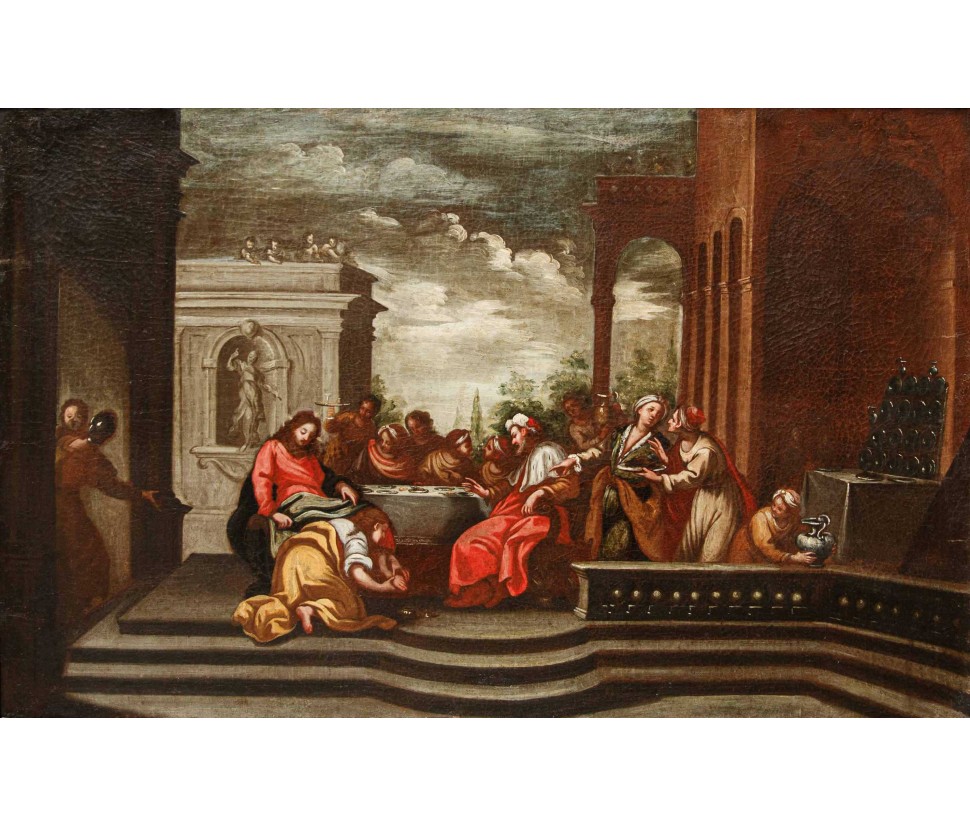
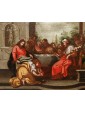
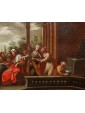
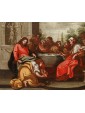
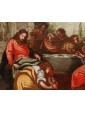
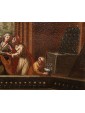
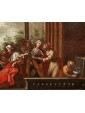
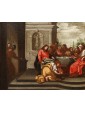
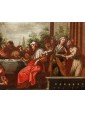
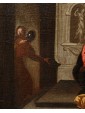
This painting, executed by a master of the Venetian school in the first half of the 17th century, depicts the biblical episode of the Anointing at Bethany. This event, narrated in the canonical Gospels, recounts Jesus being anointed by a woman during a dinner at the house of Simon the Leper, in Mark and Matthew, or at Lazarus's house, in John. The differences between the Gospels are minimal but allow us to identify the one by John as the closest to this representation: in the scene, Jesus's feet are anointed, a fact not specified by the other evangelists. According to this version, the episode took place in Bethany during a dinner, after the resurrection of Lazarus, six days before Passover. Lazarus’s sister, Mary, brings a jar containing very expensive pure nard oil; with this oil, she anoints Jesus’s feet, wiping them with her hair. Judas Iscariot, who managed the disciples' money box, is outraged by the waste and says that the perfume could have been sold for three hundred denarii to help the poor. In this case, too, Jesus tells him not to scold the woman and to let her use the oil for his burial, because the disciples would continue to have the poor with them, but not Jesus.
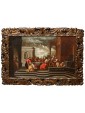
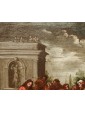
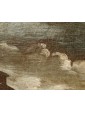
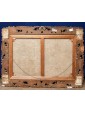
Returning to the work: the setting is architectural, with classical elements such as columns and a plinth with a statue on the left, which are well-suited to the visual imagination of artists active in Veneto between the 16th and 17th centuries, first among all the members of the Caliari family. On the right, a more imposing structure with arches can be seen, of a clear classical derivation. The cloudy and leaden sky creates a dramatic atmosphere, announcing the imminent tragic crucifixion of the Lord. The carved wooden frame, richly decorated with volute and foliage motifs, is an important element that enhances the work and emphasizes its value, perfectly suiting the technical and executive styles of the great craftsmanship of that period.
The painting presents marked similarities with the works that were part of a decorative cycle on the Redemption originally located in the Church of San Nicolò della Lattuga and currently in the Gallerie dell'Accademia in Venice, created by Paolo Veronese and his workshop in the late 1570s. For the San Nicolò church cycle, Benedetto Caliari (Verona, 1538 – Venice, 1598), Paolo's skillful brother, created three paintings: The Flagellation (which was lost), Christ Before Pilate, now in the Accademia's collections, and The Last Supper and the Washing of the Feet, one of the painter's most famous and well-known works. Although Ridolfi attributed it to Paolo Veronese, stylistic and documentary evidence leaves no doubt about Benedetto's authorship, even if some critics have hypothesized the participation of the workshop master with minimal interventions. It is precisely to this last altarpiece that the Venetian artist responsible for the work should look: from Benedetto Veronese are taken the bold perspective conception of the spaces, the agile and fluid brushwork, and the vividness of the colors, which channel into the rich tradition of Venetian colorism.
With Ars Antiqua it is possible to defer all amounts up to a maximum € 7,500 at ZERO RATE, for a total of 15 INSTALLMENTS.
Unpardoned. Vault. € 4,500 = Monthly instalment € 300 for 15 months.
Unpardoned. Vault. € 3,600 = Monthly instalment € 720 for 5 months.
For amounts greater than €7,500 or for a longer period of time (over 15 installments), we can provide a personalized payment.
Contact us directly to get the best quote.
LIVE TV
– SUNDAY 17.00 – 21.00 Dig.terr. 126 - Sky 824
– Streaming on our site www.arsantiquasrl.com and on our social networks Facebook and Youtube
All the works proposed by Ars Antiqua are sold accompanied by a certificate of authenticity in accordance with the law and an accurate in-depth sheet.
It is possible to see the works directly at the showroom gallery in Milan, in via Pisacane 55 and 57.
We personally organize transport and deliveries of the works, both for Italy and abroad.
