


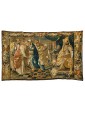




Tapestry depicting Moses and Aaron
Wool and silk, cm 395 x 237
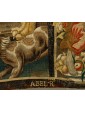
Marked ABEL R
Aubusson Manufacture, late 16th century
Tapestry depicting Moses and Aaron
Wool and silk, cm 395 x 237
Marked ABEL R
Aubusson Manufacture, late 16th century
Aubusson Manufacture, late 16th century
Tapestry depicting the conversation of Moses and Aaron with the Pharaoh of Egypt
Wool and silk, cm 395 x 237
Marked ABEL R
The beautiful and precious tapestry, of fine workmanship and made with woollen yarns, was executed in the seventeenth century by the Manufacture of Aubusson: The French centre is one of the most prolific international centres for the ancient and enigmatic art of the hoarding.
The tapestry technique, born north of the Alps in the Middle Ages, approximately around the thirteenth century, is widely spread in France and Flanders from the fourteenth century, also thanks to the commissioning of the royal house of France and the court of Burgundy, who promoted the creation of the most refined cycle of tapestries for the cathedral of Angers with the stories of the Apocalypse. At the beginning of the 15th century, the most important centre for the production of tapestries in Europe was certainly Arras: from which the Italian name comes: tapestry.
From a technical point of view, tapestry is a woven fabric, made by hand on a frame and intended to cover the walls. The preparatory drawing - the so-called cardboard - was made by a painter who then entrusted to the hands of the craftsman the realization of the work: exemplified in this sense is the case of the splendid cycle of tapestries with the stories of Saints Peter and Paul, Painted in the workshop of the Flemish Arachnist Pieter van Aelst in Brussels, whose drawings, now in the Victoria and Albert Museum in London, are designed by Raphael.
The origins of the Aubusson Manufacture are clear and date back to the 14th century. It seems that a group of Flemish tapestry weavers have moved to the Aubusson area, taking advantage of the waters of the river Creuse to wash and degrease their wool and prepare the dye colours. The presence of large flocks on the spot encouraged these weavers to stop. The Flemish influence was always present in the Aubusson Manufacture: same technique of the low liccio and same patron saint: Santa Barbara. In the early days, vegetables were produced in Aubusson, that is landscapes with woods, which soon became a distinctive feature of the manufacture. In the sixteenth century were woven scenes of hunting: the lyochon, lion, boar, deer; but also episodes taken from the Old Testament, from mythology, from the history of France. The Aubusson Manufacture was given the title of Royal Manufactory in 1665, thanks to the decision of the influential minister Jean-Baptiste Colbert.
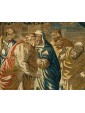
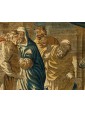
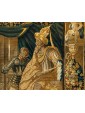
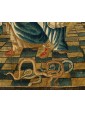
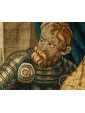
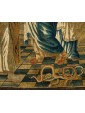
The episode here depicted is that of the conversation of Moses and Aaron with the Pharaoh of Egypt, taken from the Exodus. In this episode, as a testimony of the divine power, the two prophets turn their sticks into snakes in front of the very powerful pharaoh of Egypt: "When Pharaoh speaks to you and says, 'Do a wonder!' you will say to Aaron: 'Take your staff, throw it before Pharaoh, and it will become a snake.'". Moses and Aaron went to Pharaoh, and they did as the LORD commanded. Aaron threw his staff before Pharaoh and his servants, and he became a serpent. Pharaoh called in turn the wise men and the enchanters; and the magicians of Egypt also did so, with their occult arts. Each one threw his staff, and the staff became serpents, but the staff of Aaronne swallowed the staff of those" (Exodus 7, 9-12).
The iconographic theme of the conversation between Moses, Aaron and Pharaoh is often taken up at the turn of the seventeenth and eighteenth centuries: a further example compared to this tapestry is provided by the beautiful painting by Gaspare Diziani that presents this episode of the biblical story. The Aubusson manufactory produces several other tapestries with the stories of the lives of Moses and Aaron as a theme, such as The Adoration of the Golden Calf or Moses and Aaron with the Tablets of the Law.
The acronym ABEL R affixed to the lower right margin of the tapestry could be linked to its possible execution for the Belgian royal house.
