


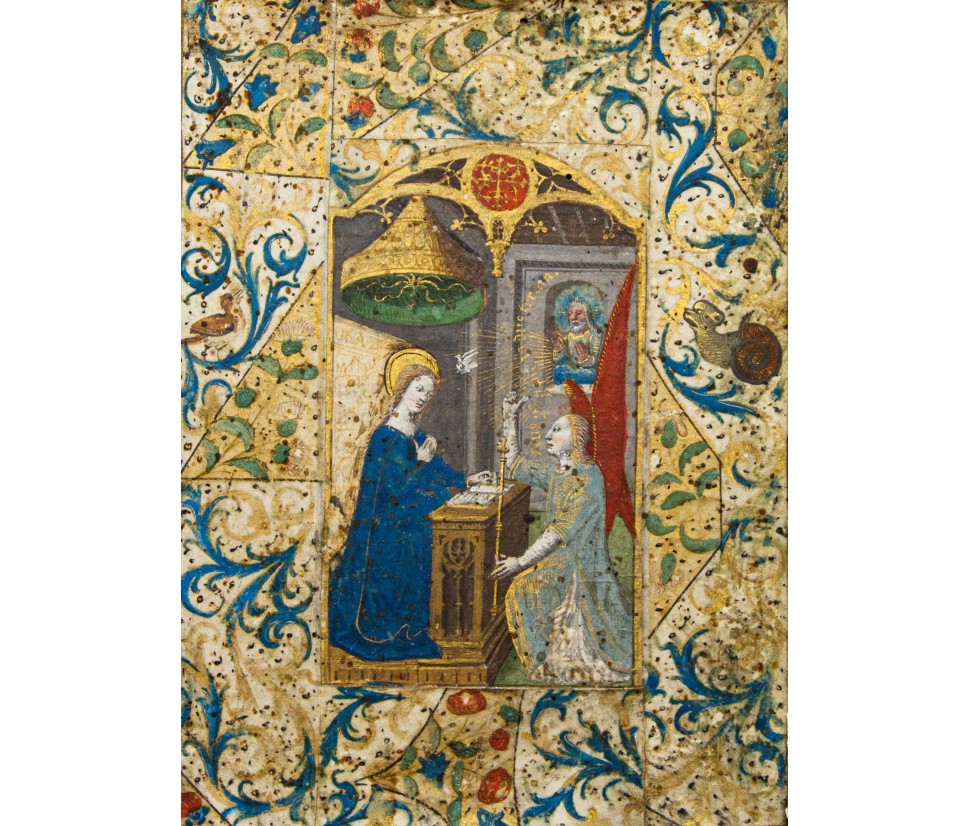
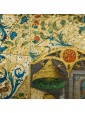
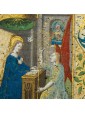
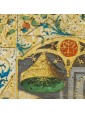
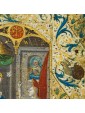
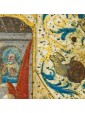
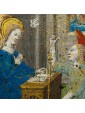
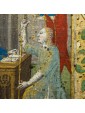
Annunciation
Miniature in wood on cardboard, cm 8,2x4,6
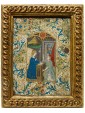
With frame cm 13,4x10,5
Master Jacques de Besançon
(active in France between 1478 and 1500)
Annunciation
Miniature in wood on cardboard, cm 8,2x4,6
With frame cm 13,4x10,5
Master Jacques de Besançon
(active in France between 1478 and 1500)
Master Jacques de Besançon
(active in France between 1478 and 1500)
Annunciation
Miniature in wood on cardboard, cm 8,2x4,6
With frame cm 13,4x10,5
The miniature is an art that has played a great importance in the artistic production of Europe and the Middle East. Its history, in some cases parallel to that of painting, goes from antiquity, especially for Europe, from the second century, until the late Renaissance, when the spread of printing allowed to create series illustrations at more affordable prices. The miniature has existed since the time of the papyrus, but it is in late antiquity, with the appearance of the book, that words and images came to merge into a perfect coexistence. The miniature represents for many centuries the main source to reconstruct the pictorial art, being almost completely lost or tampered with the testimonies of fresco, painting on board or other supports. Moreover, the illuminated codes, being very expensive luxury products, were often linked to the highest religious and secular commissioning, preserving traces of the most refined taste of those times. Between the 14th and 15th centuries, thanks to socio-cultural transformations and the gradual spread of literacy, the production of manuscripts was more widespread than ever before. In addition to religious books, which reach the highest levels of splendour never before touched, scientific books were also disseminated (medicine, botany, geometry), narrative, poetry (such as I Trionfi by Petrarch), travel and classics. A new type of votive books were the Books of Hours, born for personal use to collect the prayers and orations that the good Christian had to pronounce during the day and in the major holidays of the Catholic religion, which contained finely illustrated illustrations. The decoration of these booklets was separated from the conventional constraints that the religious character of the books had previously imposed. The target audience was the most varied, with a clear difference in quality and price. Some characters until then specific of the miniature (ornamental taste, two-dimensionality, unitarity of the sheet) were soon overcome favoring an alignment with the contemporary painting, even anticipating often some revolutions, as the case of spatiality in French and Flemish miniatures before the Renaissance of Flanders. In these two countries, illuminated production tended to exhibit great freedom in compositions: the page seemed to be broken by the most daring space constructions, as can be seen from the Book of Hours of Mary of Burgundy, the illustrations became open windows on a scene and the landscapes reached a depth never seen, as we see in Les Très riches heures du Duc de Berry by the Limbourg Brothers, in the Book of Hours of the so-called Maestro di Boucicant and in the Book of Hours of the Maestro di Bredford. It is from a book of hours that comes this miniature presenting the episode of the Annunciation and bearing precious decorations made with rare and valuable pigments: this makes us presage that the client of the work was absolutely high level. The illustrator who is responsible for the execution of the scene, identified with the anonymous master Jacques de Besançon, active in France in the last thirty years of the sixteenth century, manages to provide the image a marked sense of spatiality and depth, Not taken for granted as far as the elaborate technique of the miniature is concerned. The so-called Master Jacques de Besançon is an anonymous illustrator who was active in France, and more precisely in Paris between 1478 and 1500. The critics identified him in François Barber, son of François Barbier, alias the Master Francis. We are dealing with a hard-working artist, whose production generated a large number of books of hours, as well as various manuscripts for the nobility. At the end of his career he decorated incunabula and large titles, especially for the publisher Antoine Vérard. Archive documents indicate that in 1478 the author resided in the parish of Saint-Christophe on the Île de la Cité and was a tenant of a house called the Striped Donkey, which was owned by the chapter of Notre Dame. He was one of the rare bourgeois to be admitted in 1485 to the confraternity of Saint Augustine, which had its seat in the cathedral. In 1488 he left a legatus for a mass in Paris at the Celestine convent. It is believed that he died in 1501. He was close to the chapter of Notre Dame for which he made several messengers and knew how to express a constantly high level of life and recognition working also for the king of France.
Italy only: with Ars Antiqua it is possible to defer all amounts up to a maximum € 7,500 at ZERO RATE, for a total of 15 INSTALLMENTS.
Unpardoned. Vault. € 4,500 = Monthly instalment € 300 for 15 months.
Unpardoned. Vault. € 3,600 = Monthly instalment € 720 for 5 months.
For amounts greater than €7,500 or for a longer period of time (over 15 installments), we can provide a personalized payment.
Contact us directly to get the best quote.
LIVE TV
– SUNDAY 17.00 – 21.00 Dig.terr. 126 - Sky 824
– Streaming on our site www.arsantiquasrl.com and on our social networks Facebook and Youtube
All the works proposed by Ars Antiqua are sold accompanied by a certificate of authenticity in accordance with the law and an accurate in-depth sheet.
It is possible to see the works directly at the showroom gallery in Milan, in via Pisacane 55 and 57.
We personally organize transport and deliveries of the works, both for Italy and abroad.
