


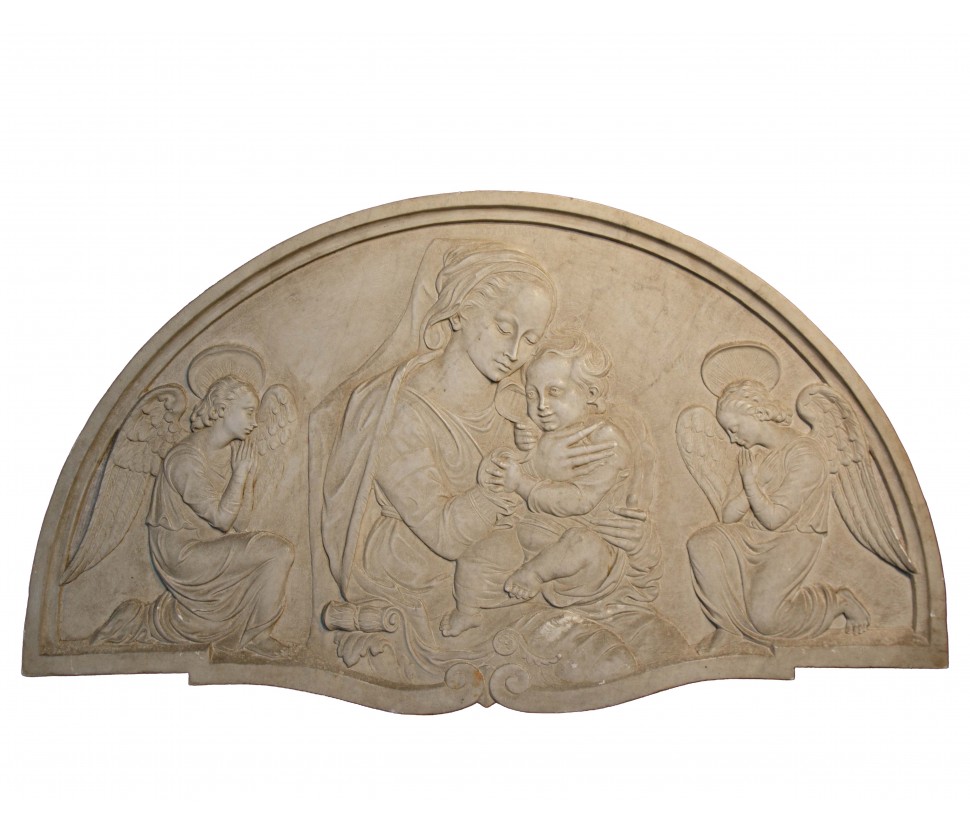
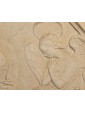
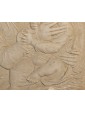
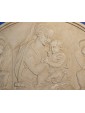
Madonna with Child and two angels
Marble, 54 x 93 x 4 cm
19th century
Madonna with Child and two angels
Marble, 54 x 93 x 4 cm
19th century
XIX century
Madonna with Child and two angels
Marble, 54 x 93 x 4 cm
The work, a nineteenth-century marble lunette, takes up, both with regard to the iconographic aspect and under the technical framework, the famous stylistic of the early Florentine Renaissance. For the sculptural technique, the artist of the XIX century certainly looks to the very successful models of Donatello and Michelangelo. Works such as the Donatellian Madonna of the clouds at the Museum of Fine Arts in Boston and Madonna with Child at the Bode Museum in Berlin or the Michelangelo Rondo Pitti and Taddei, respectively at the Bargello Museum in Florence and the Royal Academy in London, They are undoubtedly a fundamental starting point for the sculptor responsible for this work. From the iconographic point of view, the central group of the Madonna with Child seems to be linked to some of the most successful iconographic models of the fifteenth century Florentine, with particular reference to the work of Filippo Lippi: the sweetness of the faces and the intimate complicity that connect the Mother and the Divine Son seem to be taken up pedissequely by the most famous works of the Tuscan master, with particular reference to the Madonna and Child of the Alte Pinakothek in Monaco and that of Palazzo Medici Riccardi in Florence. The angels on the sides of the Virgin could also be a reference to Filippo Lippi: in fact, the shapes and fluid draperies of the robes seem to recall that of the Annunciation of the National Gallery in London. The lunette shape is also not foreign to high reliefs and bas-reliefs of the Florentine Renaissance: a pivotal example is provided by the Blood of the Redeemer by Donatello, dated around 1430 and preserved at the parish church of Torrita di Siena, dedicated to Sante Flora and Lucilla.The work falls into that vein, called neo-Renaissance, which points, in the nineteenth and early twentieth centuries, to the idealistic recovery of art of the Four and Five-Hundred. The neo-Renaissance artists aimed to draw on the stylistic richness of the Renaissance, reworking it to adapt it to the tastes and needs of their time. It was not a mere copy, but a creative revisit that took inspiration from the monuments and works of art of the past, taking the most striking elements to translate them into new masterpieces. In a period marked by the advent of industry and the emergence of the first mass processes, neo-Renaissance works were to be an anthem to Italian craftsmanship. Among the main artists active in the neo-Renaissance sculpture area is the Cremonese Alceo Dossena, able to brilliantly reinterpret the models of Rossellino, Desiderio da Settignano, Donatello and Andrea del Verrocchio, Giving life to plastic works with great charm such as the Madonna and Child of the San Diego Museum of Art or the Annunciation group of the University of Pittsburgh.
The object is in good condition
With Ars Antiqua it is possible to defer all amounts up to a maximum of € 7,500 at ZERO RATE, for a total of 15 RATES.
Ex. Tot. € 4.500 = Monthly instalment € 300 for 15 months.
Ex. Tot. € 3.600 = Monthly payment € 720 for 5 months.
For amounts over € 7,500 or for a longer delay in time (more than 15 installments), we can provide a personalized payment.
Contact us directly to get the best quote.
TV Direct
- SUNDAY 17.00 - 21.00 Dig.terr. 126 + 809 SKY
- THURSDAY 21.00 - 24.00 Dig.terr. 125 + 809 SKY
- Streaming on our website www.arsantiquasrl.com and on our social networks Facebook and Youtube
All the works proposed by Ars Antiqua are sold with a certificate of authenticity according to law and an accurate detailed information sheet.
You can see the works at the gallery showroom in Milan, in via Pisacane 55 and 57.
We personally organize transport and delivery of works, both for Italy and abroad.
