


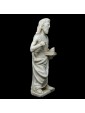
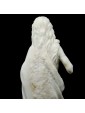
San Giovanni Battista, 1495 ca.
Candoglia marble, cm 24 x 14 x 10
Base, cm 1,2 x 10 x 8,8
Prof. Giancarlo Gentilini
Prof. David Lucini
Girolamo Viscardi (Laino, 1467 - Genoa, after 1522)
San Giovanni Battista, 1495 ca.
Candoglia marble, cm 24 x 14 x 10
Base, cm 1,2 x 10 x 8,8
Prof. Giancarlo Gentilini
Prof. David Lucini
Girolamo Viscardi (Laino, 1467 - Genoa, after 1522)
Girolamo Viscardi (Laino, 1467 - Genoa, after 1522)
St. John the baptist
1495 ca.
Candoglia marble, cm 24 x 14 x 10
Base, cm 1,2 x 10 x 8,8
Prof. Giancarlo Gentilini
Prof. David Lucini
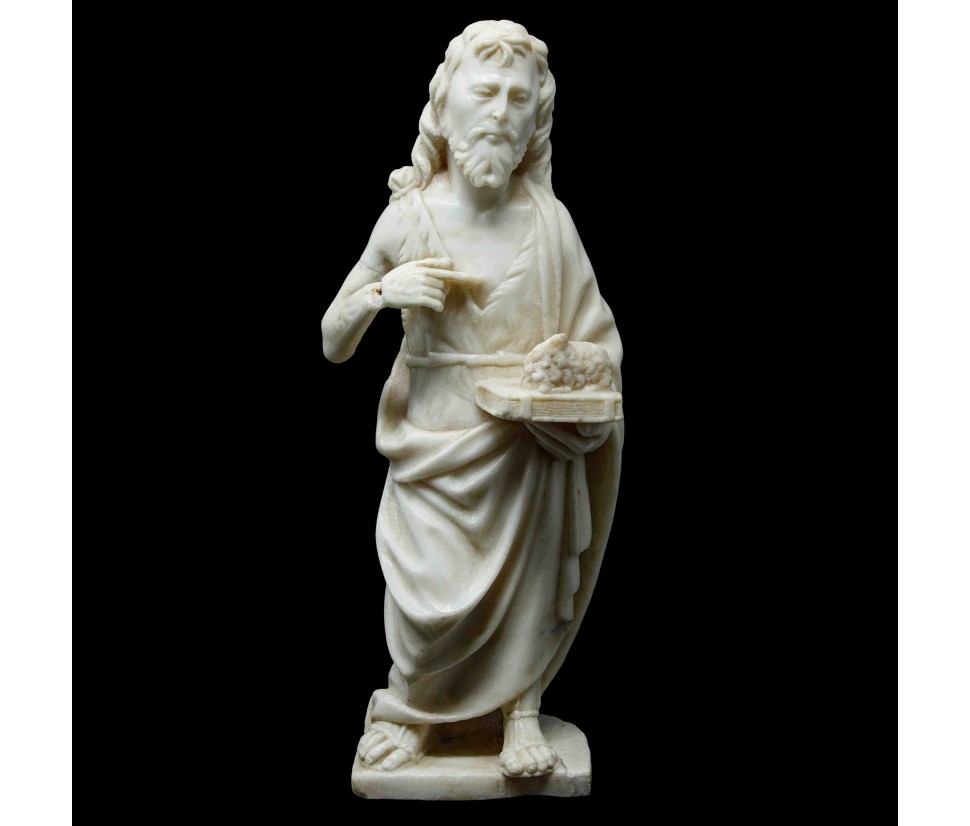
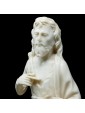
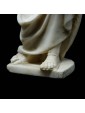
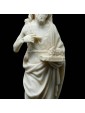
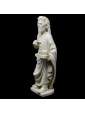
The small statuette in Candoglia marble depicts the Precursor announced by Isaiah (Is 40, 3), of a young age, with his gaze fixed forward and equipped with his typical iconographic attributes: "a dress of camel hair with a leather belt around the sides" (Matthew 3:10) knotted on the right shoulder, covered by a tunic, the little Eucharistic lamb (acephalous following an ancient break) laid over the book of sacred scriptures and the index finger stretched forward to announce the coming of the Messiah. The Saint has an icy and rarefied pose, an emaciated appearance and is characterized by a build characterized by an essential anatomy, accompanied by hints of gigantism evident in the head, feet and hands.
The drapery of the tunic solved with large, taut and sharp folds strides, the particular shaped hair, that gushes over the forehead and fall on the shoulders in long strands twisted, and especially that of the beard, conducted with a plot of symmetrical tufts, contribute to identify in the Saint a stylistic matrix of Lombard origin. The sculptor who wants to assign the authorship of the marble statuette of the Baptist is in fact Girolamo Viscardi, born in Lugano, but trained in Lombardy, educated at the side of Antonio dalla Porta, said the Tamagnino, as collaborator of the Amadeo to the plastic decoration of the Certosa of Pavia in the early nineties of the fifteenth century. Starting from 1497 he restarted his activity in Genoa, home of a complex and fortunate situation of Lombard, Ligurian and Tuscan workers exporting Renaissance forms across the Alps, and France, where he worked alongside the Florentines Donato Benti and Benedetto da Rovezzano for Louis XII at the tombs of the Dukes of Orleans in Saint-Denis (1507), and independently in the plastic decoration of the church of Saint-Trinitè in Fécamp (1507 - 8).
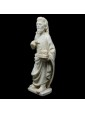
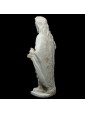
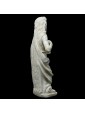
The back of the figurine worked only partially and traces of a uniform contact of the article with a vertical surface, also found in the rounded base in the back, suggest that the image of the Saint was originally placed at the top of a tabernacle or rather in the Augustan space of a niche of some altar. This latter hypothesis is supported by the predilection of the work for an exclusively frontal vision and a clean cut, evident from a lateral vision, which gives the image of the Baptist almost the features of a figure. Similar hand sculptures by Viscardi are found in the church of Saint-Trinitè in Fécamp, placed to adorn a wall tabernacle and a two-faced reliquary, both in Carrara marble, executed, according to the stipulation of the contract, from May 1507. These, depicting a blessing Christ and a series of Saints, despite the iconographic variations of the subjects represented, reproduce the identical formal inventions of Saint John the Baptist: especially the yield of sharp clothing, the slender bodies, the bony faces, the warbling hairs and the standardized poses of the characters, with one foot anchored to the ground and the other gently pushed backwards. These elements make them inclined to hypothesize the execution of the sculpture in question in that course of years.
However, it is not so simple to chronologically insert the statuette under discussion within the stylistic path of Viscardi: in fact, the few works that have come to mark the fundamental stages of his career are all qualified for a jargon that recurs continuously and uniformly, even in the last works of the sculptor in Genoa in the twenties of the sixteenth century, almost without obvious evolutionary rejections. However, in order to establish an exact chronological location of the piece, we are very useful the quality of the marble used, which is not the white Carrara widely used in Genoa and for works to be exported across the Alps, but that of Candoglia, typical for its pinkish color, used exclusively in Lombardy. This is the reason why we move the execution of the statue to the years preceding the transfer of the sculptor to Liguria, before 1479.
Bibliography of reference:
- H.W. Kruft, Gerolamo Viscardi, ein genuesischer bildhauer der Renaissance, in "Mitteilungen des Kunsthistorisches Institutes in Florenz", 15, 1971, pp. 273 - 288.
- H.W. Kruft, Genuesische Skulpturen der Renaissance in Frankreich, in Evolution Générale et développements régionaux en histoire de l'art, proceedings of the XXII International Congress of Art History, edited by G. Rózsa, Budapest 1972, pp. 697 - 704.
- P. Rouillard, voice Viscardi Girolamo, in The Dictionary of Art, XXXIII, New York, 1966, p. 603.
With Ars Antiqua you can defer all amounts up to a maximum of € 7,500 at ZERO RATE, for a total of 15 INSTALLMENTS.
Ex. Tot. € 4,500 = Monthly installment € 300 for 15 months.
Ex. Tot. € 3,600 = Monthly installment € 720 for 5 months.
For amounts over €7,500 or for a longer grace period (over 15 installments), we can provide a custom payment.
Contact us directly to get the best quote.
LIVE TV
- SUNDAY 17.00 - 21.00 Dig.terr. 126 + 809 SKY
- THURSDAY 21.00 - 23.00 Dig.terr. 134 + 809 SKY
- Streaming on our website www.arsantiquasrl.com and on our social networks Facebook and Youtube
All the works proposed by Ars Antiqua are sold accompanied by a certificate of authenticity in accordance with the law and accurate fact sheet.
You can see the works directly at the showroom gallery in Milan, in via Pisacane 55 and 57.
We personally organize transport and deliveries of the works, both for Italy and abroad.
