


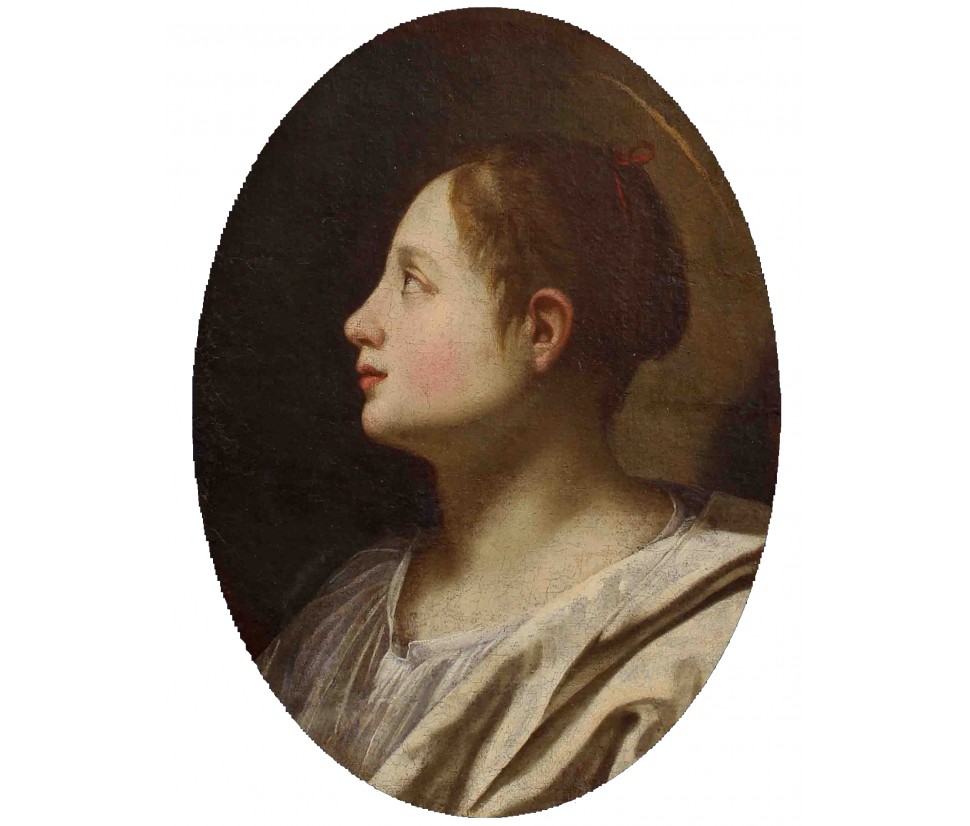
Figure of Saint
Oil on canvas, cm 41 x 31
Frame cm 59 x 64
Circle of Simon Vouet (1590 - 1649)
Figure of Saint
Oil on canvas, cm 41 x 31
Frame cm 59 x 64
Circle of Simon Vouet (1590 - 1649)
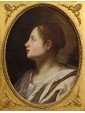
Figure of Santa
Oil on canvas, cm 41 x 31
Frame cm 59 x 64
The work analyzed here proposes the profile portrait of a young figure; probably to be identified with the profile of a young Saint. The work shows strong stylistic and formal consonances with the painting of Saint Catherine of Alexandria kept in Rome, in the Quirinal Palace, made by Simon Vouet between 1615-16. The French artist trained in Italy (1613-27), initially in contact with the world of Caravaggio and on his return to France he became court painter, receiving commissions from Louis XIII and Cardinal Richelieu, introducing the taste of Italian Baroque. It was his father, the painter Laurent Vouet, who taught him the first rudiments of art, and he, at the beginning, dedicated himself to the execution of portraits. After a first trip to England, he was part of the retinue of the Baron of Sancy, Ambassador of France to Constantinople. He then began a long stay in Italy, visiting Venice and Rome. From 1620 to 1622, he was in Genoa at the service of the family of Prince Doria and also worked for Cardinal Barberini, the future Pope Urban VIII. In Rome, finally, Vouet was so successful that, in 1624, he was placed at the head of the Academy of San Luca. The cycle of San Francesco in San Lorenzo in Lucina is the commission that confirms his Roman success. But in 1627 he had to return suddenly to his homeland for the pressing requests of the Duke of Béthunes. Thus it was that Vouet imported into France the Italian Baroque style, in particular that of Paolo Veronese, Titian and Carracci, adapting it to the great decorations of the time of Louis XIII and Richelieu. He was appointed the king’s first painter, and Louis XIII commissioned portraits, cartoons, and paintings for the Louvre, Luxembourg, and Saint-Germain-en-Laye Castle. In 1632, he worked on the building of Cardinal Richelieu in the Cardinal’s Palace (now the Palais-Royal) and in the Château de la Malmaison. In 1631 he decorated the Castle of President de Fourcy in Chessy, the Hôtel Bullion, the Castle of Marshal d'Effiat in Chilly, as well as the Palace of the Duke of Aumont, the Séguier Chapel and the Gallery of Wideville Castle. Simon Vouet represented French Baroque painting and became an emblematic artist.
