









Penitent Magdalene
Oil on canvas, 75.5 x 65 cm
Frame: 100 x 90 cm
Pseudo-Giampietrino B (Active in Milan, 1530s – 1560s)
Penitent Magdalene
Oil on canvas, 75.5 x 65 cm
Frame: 100 x 90 cm
Pseudo-Giampietrino B (Active in Milan, 1530s – 1560s)
Pseudo-Giampietrino B (Active in Milan, 1530s – 1560s)
Penitent Magdalene
Oil on canvas, 75.5 x 65 cm
Frame: 100 x 90 cm
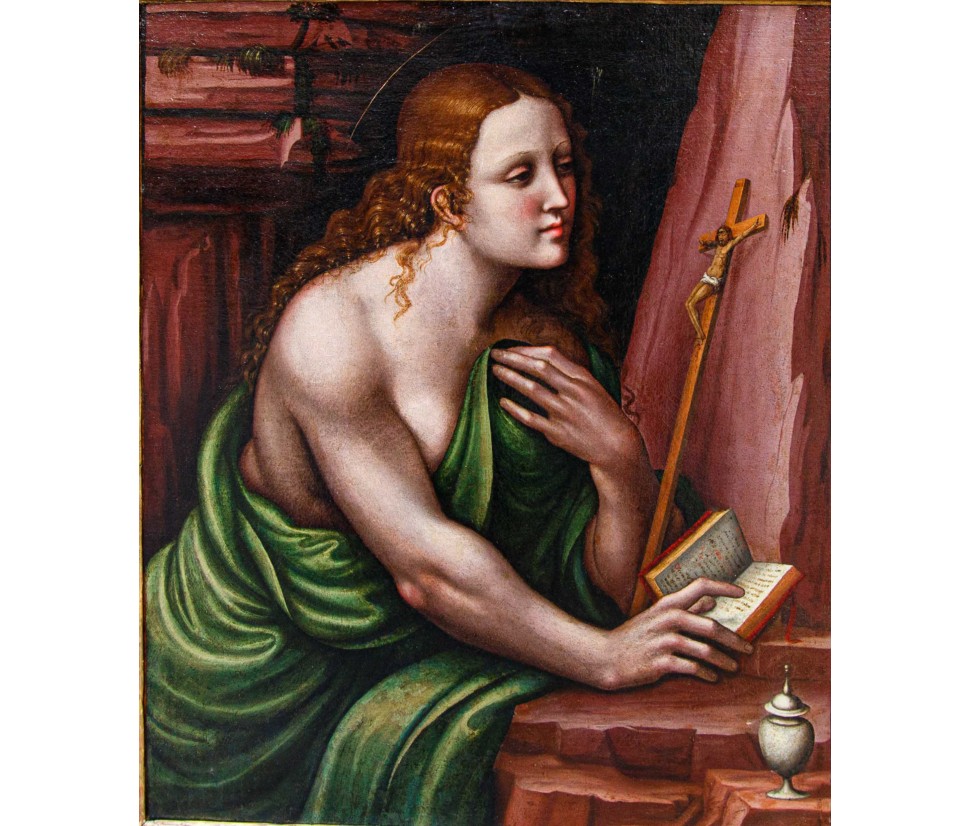
The painting under examination, depicting a Penitent Magdalene, belongs to the fertile tradition of Leonardo’s followers in Milan during the first half of the 16th century and is a work by the so-called Pseudo-Giampietrino B, an artistic personality who was distinct from but operated steadily within the workshop of Gian Pietro Rizzoli, known as Giampietrino. This figure of a collaborator, isolated by modern critics to distinguish stylistic variations from those of the master, reproduces here an iconography of extraordinary commercial and devotional success, for which the prototype preserved at the Accademia Carrara in Bergamo represents one of its absolute zeniths. Giampietrino’s work is characterized by a systematic idealization of the female figure, filtering Leonardo’s legacy through an aesthetic of polished composure that finds its highest expression in cycles dedicated to famous women of both sacred and profane history. Through subjects such as Mary Magdalene, Saint Catherine of Alexandria, and Lucrezia, the artist codifies a canon of beauty with sculptural features and a vibrant emotional charge, where the skillful use of sfumato lends the flesh an almost enameled luminosity. These figures, portrayed with a grace that oscillates between devotional mysticism and tragic sensuality, bear witness to the painter's ability to transform the Vincian model into a distinctive stylistic brand, rendering his heroines timeless archetypes of the Lombard Renaissance. Compared to Giampietrino’s Bergamo version, where the saint's face is immersed in a soft and melancholic sfumato, the work of Pseudo-Giampietrino B reveals a different plastic sensibility that translates into an almost sculptural anatomical rendering, particularly evident in the definition of the forearm and shoulder, which appear more solid and less atmospherically fused. The organization of Giampietrino's workshop involved the systematic use of preparatory cartoons replicated with minimal variations to satisfy an aristocratic clientele desiring images of intense beauty and formal rigor; in this context, Pseudo-Giampietrino B emerges as a high-level executor, capable of maintaining the elegance of the original model while adopting a more graphic touch and drapery with almost metallic folds, as seen in the emerald green mantle enveloping the figure. Characteristic of his painting are a marked plasticity in the treatment of anatomy, a more accentuated use of chiaroscuro, and a subtle tendency toward a more pronounced physiognomy in the faces, balanced by his skill in rendering the gold of the hair with small touches of color. The painter treated this same composition of the Magdalene, derived from the aforementioned Carrara model, in two other versions: that of the Museo Horne in Florence and that of the collection of the Earls of Wemyss and March in Scotland.
Italy only: with Ars Antiqua it is possible to defer all amounts up to a maximum € 7,500 at ZERO RATE, for a total of 15 INSTALLMENTS.
Unpardoned. Vault. € 4,500 = Monthly instalment € 300 for 15 months.
Unpardoned. Vault. € 3,600 = Monthly instalment € 720 for 5 months.
For amounts greater than €7,500 or for a longer period of time (over 15 installments), we can provide a personalized payment.
Contact us directly to get the best quote.
LIVE TV
– SUNDAY 17.00 – 21.00 Dig.terr. 126 - Sky 824
– Streaming on our site www.arsantiquasrl.com and on our social networks Facebook and Youtube
All the works proposed by Ars Antiqua are sold accompanied by a certificate of authenticity in accordance with the law and an accurate in-depth sheet.
It is possible to see the works directly at the showroom gallery in Milan, in via Pisacane 55 and 57.
We personally organize transport and deliveries of the works, both for Italy and abroad.
