





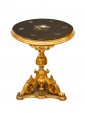
Table with Pietra Dura Inlay Top
Top: diameter 65 x 2 cm
Table: 82.5 x 72 cm
Botteghe Granducali, 19th Century
Table with Pietra Dura Inlay Top
Top: diameter 65 x 2 cm
Table: 82.5 x 72 cm
Botteghe Granducali, 19th Century
Botteghe Granducali, 19th Century
Table with Pietra Dura Inlay Top
Top: diameter 65 x 2 cm
Table: 82.5 x 72 cm
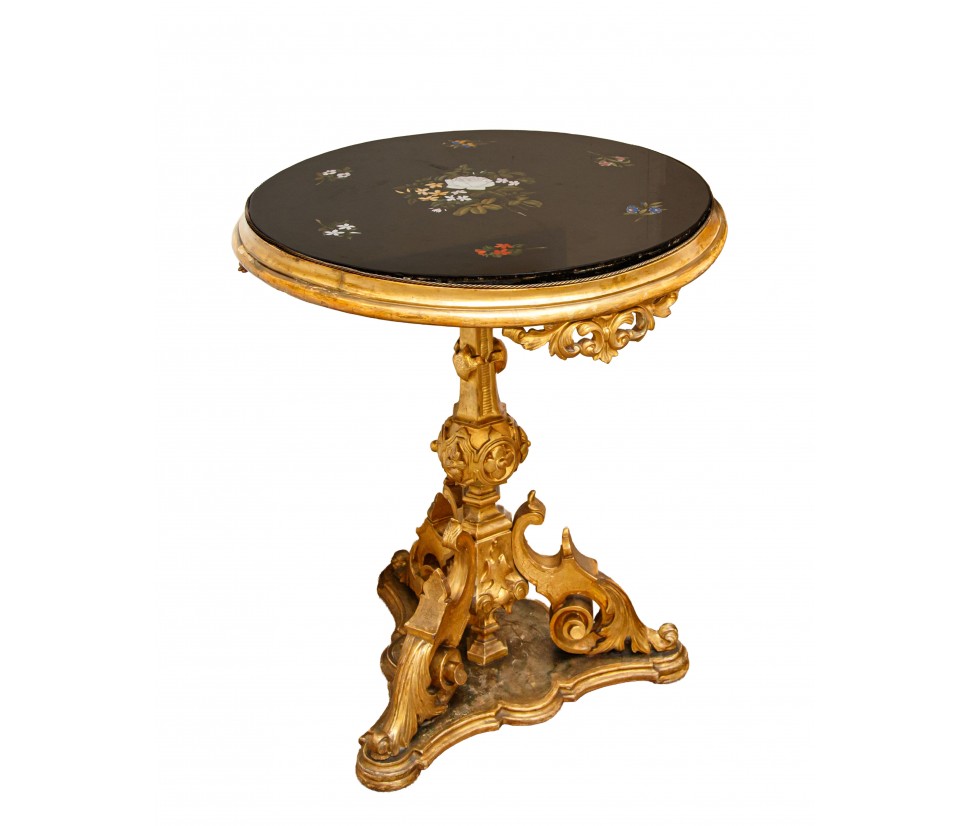
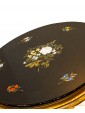
This refined circular table, a product of the mastery of a 19th-century Florentine workshop, embodies the sublime synthesis of fine cabinet-making and the ancient art of commesso in pietre dure (hardstone inlay). The top is a chromatic and compositional masterpiece: an elaborate floral inlay flourishes upon a base of polished black marble. The central bouquet, dominated by a pristine white rose and surrounded by yellow and white jasmine, is encircled by six satellite sprays—among which one can recognize delicate pink roses, deep blue forget-me-nots, white bellflowers, and vibrant orange corollas.
The technique of "Florentine commesso," or "stone painting," masterfully executed here, has its roots in late 16th-century Florence, evolving from Roman opus sectile thanks to the Humanist passion for antiquity. It was the forward-thinking vision of the Medici family that realized the artistic potential of this technique, transforming it from mere architectural cladding—as seen in Rome—into a sophisticated art form applied to the most sumptuous furnishings. In 1588, Grand Duke Ferdinando I established the Opificio delle Pietre Dure, a state manufactory that brought together mosaicists and carvers, ensuring the Medici dynasty’s exclusivity over these extraordinary creations, celebrated for their pictorial effects and executive perfection.
The term "commesso", deriving from the Latin committere (to join together), perfectly describes the skill of the artisans in cutting and shaping colored marbles and semi-precious stones—such as jasper, agate, and lapis lazuli—following a watercolor preparatory drawing. They assembled them with such precision that the joints remained invisible, setting the technique apart from traditional mosaic. It is a slow and patient art, where only the master’s hand and eye could select the correct stone shades (often using local stones like "verde Arno") and cut them with a rudimentary soft iron wire bow—a technique that has remained virtually unchanged over centuries and resistant to automation.
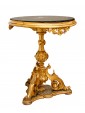
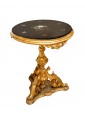
While the magnificent Chapel of the Princes in San Lorenzo represents the monumental peak of this tradition, high-quality artifacts like this 19th-century table testify to the persistence of Florentine taste and craftsmanship over time. The top rests on a tripod base of richly carved wood, gilded in leaf, which culminates in scroll volutes and foliate decorations typical of the eclectic 19th-century style. This base provides the piece with solid stability and an aura of opulent preciousness. The central shaft, also gilded, features an original nodule decorated with polychrome blue and green enamels, further highlighting the refinement of the materials and the complexity of the workmanship.
Italy only: with Ars Antiqua it is possible to defer all amounts up to a maximum € 7,500 at ZERO RATE, for a total of 15 INSTALLMENTS.
Unpardoned. Vault. € 4,500 = Monthly instalment € 300 for 15 months.
Unpardoned. Vault. € 3,600 = Monthly instalment € 720 for 5 months.
For amounts greater than €7,500 or for a longer period of time (over 15 installments), we can provide a personalized payment.
Contact us directly to get the best quote.
LIVE TV
– SUNDAY 17.00 – 21.00 Dig.terr. 126 - Sky 824
– Streaming on our site www.arsantiquasrl.com and on our social networks Facebook and Youtube
All the works proposed by Ars Antiqua are sold accompanied by a certificate of authenticity in accordance with the law and an accurate in-depth sheet.
It is possible to see the works directly at the showroom gallery in Milan, in via Pisacane 55 and 57.
We personally organize transport and deliveries of the works, both for Italy and abroad.
