


Portrait of a Gentleman, c. 1650
Oil on canvas, 121 x 94.5 cm
with frame, 144 x 119 cm
Critical essay by Prof. Giacomo Montanari
Giovanni Bernardo Carbone (Genoa, 1616 – 1683)
Portrait of a Gentleman, c. 1650
Oil on canvas, 121 x 94.5 cm
with frame, 144 x 119 cm
Critical essay by Prof. Giacomo Montanari
Giovanni Bernardo Carbone (Genoa, 1616 – 1683)
Giovanni Bernardo Carbone (Genoa, 1616 – 1683)
Portrait of a Gentleman, c. 1650
Oil on canvas, 121 x 94.5 cm – with frame, 144 x 119 cm
Critical essay by Prof. Giacomo Montanari
“...with his beautiful portraits, he nevertheless causes even the experts to err by judging them to be by Van Dyck”: thus did Carlo Giuseppe Ratti describe the portraiture of Giovanni Bernardo Carbone in his Vite de' pittori, scultori, ed architetti genovesi (1768), identifying a master who was already highly esteemed by his contemporaries. The artist trained in the workshop of Giovanni Andrea De Ferrari during the 1630s, a period when the Genoese figurative scene was energized by intense external stimuli and vibrant processes of cultural cross-pollination. In particular, the Flemish influence—bolstered by the presence of eminent figures such as Rubens, who was in Genoa in the first decade of the 17th century, and later Van Dyck, as well as a well-established community of Netherlandish painters—offered expressive models rooted in a refined and luxurious naturalism. These models were perfectly suited to an aristocratic clientele eager for imagery that could reassert their social prestige. In this context, Carbone skillfully assimilated and reinterpreted the teachings of De Ferrari and Domenico Fiasella, alongside the influence of Van Dyck and Jan Roos, as well as the stylistic contributions of Valerio Castello and Domenico Piola. Consequently, the portrait genre saw a remarkable surge in popularity, and Carbone established himself as one of the most sought-after painters, distinguished by his ability to adapt the Van Dyckian model to the expectations of the most fashionable Genoese nobility.
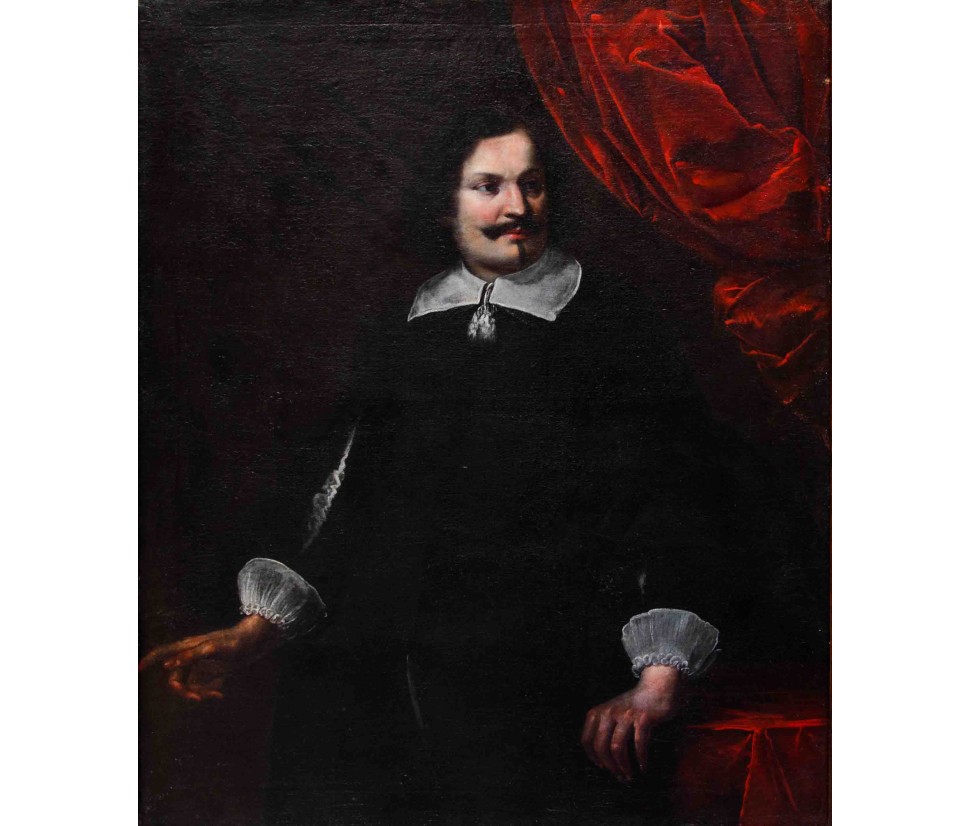
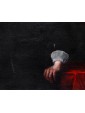
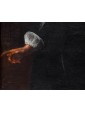
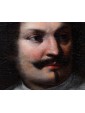
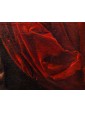
The painting depicts an unidentified aristocrat captured in the act of turning his head and gaze toward the left, as if suddenly distracted by someone entering the scene. Emerging powerfully from the dark background are the red drape occupying the right side of the composition—recalling solutions typical of Van Dyck—and the vibrant cloth spread across the small table. The subject’s left hand rests upon this table, while his right is suspended in mid-air. His attire is characterized by elegant slashed sleeves, complemented by white cuffs and a collar fastened at the neck by a small ornament hanging over the chest. The face, suggesting a man no older than thirty, features a vivid and slightly flushed complexion, accentuated by full, deep red lips set in a composed and impassive expression. The work reflects the formal characteristics of Genoese portraiture that developed from the late 1620s onward, derived largely from the example of Van Dyck—active in Genoa between 1621 and 1627—and shared by other Flemish painters like Jan Roos and Jan Hovaert, who were present in the same milieu in the following years.
Beyond these influences, however, the painting clearly reveals the hand of an artist with a solid Genoese foundation, such as Carbone. His autograph traits emerge in the vibrant and restless brushwork that defines and illuminates the textile surfaces, as well as in the fleshy, vital rendering of the hands and face. The red tones of the drapery find a precise parallel in the robe of the Virgin in the Madonna with Sleeping Child held at the Musei di Strada Nuova in Genoa. Similarly, the meticulous care for skin tones and the concrete, everyday rendering of lips, hands, and gazes can be found in the Portrait of Lucrezia Pallavicino, executed around 1658 on the occasion of her marriage to Giovanni Giacomo Brignole, which serves as a terminus ante quem for the dating of this canvas. By the late 1650s, Carbone appeared fully autonomous and capable of imprinting a strong personal mark on his works while still honoring the Van Dyckian legacy. This specific painting can be placed in an earlier phase of this process, around 1650, when the artist remained firmly anchored to the compositional schemes and execution styles that had so decisively defined Genoese portraiture.
Italy only: with Ars Antiqua it is possible to defer all amounts up to a maximum € 7,500 at ZERO RATE, for a total of 15 INSTALLMENTS.
Unpardoned. Vault. € 4,500 = Monthly instalment € 300 for 15 months.
Unpardoned. Vault. € 3,600 = Monthly instalment € 720 for 5 months.
For amounts greater than €7,500 or for a longer period of time (over 15 installments), we can provide a personalized payment.
Contact us directly to get the best quote.
LIVE TV
– SUNDAY 17.00 – 21.00 Dig.terr. 126 - Sky 824
– Streaming on our site www.arsantiquasrl.com and on our social networks Facebook and Youtube
All the works proposed by Ars Antiqua are sold accompanied by a certificate of authenticity in accordance with the law and an accurate in-depth sheet.
It is possible to see the works directly at the showroom gallery in Milan, in via Pisacane 55 and 57.
We personally organize transport and deliveries of the works, both for Italy and abroad.
