Egisto Sarri (Figline Valdarno, 1837 – Florence, 1901)
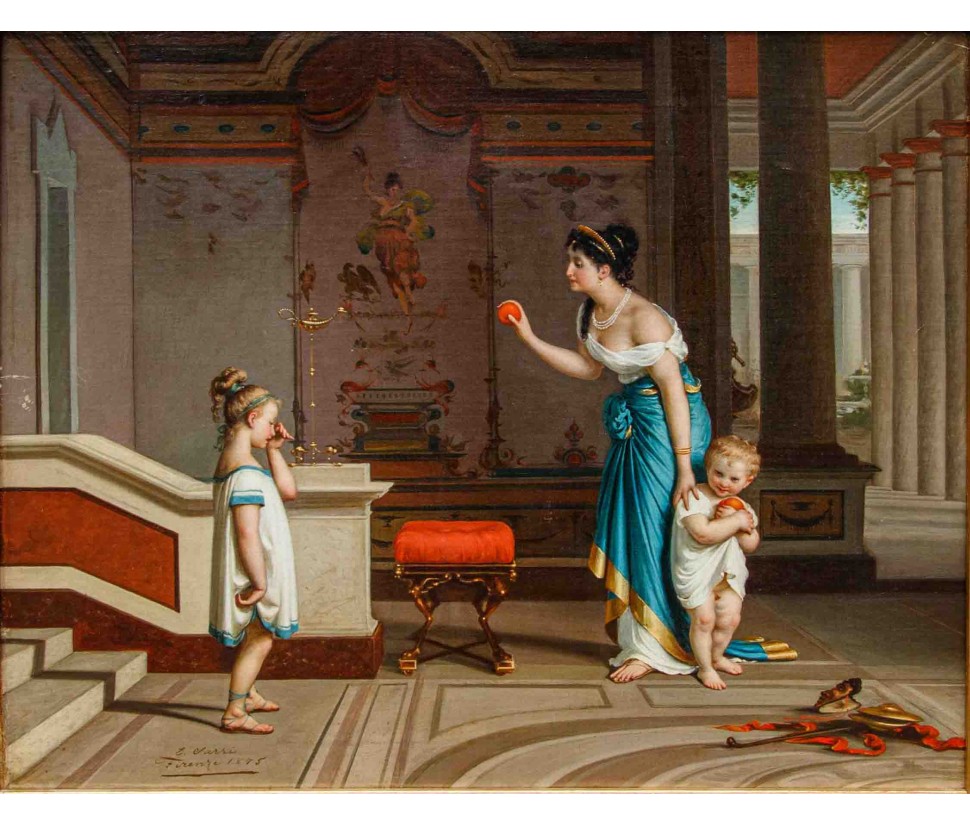
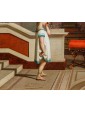
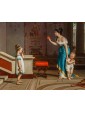
Pompeian Interior: Mother Consoling her Crying Daughter
Oil on canvas, 47.5 x 58.5 cm
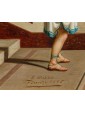
Signed and dated lower left: “E. Sarri / Firenze 1875”
Published in: Moreno Bucci (ed.), Egisto Sarri 1837-1901, Opus Libri, Figline Valdarno, 2000, p. 87.
Bbliography: Old Master and 19th Century European Paintings, Christie’s New York auction catalogue, February 26, 1997, lot no. 361, p. 90.
This refined canvas by Egisto Sarri (Figline Valdarno, 1837 – Florence, 1901), signed and dated 1875, represents one of the zeniths of the Tuscan master’s genre production. It fits with aristocratic poise into the successful vein of Neo-Pompeian painting that enjoyed such immense popularity among European collectors in the second half of the 19th century. The work—sold at Christie’s New York in 1997 and published in Moreno Bucci’s monograph—stages an intimate domestic narrative transposed into an idealized classical antiquity, where architectural monumentality merges harmoniously with the sincerity of human affection.
The scene unfolds in an interior rendered with near-archaeological precision. The rigor of the Doric columns and the mural decorations serve as a stage for a small, everyday drama. Sarri does not limit himself to a generic ancient setting; rather, he reconstructs a Pompeian interior with extreme philological skill, drawing directly from the archaeological discoveries that were fueling the European collective imagination at the time.
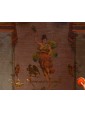
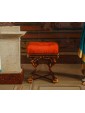
The background is dominated by complex wall decorations reminiscent of the "Fourth Pompeian Style," characterized by fantastical architectural perspectives and isolated figures on monochrome backgrounds. At the center of the wall, a floating female figure—perhaps a maenad or a winged Victory—stands out within a painted aedicule. This detail suggests a direct study of the decorative repertoires of the domus of Pompeii and Herculaneum, which were widely circulated at the time through engravings and illustrated catalogues. Even the precision of the furnishings, such as the stool with its red velvet cushion (a 19th-century reimagining of the sella curulis), allows Sarri to create a deliberate contrast between the grandeur of the context and the fragility of the human emotion depicted.
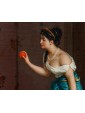
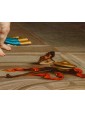
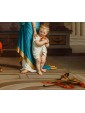
At the heart of the composition, a young girl in tears wipes her face—her features recalling the female figures in Sarri's works held at the Gallery of Modern Art in Florence and the Palazzo Pretorio in Livorno. She is overcome by a childish sorrow that seems to stem from an interrupted game, as suggested by the helmet and small sword abandoned carelessly on the marble floor. To counter this moment of distress, the mother intervenes—a matron of statuesque grace wrapped in a vibrant, intense blue peplos. Her gesture, offering an orange to distract the child from her weeping, exudes sweetness and maternal instinct, while a second child observes the scene with curiosity, clutching a "golden fruit" of his own.
The theme of motherhood and childhood represents one of the deepest poetic cornerstones of Sarri's work. While evoking the solemnity of Roman matrons, the mother figure is always softened by a tilt of the head or a gesture of the hands that reveals a protective intent. Sarri explores the filial bond through a play of glances and physical contact, allowing the artist to satisfy the specific demands of the Florentine and international art markets, which sought in art a decorative and reassuring refuge.
Technically, Sarri demonstrates exceptional mastery in his treatment of surfaces and light. The clear, limpid luminosity that floods the room enhances the brilliance of the fabrics and the fairness of the skin, creating a sophisticated contrast with the warm, earthy tones of the wall paintings. The paint application is enameled and flawless, a product of that academic mastery which the painter successfully updated through a modern chromatic sensitivity and a subtle capacity for psychological inquiry.
Born in Figline Valdarno in 1837, Sarri trained at the Academy of Fine Arts in Florence, becoming the favorite pupil of masters such as Giuseppe Bezzuoli, Enrico Pollastrini, and Antonio Ciseri. Although his career flourished during the height of the Macchiaioli revolution, Sarri chose not to embrace their more "rustic" realism. Instead, he preferred a middle path that combined Purist draftsmanship with a taste for historical revival.
After early success with large altarpieces and historical subjects, it was his classically inspired genre painting that brought him international acclaim. In April 1863, King Victor Emmanuel II commissioned a historical work from him regarding Conradin of Swabia. However, his masterpiece is widely considered to be his cycle of paintings depicting daily life in Pompeii, executed between 1875 and 1887. Influenced by the fashion launched by artists like Lawrence Alma-Tadema and French contemporaries like Gérôme and Boulanger, Sarri became a highly sought-after interpreter for his ability to "feel" the ancient world as a living, breathing space.
Italy only: with Ars Antiqua it is possible to defer all amounts up to a maximum € 7,500 at ZERO RATE, for a total of 15 INSTALLMENTS.
Unpardoned. Vault. € 4,500 = Monthly instalment € 300 for 15 months.
Unpardoned. Vault. € 3,600 = Monthly instalment € 720 for 5 months.
For amounts greater than €7,500 or for a longer period of time (over 15 installments), we can provide a personalized payment.
Contact us directly to get the best quote.
LIVE TV
– SUNDAY 17.00 – 21.00 Dig.terr. 126 - Sky 824
– Streaming on our site www.arsantiquasrl.com and on our social networks Facebook and Youtube
All the works proposed by Ars Antiqua are sold accompanied by a certificate of authenticity in accordance with the law and an accurate in-depth sheet.
It is possible to see the works directly at the showroom gallery in Milan, in via Pisacane 55 and 57.
We personally organize transport and deliveries of the works, both for Italy and abroad.