


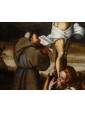
Crucifixion
Oil on canvas, 93 x 57 cm
Expertise by Prof. Alberto Crispo
Marcantonio Mainardi (Cremona, c. 1570 – 1629)
Crucifixion
Oil on canvas, 93 x 57 cm
Expertise by Prof. Alberto Crispo
Marcantonio Mainardi (Cremona, c. 1570 – 1629)
Marcantonio Mainardi (Cremona, c. 1570 – 1629)
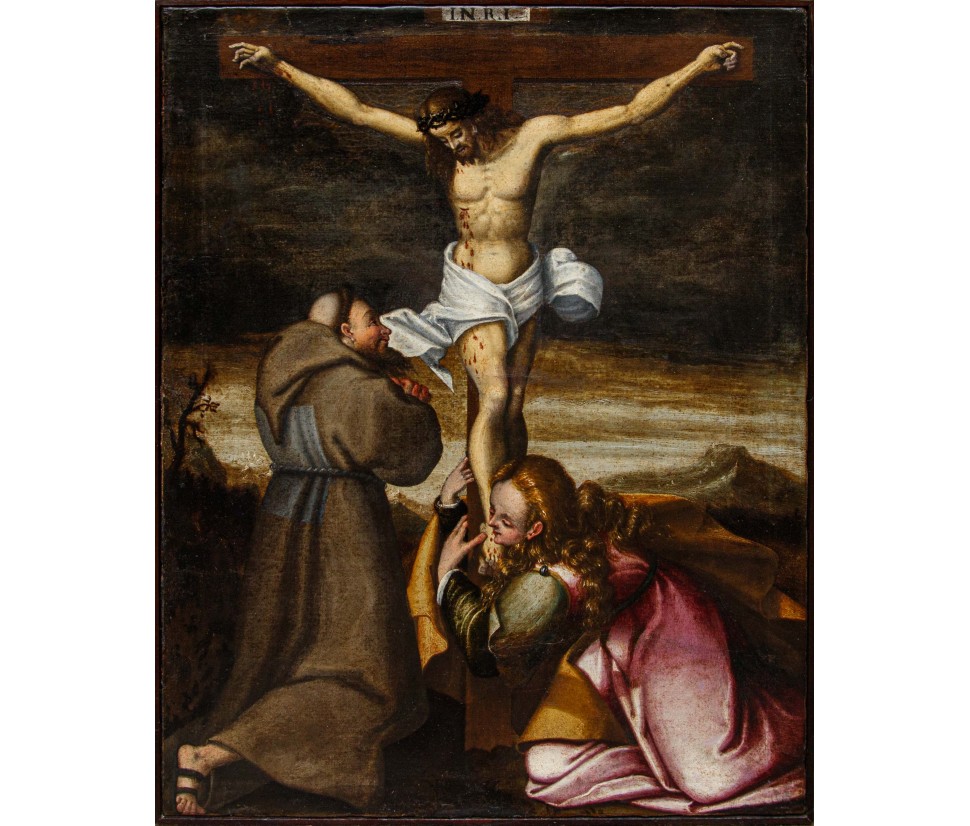
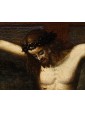
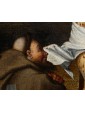
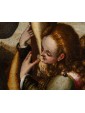
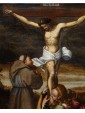
Crucifixion with Mary Magdalene and a Franciscan Saint
Oil on canvas, 93 x 57 cm
Expertise by Prof. Alberto Crispo
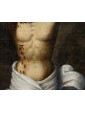
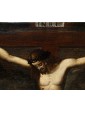
The painting under examination represents an unpublished testament to Cremonese painting between the end of the 16th and the beginning of the 17th century. Although the work exhibits stylistic features very close to those of Andrea Mainardi, known as il Chiaveghino, an analysis of the pictorial execution allows the work to be attributed to his nephew, Marcantonio Mainardi (Cremona, c. 1570 – 1629).
Compared to his uncle’s mastery, Marcantonio displays here a less delicate craftsmanship and a propensity for more redundant forms. One notes, in particular, a plastic emphasis of the bodies and a schematism in the rendering of the drapery that find direct parallels in his other works, such as the Crucifix and Mary Magdalene of Ospedaletto Lodigiano (executed between 1598 and 1600) and the Madonna "Salus Populi Romani" of Martignana di Po.
Marcantonio Mainardi was born in Cremona, likely around 1570. The son of Francesco Giuseppe (Andrea Mainardi’s brother), the young Marcantonio trained and lived with his painter uncle. His activity is documented from 1591 onwards and continued with important commissions such as the Saint George and the Dragon in Casalbuttano (1593) and the decoration of the Hieronymite abbey of Ospedaletto Lodigiano (1598–1600). In 1610, he painted the Delivery of the Chasuble to Saint Ildefonsus in Casalmorano, and in 1626, the Martyrdom of Saint Catherine in Antegnate. He died in 1629, leaving several works unfinished in Polengo.
The Mainardi family represents a pillar of the Cremonese School, acting as the primary heirs and continuers of Bernardino Campi’s teaching. Through Andrea’s apprenticeship with Campi, the Mainardi workshop was able to bridge the elegance of the Late Renaissance with the rigid demands of the Counter-Reformation. While Bernardino Campi had introduced a formal grace of Raphaelesque inspiration, Marcantonio—as this canvas demonstrates—evolved those lessons toward a greater volumetric emphasis and plastic robustness, consolidating a style that remained the point of reference for the region until the 1630s.
Italy only: with Ars Antiqua it is possible to defer all amounts up to a maximum € 7,500 at ZERO RATE, for a total of 15 INSTALLMENTS.
Unpardoned. Vault. € 4,500 = Monthly instalment € 300 for 15 months.
Unpardoned. Vault. € 3,600 = Monthly instalment € 720 for 5 months.
For amounts greater than €7,500 or for a longer period of time (over 15 installments), we can provide a personalized payment.
Contact us directly to get the best quote.
LIVE TV
– SUNDAY 17.00 – 21.00 Dig.terr. 126 - Sky 824
– Streaming on our site www.arsantiquasrl.com and on our social networks Facebook and Youtube
All the works proposed by Ars Antiqua are sold accompanied by a certificate of authenticity in accordance with the law and an accurate in-depth sheet.
It is possible to see the works directly at the showroom gallery in Milan, in via Pisacane 55 and 57.
We personally organize transport and deliveries of the works, both for Italy and abroad.
