



The Giants' Staircase
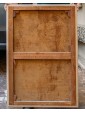
Oil on canvas, 69 x 98 cm – with frame, 107 x 80 cm
Signed lower left: Alex…
19th Century
The Giants' Staircase
Oil on canvas, 69 x 98 cm – with frame, 107 x 80 cm
Signed lower left: Alex…
19th Century
19th Century
The Giants' Staircase at the Doge's Palace, Venice
Oil on canvas, 69 x 98 cm – with frame, 107 x 80 cm
Signed lower left: Alex…
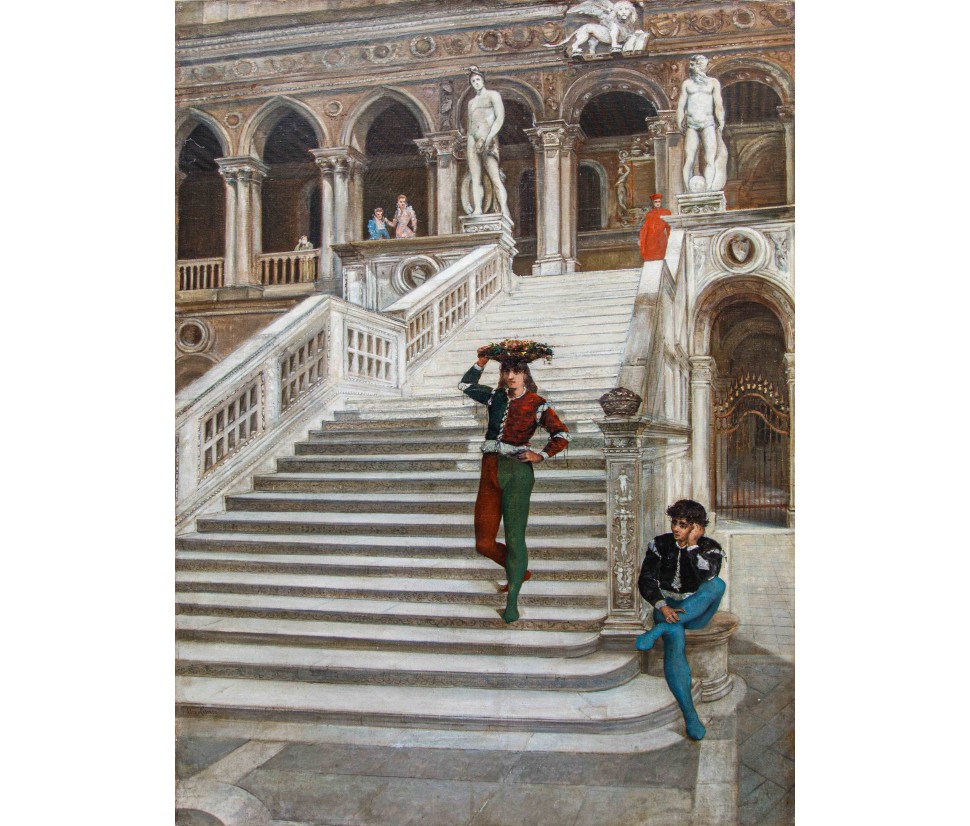
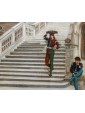
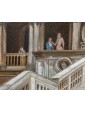
This 19th-century painting captures an evocative genre scene set upon the celebrated Giants' Staircase (Scala dei Giganti) of the Doge's Palace in Venice. The work belongs to the tradition of 19th-century academic and historicist painting that delighted in evoking the former glory of the Serenissima, blending observation from life with an idealized, melancholic reconstruction of the past.
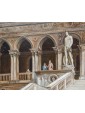
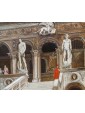
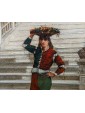
The composition is dominated by the powerful marble architecture of the staircase. At the center, a young man in Renaissance costume—a two-tone red and green tunic with matching tights—descends the steps carrying a basket on his head, a detail that introduces a touch of everyday life into the solemnity of the setting. In the lower right, a second youth sits on the balustrade in a pensive, languid pose typical of Romantic sensibilities. In the background, between the arches of the loggia, other figures in period dress are visible, suggesting a narrative suspended in time.
The technical execution reveals meticulous attention to the rendering of materials: the marble of the stairs, the Istrian stone of the palace, and the textures of the clothing are depicted with a nearly photographic precision characteristic of 19th-century academic training.
The painting reflects the legacy of Italian Neoclassicism as it evolved into Purism and Historicism. While the 18th-century movement sought an aesthetic and moral canon of absolute perfection in Greco-Roman antiquity, the painting of the following century sought to reclaim the "national past." In Italy, this meant looking back with nostalgia not only to classical antiquity but also to the Renaissance. The sculpted figures atop the staircase in the painting represent the ideal of classical beauty integrated into Venetian architecture—a symbol of cultural continuity celebrated to reaffirm Italian artistic identity during a century of major political transformation.
The Giants' Staircase, the monumental heart of the Doge's Palace, was designed at the end of the 15th century by Antonio Rizzo. It served as the site for the solemn coronation ceremony of the Doge, who received the Zoglia (the ducal crown) at the top of the landing to ensure visibility to all those gathered in the courtyard.
The name of the staircase derives from the two colossal Carrara marble statues placed at its summit in 1567 by Jacopo Sansovino, depicting Mars and Neptune. These deities symbolize the Republic of Venice’s dominion over the mainland and the sea, respectively. The architecture itself is a triumph of Renaissance decoration, featuring marble inlays and reliefs that make it one of the ultimate examples of the celebration of Dogal power. In the painting, the presence of these imposing statues looming behind the human figures underscores the contrast between the eternal greatness of myth (and Venetian history) and the transience of daily life.
Italy only: with Ars Antiqua it is possible to defer all amounts up to a maximum € 7,500 at ZERO RATE, for a total of 15 INSTALLMENTS.
Unpardoned. Vault. € 4,500 = Monthly instalment € 300 for 15 months.
Unpardoned. Vault. € 3,600 = Monthly instalment € 720 for 5 months.
For amounts greater than €7,500 or for a longer period of time (over 15 installments), we can provide a personalized payment.
Contact us directly to get the best quote.
LIVE TV
– SUNDAY 17.00 – 21.00 Dig.terr. 126 - Sky 824
– Streaming on our site www.arsantiquasrl.com and on our social networks Facebook and Youtube
All the works proposed by Ars Antiqua are sold accompanied by a certificate of authenticity in accordance with the law and an accurate in-depth sheet.
It is possible to see the works directly at the showroom gallery in Milan, in via Pisacane 55 and 57.
We personally organize transport and deliveries of the works, both for Italy and abroad.
