


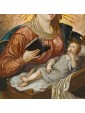
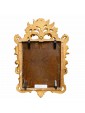
Madonna and Child
Oil on copper, 15 x 23 cm
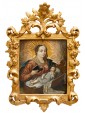
with frame, 41 x 28 cm
Spanish-Flemish School, 17th Century
Madonna and Child
Oil on copper, 15 x 23 cm
with frame, 41 x 28 cm
Spanish-Flemish School, 17th Century
Spanish-Flemish School, 17th Century
Madonna and Child
Oil on copper, 15 x 23 cm – with frame, 41 x 28 cm
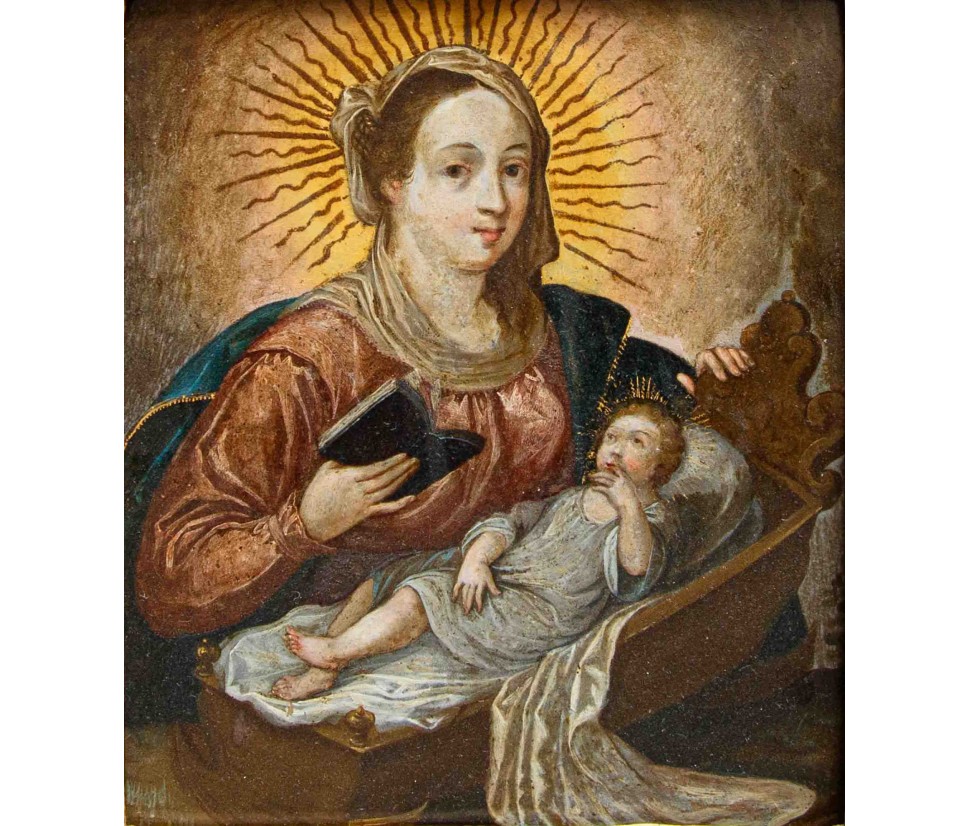
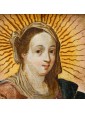
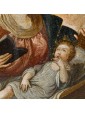
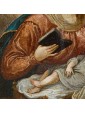
In this small-scale oil on copper, the richly dressed Virgin, holding the book of Holy Scriptures in her hands, watches over the docile Christ Child, who lies asleep in an elaborate wooden cradle.
The practice of painting on copper established itself alongside Mannerist taste at the dawn of the 16th century. During the same years that saw the spread of engraving for printmaking and the refinement of painted enamel techniques, many painters began using copper for landscapes, still lifes, religious and mythological subjects, and battle or genre scenes.
Copper served as a more precious support than ordinary canvas or wood panels, catering to the Mannerist pursuit of preziosismo (preciousness). This technique was cultivated by masters such as Domenichino, Guercino, Guido Reni, Caravaggio, Sebastiano del Piombo, and Bronzino, as well as by numerous Flemish painters. The invention of the laminate process allowed for the quick production of very smooth surfaces without casting, using specifically studied techniques that sometimes involved coating the plate with other alloys.
While the exact originator of copper painting in Europe is unknown, it is clear that from the mid-16th century, this support was widely used in Italy, Germany, and the Netherlands for small, refined paintings. Guido Reni, for instance, learned the technique from the Fleming Denys Calvaert and often coated the copper with thin sheets of silver, gold, or a tin-like metal to achieve an effect of extreme luminosity. Vivid and brilliant, oil on copper was ideal for both sacred and profane themes. However, the technique declined from the second half of the 17th century due to issues with metal corrosion, the perishability of the works, and the difficulty of creating large-scale pieces.
The iconography of the Virgin with the Book of Scriptures became widespread in the Florentine area as early as the late 15th century, as seen in Sandro Botticelli’s Madonna and Child Reading (Museo Poldi Pezzoli) and Giorgione’s Reading Madonna (Ashmolean Museum). From the 16th century onward, this motif spread to Spain, evidenced by works such as the painting by the Master of Santa Inés in the Museo Galdiano, Madrid.
Conversely, the depiction of the Christ Child in a cradle is more characteristic of Northern Europe. This detail, quite unusual in Italian art, is frequently found in 17th-century Flemish paintings; a famous example is Rembrandt’s Holy Family with Angels in the Hermitage. Furthermore, the Virgin’s radiant sunburst halo connects the work to Spanish models from the late 16th century.
Italy only: with Ars Antiqua it is possible to defer all amounts up to a maximum € 7,500 at ZERO RATE, for a total of 15 INSTALLMENTS.
Unpardoned. Vault. € 4,500 = Monthly instalment € 300 for 15 months.
Unpardoned. Vault. € 3,600 = Monthly instalment € 720 for 5 months.
For amounts greater than €7,500 or for a longer period of time (over 15 installments), we can provide a personalized payment.
Contact us directly to get the best quote.
LIVE TV
– SUNDAY 17.00 – 21.00 Dig.terr. 126 - Sky 824
– Streaming on our site www.arsantiquasrl.com and on our social networks Facebook and Youtube
All the works proposed by Ars Antiqua are sold accompanied by a certificate of authenticity in accordance with the law and an accurate in-depth sheet.
It is possible to see the works directly at the showroom gallery in Milan, in via Pisacane 55 and 57.
We personally organize transport and deliveries of the works, both for Italy and abroad.
