











Leda a – Danae
Oil on canvas, 50 x 134 cm
Critical Analysis by Prof. Marco Ciampolini
Mattia Bolognini (Montevarchi, 1605 – Siena, 1667)
Leda a – Danae
Oil on canvas, 50 x 134 cm
Critical Analysis by Prof. Marco Ciampolini
Mattia Bolognini (Montevarchi, 1605 – Siena, 1667)
Mattia Bolognini (Montevarchi, 1605 – Siena, 1667)
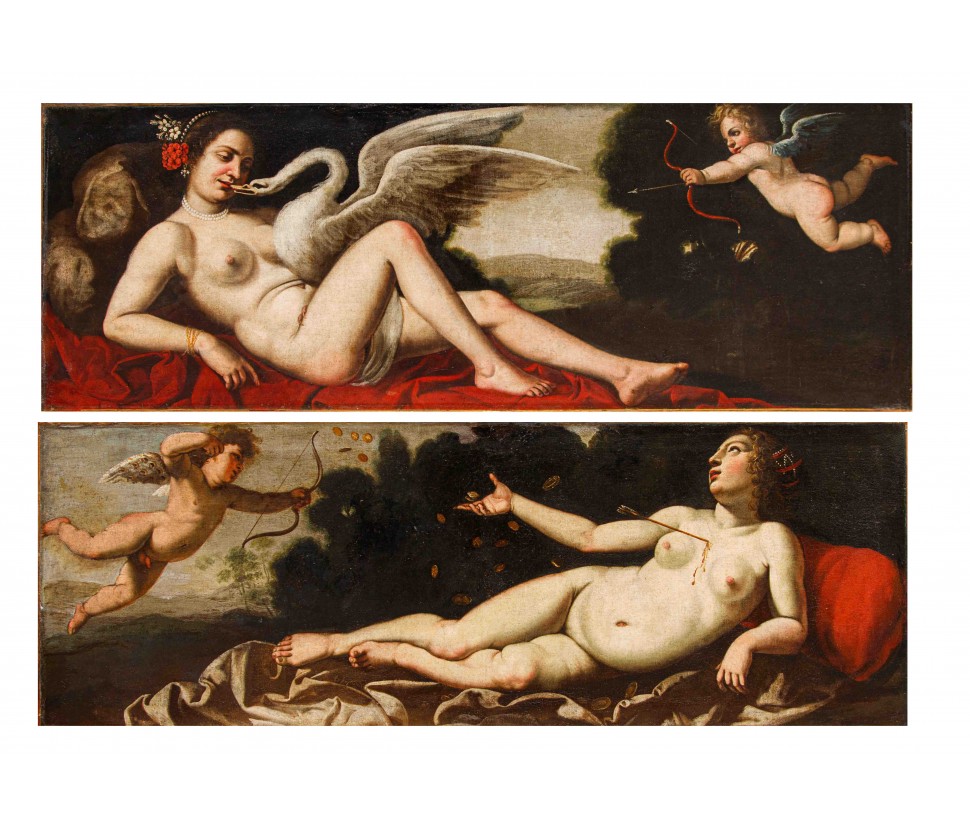
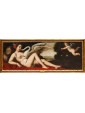
Leda and the Swan – Danaë Covered by the Shower of Gold
Oil on canvas, 50 x 134 cm
Critical Analysis by Prof. Marco Ciampolini
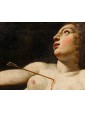
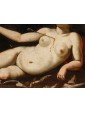
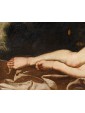
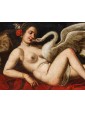
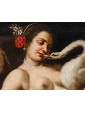
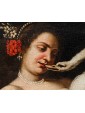
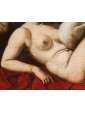
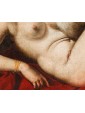
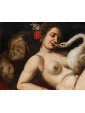
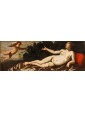
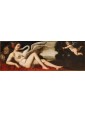
This pair of paintings illustrates two of the mythological themes most beloved in the figurative culture of the time, centered on the amorous metamorphoses of Jupiter. The first episode depicts Leda, sensually reclined on a red drape as she yields to the kiss of the swan—the form assumed by the father of the gods to seduce her. According to myth, their union gave rise to the Dioscuri (Castor and Pollux) and Clytemnestra. The stylistic hallmark of the composition appears as an explicit homage to Michelangelo’s celebrated invention for Alfonso d’Este, an essential model for the success of this subject in the modern era.
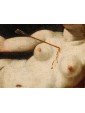
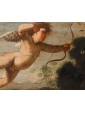
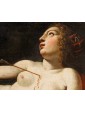
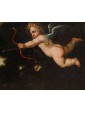
In the second canvas, the princess Danaë is portrayed at the myth's climax: pierced by Cupid’s arrow, she is impregnated by the shower of gold, another divine manifestation of Jupiter. Here too, the scholarly references are evident: the pose of the putto precisely recalls the youth appearing in Guido Reni’s Aurora, testifying to a refined visual culture indebted to the great Baroque and Renaissance traditions.
Despite the citations of the master of Classicism, these canvases are imbued with an unshaded reality—a love for the "real" that treats female bodies not as perfect goddesses, but as ordinary women. This poetic approach, combined with the use of cool colors and incisive draftsmanship, recalls the language of the Sienese Rutilio Manetti (1571–1639). Here, the painter reinterprets these elements toward a Neo-Venetian vision, as seen in the attention to the landscape; the author is thus an artist close to Rutilio but attentive to the "pictorial speed" of the period.
The artist is Mattia Bolognini, originally from the Valdarno Aretino. Baptized in Montevarchi in 1605, he likely trained within the circle of Giovanni da San Giovanni, from whom he derived a formal rigor and a "humoral" sensitivity foreign to the prevailing Caravaggism. Having moved to Siena, where he is documented from 1636, he consolidated his career through prestigious public and private commissions, collaborating extensively with the Hospital of Santa Maria della Scala, for which he painted the Saint Anthony Abbot in 1638.
Over time, Bolognini absorbed the influence of Bernardino Mei and the suggestions of the Roman Baroque, as demonstrated by his Magdalenes, whose sculptural poses echo Bernini’s Truth. Their relationship was so profound that Bolognini is today considered the natural successor to Mei’s workshop after the latter’s departure for Rome in 1557. In this phase, his painting evolved toward greater fluidness of medium, evident in sacred works like the Vision of Saint Andrea Gherardi, which reveals openings toward the Neo-Venetian and Roman landscaping of Andrea Sacchi.
Beyond altarpieces, Bolognini distinguished himself as one of the most prolific and acute portraitists of the mid-century, capable of interpreting the perspicacity of Sustermans through a "fragrant" brushstroke and deep psychological introspection. Significant examples include the portrait of Aregofila Incontri or those of the Gori Pannilini spouses, where physiognomic truth and care for material details unite with a monumental setting.
The work that best summarizes his artistic maturity is the Saint Anthony of Padua in Pelago. Despite dating uncertainties, the painting is a masterpiece of balance: it fuses a solemn melodramatic tone with citations of "raw reality" and an almost theatrical flavor. His activity, documented until his death in Siena in 1667, bears witness to an artistic trajectory capable of blending Northern analytical realism with the elegance and light of Italian Classicism.
Italy only: with Ars Antiqua it is possible to defer all amounts up to a maximum € 7,500 at ZERO RATE, for a total of 15 INSTALLMENTS.
Unpardoned. Vault. € 4,500 = Monthly instalment € 300 for 15 months.
Unpardoned. Vault. € 3,600 = Monthly instalment € 720 for 5 months.
For amounts greater than €7,500 or for a longer period of time (over 15 installments), we can provide a personalized payment.
Contact us directly to get the best quote.
LIVE TV
– SUNDAY 17.00 – 21.00 Dig.terr. 126 - Sky 824
– Streaming on our site www.arsantiquasrl.com and on our social networks Facebook and Youtube
All the works proposed by Ars Antiqua are sold accompanied by a certificate of authenticity in accordance with the law and an accurate in-depth sheet.
It is possible to see the works directly at the showroom gallery in Milan, in via Pisacane 55 and 57.
We personally organize transport and deliveries of the works, both for Italy and abroad.
