


Flora and Putti
Oil on copper, 36 x 30 cm
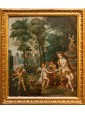
Framed, 42.5 x 37.5 cm
Workshop of Jan Brueghel the Younger (1601 – 1678) and Workshop of Hendrick van Balen (1575 – 1632)
Flora and Putti
Oil on copper, 36 x 30 cm
Framed, 42.5 x 37.5 cm
Workshop of Jan Brueghel the Younger (1601 – 1678) and Workshop of Hendrick van Balen (1575 – 1632)
Workshop of Jan Brueghel the Younger (1601 – 1678) and Workshop of Hendrick van Balen (1575 – 1632)
Flora and Putti
Oil on copper, 36 x 30 cm
Framed, 42.5 x 37.5 cm
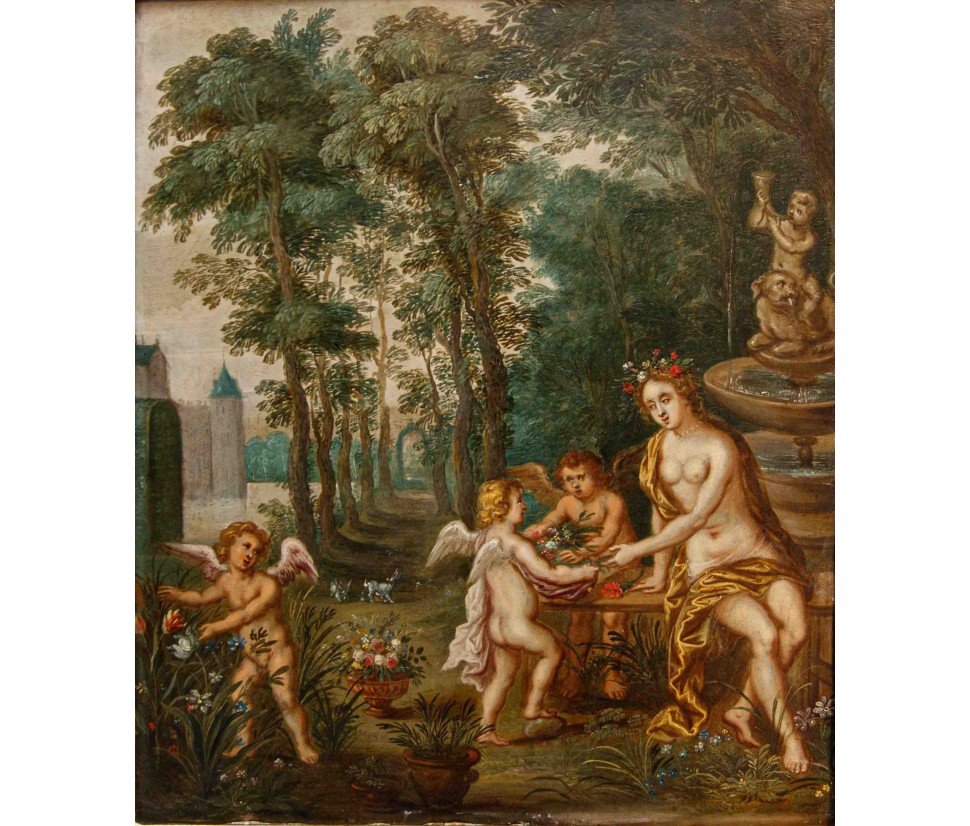
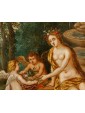
An in-depth study of this painting identifies the workshops of two Flemish artists as its creators: Jan Brueghel the Younger (1601–1678) and Hendrick van Balen (1575–1632).
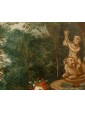
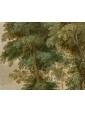
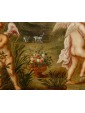
Jan Brueghel the Younger is specifically credited with the execution of the landscape—rendered in his signature chromatic tones—as well as the flowers and fruit, which are characteristic of the artist's early painterly endeavors. A member of the most famous dynasty of Flemish painters, Jan was the son of Jan Brueghel the Elder, the grandson of Pieter Bruegel the Elder, and the father of Abraham Brueghel. Having trained under his father, Jan traveled to Milan as a young man to meet Cardinal Federico Borromeo, the former patron of "the Elder." Following a journey through Italy that took him to Rome, Naples, and Palermo in the company of his friend Anthony van Dyck, Jan returned to Antwerp in 1625 upon his father's sudden death to take over the management of the family workshop.
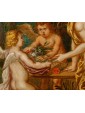
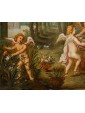
Despite inheriting his father’s studio, Brueghel was still refining his personal style, which was defined by a precise and meticulous rendering of detail—a quality particularly evident here in the depiction of the various flower species. Throughout his life, he continued to collaborate with notable painters such as Peter Paul Rubens, Pieter van Avont, and Hendrick van Balen, to whom the winged putto in this work is attributed.
The results of the collaboration with van Balen give the viewer the impression that these paintings were created "as one," by the hand of a single artist. However, the collaboration of multiple painters on a single work was a phenomenon frequently encountered in 17th-century Flemish painting. Van Balen was instrumental in the renewal of Flemish art during this period, serving as a bridge between the generation of his tutor, Marten de Vos, and his own prodigious pupil, Anthony van Dyck. Van Balen served as the dean of the Antwerp Romanists—a guild of artists who had studied in Rome. The winged putto depicted here exudes this classical training among the ancient statues and Renaissance frescoes of the Eternal City, while maintaining a brilliant Northern sensibility for light, flesh, and texture.
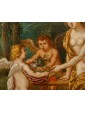
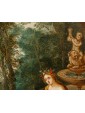
In this oil on copper, Flora, the Italic goddess of spring, is depicted seated on the edge of a fountain. She is portrayed nude, draped only in a golden cloth and a garland of flowers crowning her long chestnut hair. The scene is completed by three winged putti, also depicted nude, who are busily gathering flowers in honor of the goddess.
Italy only: with Ars Antiqua it is possible to defer all amounts up to a maximum € 7,500 at ZERO RATE, for a total of 15 INSTALLMENTS.
Unpardoned. Vault. € 4,500 = Monthly instalment € 300 for 15 months.
Unpardoned. Vault. € 3,600 = Monthly instalment € 720 for 5 months.
For amounts greater than €7,500 or for a longer period of time (over 15 installments), we can provide a personalized payment.
Contact us directly to get the best quote.
LIVE TV
– SUNDAY 17.00 – 21.00 Dig.terr. 126 - Sky 824
– Streaming on our site www.arsantiquasrl.com and on our social networks Facebook and Youtube
All the works proposed by Ars Antiqua are sold accompanied by a certificate of authenticity in accordance with the law and an accurate in-depth sheet.
It is possible to see the works directly at the showroom gallery in Milan, in via Pisacane 55 and 57.
We personally organize transport and deliveries of the works, both for Italy and abroad.
