


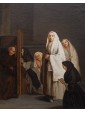

The Confession
Oil on canvas, 54.5 x 44.5 cm
with frame, 67 x 59 c
Pietro Longhi (Venice, 1701 – 1785)
The Confession
Oil on canvas, 54.5 x 44.5 cm
with frame, 67 x 59 c
Pietro Longhi (Venice, 1701 – 1785)
Pietro Longhi (Venice, 1701 – 1785)
The Confession
Oil on canvas, 54.5 x 44.5 cm
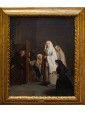
with frame, 67 x 59 cm
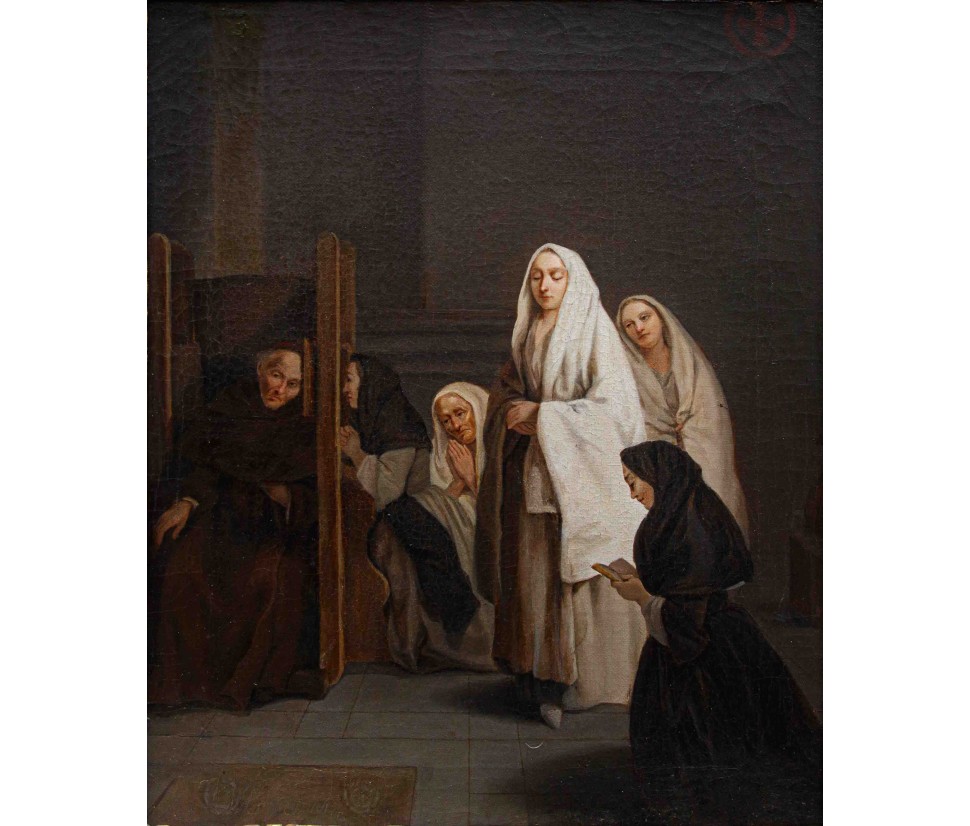
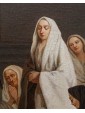
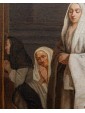
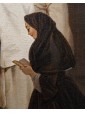
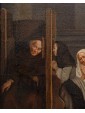
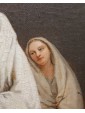
The canvas under examination depicts a subject, The Confession, which Pietro Longhi revisited in several variations. This specific model references a work by Longhi held at the Galleria Querini Stampalia in Venice, from which Marco Alvise produced an engraving (now preserved at the Luigi Bailo Museum in Treviso). Upon close observation, however, one can notice slight discrepancies between Alvise's engraving and the version at the Querini Stampalia; notably, these differences become points of correspondence when compared to the work analyzed here. In this regard, one should observe—in addition to the presence of the dog—the closed eyes (rather than open) of the central female figure and the symbol in the upper right corner instead of the clock.
Longhi dedicated himself to the theme of the Sacraments and The Confession on multiple occasions. Another analogous work is currently on display at the Uffizi Gallery in Florence.
The Venetian painter Pietro Longhi, born Pietro Antonio Falca in Venice in 1701, received his initial training in the workshop of his father, a silversmith. From an early age, Pietro showed a great aptitude for art, and it was his father who encouraged him to master the technique of drawing. He later studied under the celebrated painter Antonio Balestra, with whom he worked and learned the art of painting.
From approximately 1734, Longhi’s work moved away from religious subjects for a period to focus on genre painting. During a stay in Bologna, he became acquainted with the work of Giuseppe Maria Gambarini, a refined painter of genre scenes. Upon his return to Venice, he dedicated himself to portraying scenes from the daily life of the Venetian bourgeoisie, following the style of Nicolas Lancret, though with a more ironic touch. His paintings provide a detailed documentation of Venetian life, manifesting the artist's keen interest in the social dynamics of the era.
In the first half of the 1750s, he focused on the representation of "careers"—scenes depicting real and common activities of both the working class and the bourgeoisie. By the 1760s, his palette shifted toward brownish tones with less emphasis on perspective lines, showing an affinity with the style of Rembrandt.
In 1763, Pietro Longhi directed the Accademia Pisani del Disegno e dell’Intaglio and turned his attention to portraiture, often with the assistance of his son, Alessandro Longhi.
The great Venetian playwright Carlo Goldoni (1707–1793) praised Longhi’s dedication to representing the foibles and "manias" of contemporary society. Indeed, Longhi’s work, rich in humor and irony, functions much like Goldoni’s comedies. The artist is even cited in Goldoni’s Commedie. Their careers moved in parallel across two different artistic fronts: the theater and the visual arts.
Italy only: with Ars Antiqua it is possible to defer all amounts up to a maximum € 7,500 at ZERO RATE, for a total of 15 INSTALLMENTS.
Unpardoned. Vault. € 4,500 = Monthly instalment € 300 for 15 months.
Unpardoned. Vault. € 3,600 = Monthly instalment € 720 for 5 months.
For amounts greater than €7,500 or for a longer period of time (over 15 installments), we can provide a personalized payment.
Contact us directly to get the best quote.
LIVE TV
– SUNDAY 17.00 – 21.00 Dig.terr. 126 - Sky 824
– Streaming on our site www.arsantiquasrl.com and on our social networks Facebook and Youtube
All the works proposed by Ars Antiqua are sold accompanied by a certificate of authenticity in accordance with the law and an accurate in-depth sheet.
It is possible to see the works directly at the showroom gallery in Milan, in via Pisacane 55 and 57.
We personally organize transport and deliveries of the works, both for Italy and abroad.
