


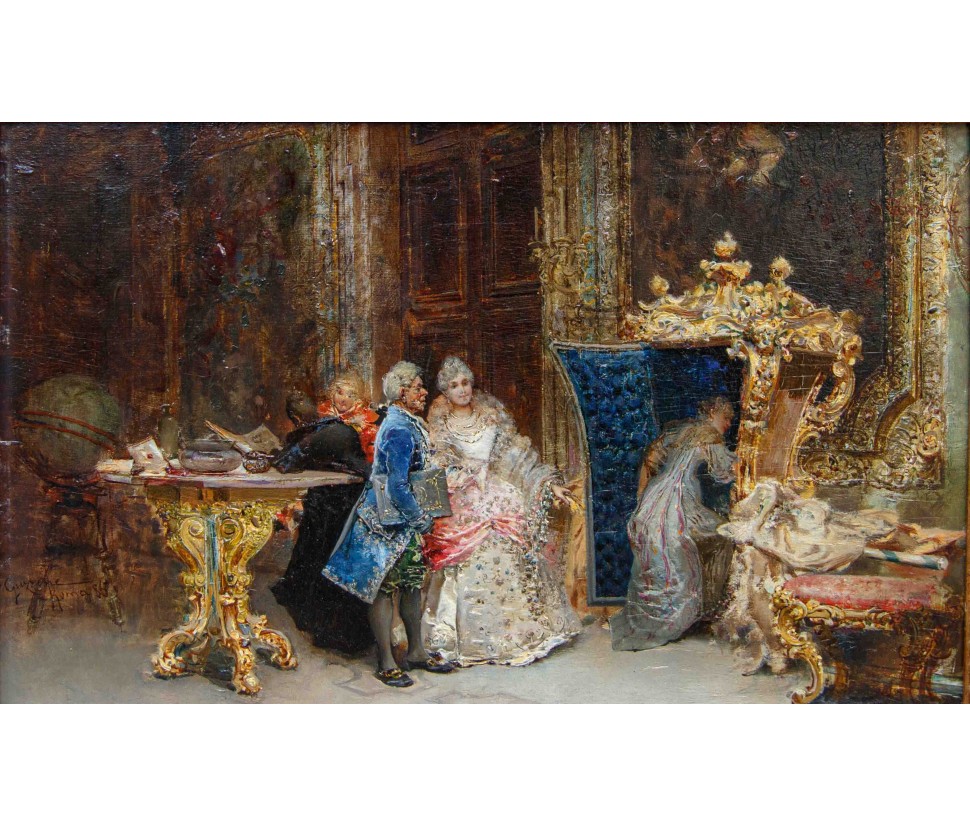
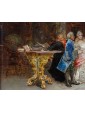
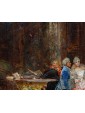
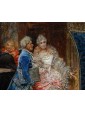
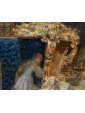
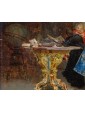
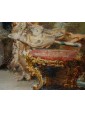
Interior with Figures, 1885
Oil on panel, 26.5 x 41.5 cm
Signed and dated lower left: “Guzzone, Roma, ‘85”
Sebastiano Guzzone (Militello, 1856 – Florence, 1890)
Interior with Figures, 1885
Oil on panel, 26.5 x 41.5 cm
Signed and dated lower left: “Guzzone, Roma, ‘85”
Sebastiano Guzzone (Militello, 1856 – Florence, 1890)
Sebastiano Guzzone (Militello, 1856 – Florence, 1890)
Interior with Figures in Costume, 1885
Oil on panel, 26.5 x 41.5 cm
Signed and dated lower left: “Guzzone, Roma, ‘85”
Sebastiano Guzzone represents one of the most fascinating and gifted figures in the Sicilian artistic landscape of the second half of the 19th century. His biographical and creative journey is set within the delicate era that redefined the power balances and cultural hierarchies of the European continent, making him a privileged observer, if not a prominent actor, of his time. Born in 1856 in Militello in Val di Catania, the heart of the Sicilian province, Guzzone grew up in a family of small landowners. His early education was entrusted to his uncle, Father Rosario, a priest with conservative political leanings who nevertheless maintained close ties with the liberal elite, represented by Salvatore Majorana Calatabiano, the future minister in the governments of the Sinistra storica. Thanks to this network of influential patrons and a precocious graphic talent already admired by local masters—including names such as Salvatore Grande, Emanuele Fagone, Nicolò Culosi, and Francesco Sinatra—the young artist was able to move to Rome at a very young age to refine his studies at the Accademia di San Luca under the guidance of masters like Tommaso Minardi, Francesco Podesti, and Cesare Mariani.
His Roman training was decisive in the development of a style that, while starting from academic rigor and Purist drawing, opened up to a vibrant brushstroke and a use of light that was almost "pre-Impressionist," often compared to the atmospheres of the great Mariano Fortuny. A moment of great creative success was his participation in the 1885 edition of the historic Carnival of Rome (also famously mentioned by Dumas in The Count of Monte Cristo), alongside the painter Salvatore Franciamore and the architect Ernesto Basile. They were tasked with designing a carnival float representing Sicily; the work not only won first prize but was also highly admired abroad, particularly in France—where he befriended the photographer Nadar—and in England, where his work featured in four exhibitions at the Royal Academy.
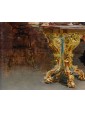
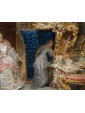
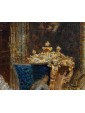
Guzzone’s production was distinguished by a refined versatility, allowing him to excel in portraiture as much as in genre and "costume" painting, as evidenced by the work presented here. In this 18th-century interior scene, signed and dated 1885, the artist demonstrates extraordinary mastery in the tactile rendering of the fabrics, the golden reflections of the Rococo furnishings, and the velvets, infusing the narrative with a vitality that captivates the viewer. It is no coincidence that his career led him to exhibit successfully not only in Italy but also in Paris and London, entering the circuit of the prestigious art dealer Goupil, who dictated international collecting tastes at the time.
Despite his premature death in Florence in 1890, which cut short a career at its peak, Guzzone’s legacy is preserved today in important museum collections. Among his most significant works in public institutions, special mention must go to The Sick Shepherd Boy and the Portrait of the Baroness of Sangiuliano at the Castello Ursino in Catania, as well as the canvases held in the Galleria Civica d'Arte Moderna in Rome. His hometown, Militello, also pays him tribute through a rich collection of drawings and studies at the local Civic Museum named in his honor, allowing for an appreciation of the intellectual genesis of his sumptuous oil paintings. In these venues, one can observe how the artist succeeded in balancing the aristocratic elegance of his subjects with profound psychological sensitivity, establishing Sebastiano Guzzone as a leading figure of lyrical realism in 19th-century Italian art.
Italy only: with Ars Antiqua it is possible to defer all amounts up to a maximum € 7,500 at ZERO RATE, for a total of 15 INSTALLMENTS.
Unpardoned. Vault. € 4,500 = Monthly instalment € 300 for 15 months.
Unpardoned. Vault. € 3,600 = Monthly instalment € 720 for 5 months.
For amounts greater than €7,500 or for a longer period of time (over 15 installments), we can provide a personalized payment.
Contact us directly to get the best quote.
LIVE TV
– SUNDAY 17.00 – 21.00 Dig.terr. 126 - Sky 824
– Streaming on our site www.arsantiquasrl.com and on our social networks Facebook and Youtube
All the works proposed by Ars Antiqua are sold accompanied by a certificate of authenticity in accordance with the law and an accurate in-depth sheet.
It is possible to see the works directly at the showroom gallery in Milan, in via Pisacane 55 and 57.
We personally organize transport and deliveries of the works, both for Italy and abroad.
