


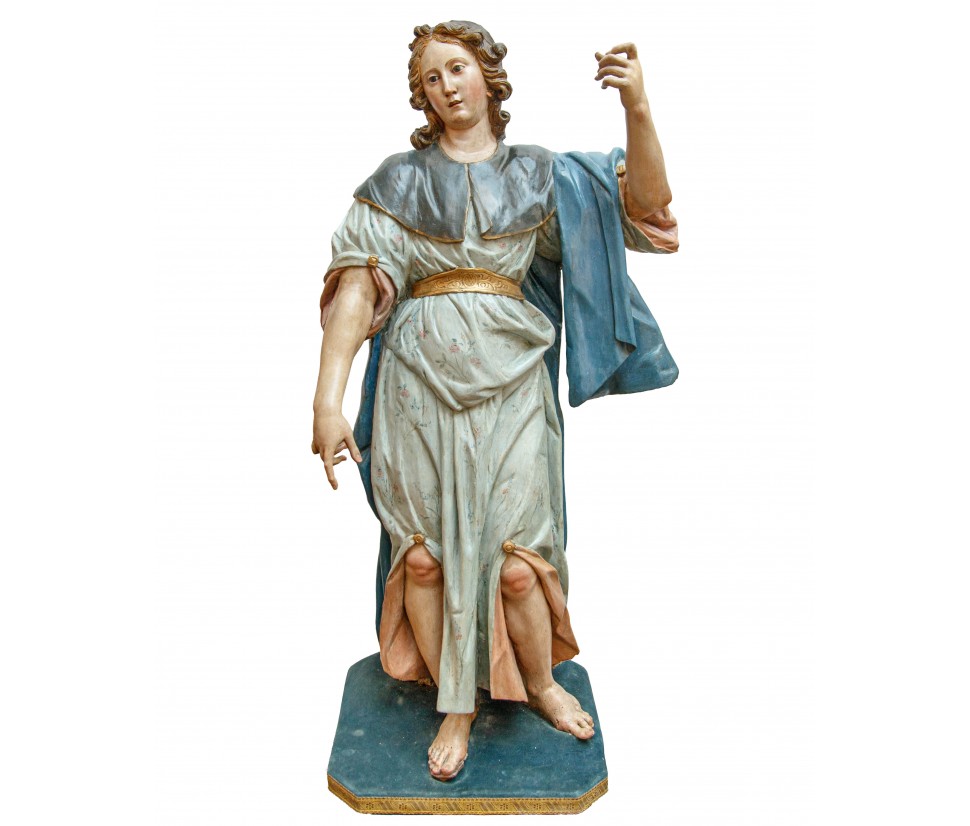
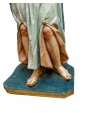
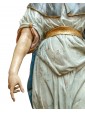
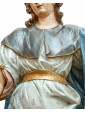
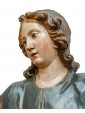
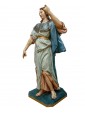
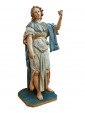
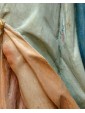
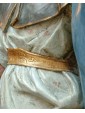
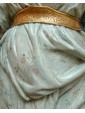
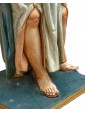
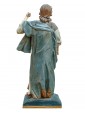
Archangel Raphael
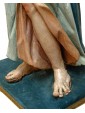
Polychrome wood and glass paste, : h. 139 x 40 x 60 cm
Written statement by Prof. Giuseppe Sava
Giuseppe Picano (Sant'Elia Fiumerapido, 1732 – c. 1810)
Archangel Raphael
Polychrome wood and glass paste, : h. 139 x 40 x 60 cm
Written statement by Prof. Giuseppe Sava
Giuseppe Picano (Sant'Elia Fiumerapido, 1732 – c. 1810)
Giuseppe Picano (Sant'Elia Fiumerapido, 1732 – c. 1810)
Archangel Raphael
Polychrome wood and glass paste, : h. 139 x 40 x 60 cm
Written statement by Prof. Giuseppe Sava
Considered one of the most fascinating figures of the Neapolitan Settecento, Giuseppe Picano distinguished himself as an exceptional master of wooden sculpture, capable of infusing wood with the same softness and emotional intensity typically reserved for stone. Born into the craft—his father, Francesco Antonio, was also a sculptor—Picano was born in 1732 in Sant'Elia Fiumerapido (in the present-day province of Frosinone). He was active in Naples until the early 19th century, passing away around 1810.
Picano trained in the vibrant heart of the Neapolitan High Baroque. He refined his natural talent under the guidance and patronage of the architects Luigi Vanvitelli and his son Carlo, later becoming the principal collaborator and close follower of Giuseppe Sanmartino—the creator of the famous Veiled Christ—and Giacomo Colombo. A fruit of this successful synergy was the extraordinary 1740 Nativity group housed in the church of Santa Maria in Portico in Naples: a unique monumental complex consisting of 24 life-sized figures that can still be admired in their original location.
While primarily operating between Naples and the Campania region and favoring wood for his sacred subjects, Picano demonstrated extraordinary versatility, working successfully in marble, terracotta, stucco, and papier-mâché. His stylistic hallmark is defined by a vibrant realism, evident in the expressive faces and complex chiaroscuro drapery that lends dynamism to his figures, as seen in the statues of saints within the Church of the Santissima Annunciata in Naples. His reputation allowed his work to spread throughout the Kingdom, leaving prestigious examples in Calabria and numerous altar pieces and Nativity figures across Neapolitan churches. He remains a fundamental bridge between the theatricality of the Late Baroque and the emerging composure of Neoclassical taste.
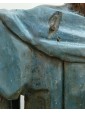
From a technical standpoint, after carving the wood (usually soft essences such as linden or poplar), Picano applied a thin linen or hemp canvas soaked in glue to mask the grain and joints of the material. Over this base, he applied numerous layers of gesso and animal glue, which were meticulously sanded to achieve a surface as smooth and silky as porcelain.
This preparation was vital for the rendering of the flesh tones (incarnato); the artist did not merely paint the surface but created an "artificial skin" capable of reacting naturally to light. The color was applied through successive oil glazes, with a palette ranging from pearlescent tones for Madonnas to browner, more weathered hues for hermit saints or prophets.
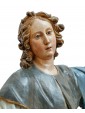
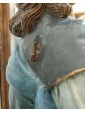
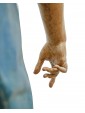
To heighten the realism, Picano utilized the "blushing" technique: applying rosy or vermilion shades to knuckles, elbows, cheeks, and eyelids to simulate the blood flow of a living body. A distinctive technical detail, inherited from the great Neapolitan Nativity tradition, was the insertion of back-painted crystal or glass paste eyes, as seen in the Archangel Raphael presented here. These were inserted from inside the skull or fitted with extreme precision into the sockets, granting the statue a supernatural depth of gaze. Finally, a finishing varnish—often mastic or amber-based—provided a subtle sheen that mimicked the natural moisture of skin and eyes, rendering his sculptures almost unsettling in their lifelike verisimilitude.
Italy only: with Ars Antiqua it is possible to defer all amounts up to a maximum € 7,500 at ZERO RATE, for a total of 15 INSTALLMENTS.
Unpardoned. Vault. € 4,500 = Monthly instalment € 300 for 15 months.
Unpardoned. Vault. € 3,600 = Monthly instalment € 720 for 5 months.
For amounts greater than €7,500 or for a longer period of time (over 15 installments), we can provide a personalized payment.
Contact us directly to get the best quote.
LIVE TV
– SUNDAY 17.00 – 21.00 Dig.terr. 126 - Sky 824
– Streaming on our site www.arsantiquasrl.com and on our social networks Facebook and Youtube
All the works proposed by Ars Antiqua are sold accompanied by a certificate of authenticity in accordance with the law and an accurate in-depth sheet.
It is possible to see the works directly at the showroom gallery in Milan, in via Pisacane 55 and 57.
We personally organize transport and deliveries of the works, both for Italy and abroad.
