


Nascendo Morimur
Oil on canvas, 55 x 45 cm
with frame 64 x 53 cm
Flemish Painter of the first half of the 17th Century
Nascendo Morimur
Oil on canvas, 55 x 45 cm
with frame 64 x 53 cm
Flemish Painter of the first half of the 17th Century
Flemish Painter of the first half of the 17th Century
Nascendo Morimur
Oil on canvas, 55 x 45 cm
with frame 64 x 53 cm
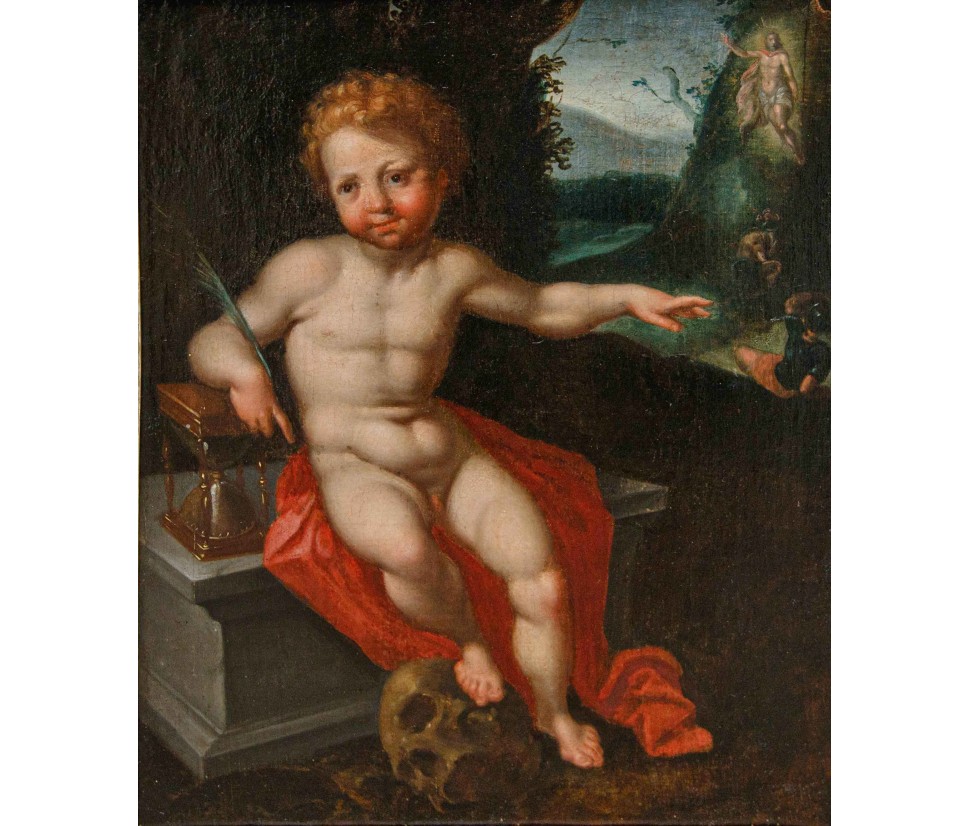
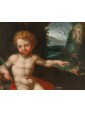
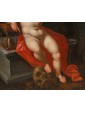
The allegorical painting commonly identified by the title Nascendo Morimur is the work of a Flemish painter active in the first half of the 17th century. The artist is deeply indebted to the figurative tradition developed in Antwerp during the previous century—specifically to the models established by Frans Floris. The work belongs to a line of iconographic and conceptual continuity that reached Northern Baroque sensibilities through the circulation of prototypes and the mediation of Floris's workshop.
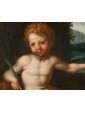
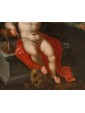
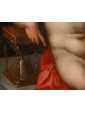
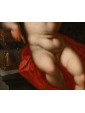
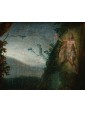
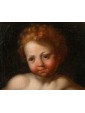
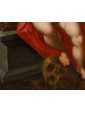
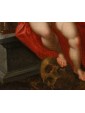
The painting depicts a young nude boy seated on a stone plinth. His body, solid and sculptural, is rendered with meticulous attention to anatomical modeling, while his pose introduces a complex symbolic system: his right foot rests upon a skull, an overt allusion to death, while his right arm leans against an exhausted hourglass, an emblem of elapsed time and the transience of existence. These elements clearly belong to the repertoire of the Vanitas, a central theme of moral reflection between the 16th and 17th centuries. The gesture of his right arm, extending toward the background, invites the viewer to observe the scene behind him, where the Resurrection of Christ is glimpsed—the only possible answer to the human finitude evoked in the foreground.
From an iconographic perspective, the work reimagines a precise model: the Allegory by Frans Floris (currently in a private collection), which was subsequently reformulated by Floris himself or an artist in his circle into a painting also titled Nascendo Morimur, now held in the collections of the National Museum in Stockholm. The meaning of the motto—"we are born to die"—is expanded here through a Christological lens, contrasting physical death with the promise of resurrection. This dialectic between mors (death) and salus (salvation) constitutes the conceptual core of the image.
Frans Floris (born Frans de Vriendt in Antwerp in 1516) was the son of the stonecutter Cornelis I de Vriendt. He initially trained as a sculptor before dedicating himself to painting. After an apprenticeship with Lambert Lombard in Liège, he undertook a decisive journey to Italy, staying in Florence and Rome, where he deeply absorbed the lessons of Italian art. He was particularly influenced by Michelangelo and the Mannerists, notably Giorgio Vasari and Parmigianino. Upon returning to Antwerp, Floris founded an exceptionally large workshop with over a hundred pupils, becoming the primary conduit for Italian models in the Low Countries.
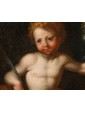
In the specific case of Nascendo Morimur, the link to Parmigianino is particularly striking: the face and torso of the boy reference the infant in the Madonna of the Rose (Staatliche Kunstsammlungen, Dresden), as well as the Christ Child in the Holy Family with Angels (Prado Museum). The work thus stands as a significant example of the persistence and transformation of Frans Floris's legacy in 17th-century Flemish art, demonstrating how his prototypes remained relevant and fruitful long after his death in 1570.
Italy only: with Ars Antiqua it is possible to defer all amounts up to a maximum € 7,500 at ZERO RATE, for a total of 15 INSTALLMENTS.
Unpardoned. Vault. € 4,500 = Monthly instalment € 300 for 15 months.
Unpardoned. Vault. € 3,600 = Monthly instalment € 720 for 5 months.
For amounts greater than €7,500 or for a longer period of time (over 15 installments), we can provide a personalized payment.
Contact us directly to get the best quote.
LIVE TV
– SUNDAY 17.00 – 21.00 Dig.terr. 126 - Sky 824
– Streaming on our site www.arsantiquasrl.com and on our social networks Facebook and Youtube
All the works proposed by Ars Antiqua are sold accompanied by a certificate of authenticity in accordance with the law and an accurate in-depth sheet.
It is possible to see the works directly at the showroom gallery in Milan, in via Pisacane 55 and 57.
We personally organize transport and deliveries of the works, both for Italy and abroad.
