


Landscape with Shepherd
Oil on canvas, 61 x 97.5 cm
With frame: 78 x 114 cm
Flemish Painter, late 17th Century
Landscape with Shepherd
Oil on canvas, 61 x 97.5 cm
With frame: 78 x 114 cm
Flemish Painter, late 17th Century
Flemish Painter, late 17th Century
Landscape with Shepherd and Waterfall
Oil on canvas, 61 x 97.5 cm
With frame: 78 x 114 cm
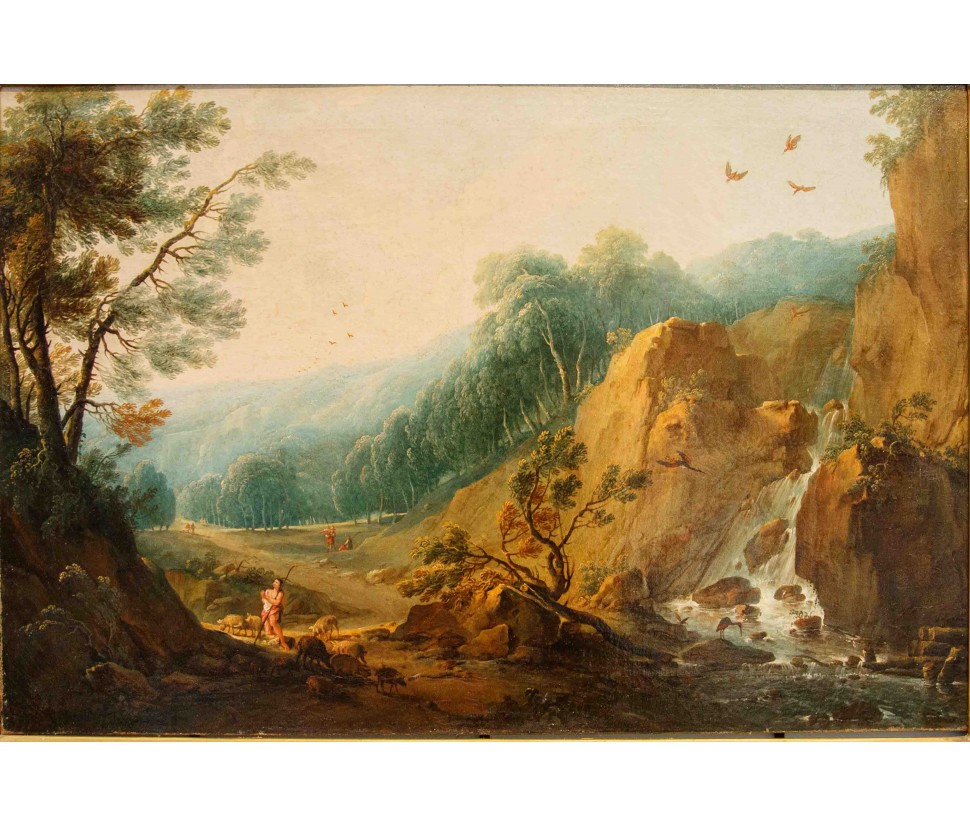
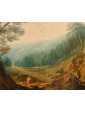
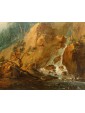
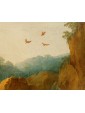
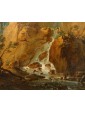
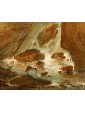
The painting depicts a vast natural landscape conceived as the true protagonist of the composition, reflecting a sensitivity typical of the Romanized Flemish tradition between the late 17th and early 18th centuries. The viewer's eye is guided through a spatial construction articulated in depth, organized according to the principle of "natural wings": on the left, a dark and compact arboreal mass serves as a closing element, while on the right, an imposing rock formation—animated by a waterfall and a stream—creates a scenographic counterpoint that frames the central opening of the small valley. This compositional structure, clearly derived from the models developed by Paul Bril and his workshop, organizes nature in a harmonious and legible manner.
The landscape is divided into two main registers: the mountainous and rocky terrain on the right, dominated by the waterfall, and the softer, wooded area on the left, with broad green zones receding toward the background. The waterfall is not rendered as a precise transcription of nature, but rather as a scenographic effect—a recurring motif in Northern Italianate landscapes, often inspired by ideal views of Central Italy.
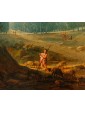
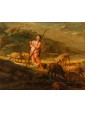
Within this expansive natural frame, a small figure of a shepherd is placed in an apparently marginal but semantically central position. The man, intent on grazing his livestock, is depicted kneeling in prayer, turning toward a source of light not directly visible to the viewer. The scene does not recount a specific episode, nor does it refer to an identifiable saint or a recognizable biblical character. On the contrary, the shepherd takes on the value of a "universal man"—an homo rusticus embodying a spontaneous and natural piety.
In this context, the prayer serves a symbolic rather than a narrative function: it does not describe an event, but suggests an inner state. This iconographic choice allows for a plurality of interpretations:
From a Christian perspective, the kneeling figure alludes to the presence of the divine within creation.
On a moral level, the shepherd's silent gesture evokes values of humility and contemplation, devoid of rhetoric.
Fom a philosophical viewpoint, the image suggests a cosmic harmony—a balance between man and the natural world.
Due to these characteristics, the work fits coherently into the genre of Flemish Italianate landscape of the late 17th and early 18th centuries, likely the work of a late follower of 17th-century models. Such paintings were highly prized by private collectors and were ideally suited for studioli, cabinets, or spaces dedicated to meditation, where the landscape was not merely observed but contemplated as a mental space of silence, order, and reflection.
Italy only: with Ars Antiqua it is possible to defer all amounts up to a maximum € 7,500 at ZERO RATE, for a total of 15 INSTALLMENTS.
Unpardoned. Vault. € 4,500 = Monthly instalment € 300 for 15 months.
Unpardoned. Vault. € 3,600 = Monthly instalment € 720 for 5 months.
For amounts greater than €7,500 or for a longer period of time (over 15 installments), we can provide a personalized payment.
Contact us directly to get the best quote.
LIVE TV
– SUNDAY 17.00 – 21.00 Dig.terr. 126 - Sky 824
– Streaming on our site www.arsantiquasrl.com and on our social networks Facebook and Youtube
All the works proposed by Ars Antiqua are sold accompanied by a certificate of authenticity in accordance with the law and an accurate in-depth sheet.
It is possible to see the works directly at the showroom gallery in Milan, in via Pisacane 55 and 57.
We personally organize transport and deliveries of the works, both for Italy and abroad.
