


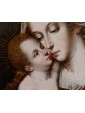
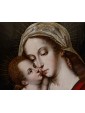

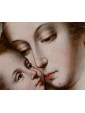
Madonna with Child
Oil on panel, 92 x 72 cm
With frame, 136 x 115 cm
16th century, Bruges School
Madonna with Child
Oil on panel, 92 x 72 cm
With frame, 136 x 115 cm
16th century, Bruges School
16th century, Bruges School
Madonna with Child
Oil on panel, 92 x 72 cm
With frame, 136 x 115 cm
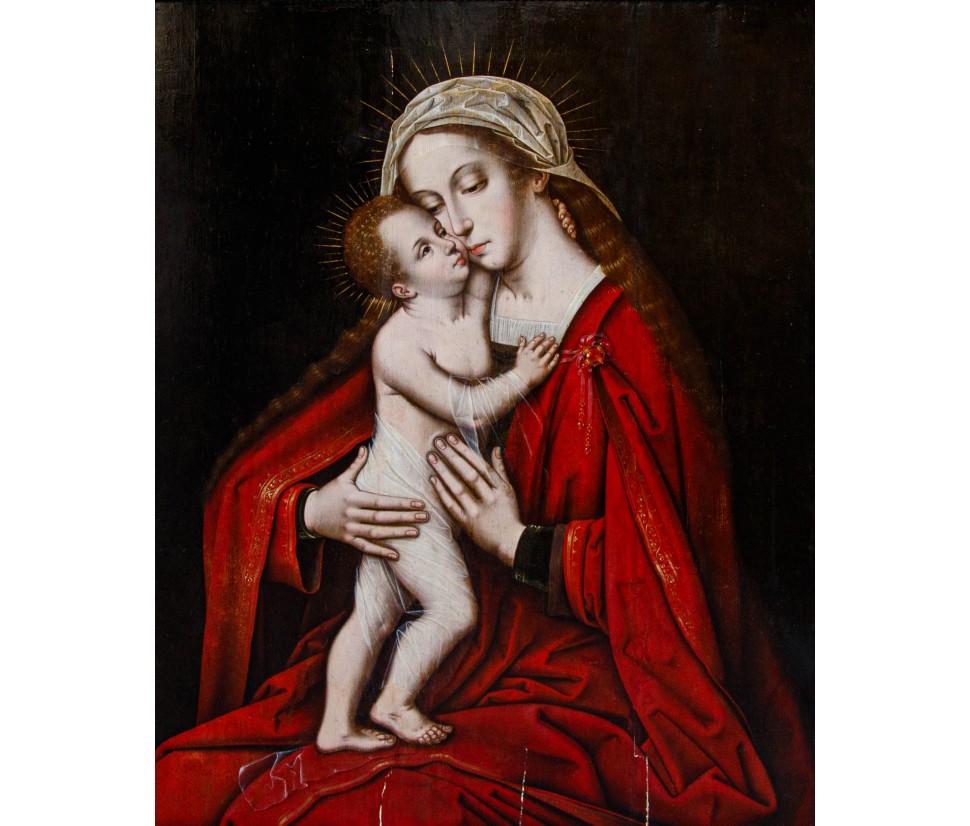
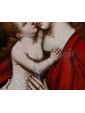
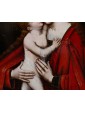
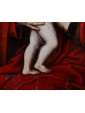
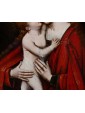
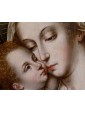
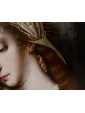
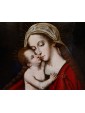
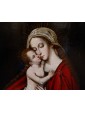
In this painting, the Virgin, depicted with an aura of mystical serenity, invites us to an intimate dialogue between faith and art. Sitting on a throne, she holds the Child close in a tender embrace. Their faces, with delicate features, express a deep maternal bond. The golden light enveloping the pair creates an atmosphere of warm intimacy, in contrast with the dark background.
The work shows a strong affinity with the style of Roger van der Weyden, known for his ability to convey human feelings with great intensity. However, the triangular composition and the use of colour, with a predominance of warm tones, highlight the influence of the Italian Renaissance. This synthesis between North and South is typical of the work of Ambrosius Benson. A Lombardy native, the artist paints with unprecedented freshness and liveliness. The style of this panel also bears similarities to a painting from the Veruela Monastery, now in the collections of the Zaragoza Museum. The first versions were in fact mistakenly attributed to Van der Weyden
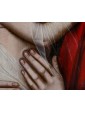
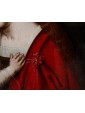
A leading figure among the Flemish Masters of the 16th century, Benson was able to harmoniously combine the rich tradition of Northern Europe with innovative Italian trends. Trained at the Bruges School, he inherited the elegance and refinement of the Flemish Primitives, in particular of Van Eyck and Van der Weyden. However, also his Lombard origins are manifest in his paintings, bringing a brightness and a more dynamic composition, typical of the Italian Renaissance. The triangular composition and the skillful use of colour, with the warm brown tones contrasting with the delicate skin tones, are a clear example of such stylistic synthesis.
Despite an initial period of tension with Flemish master Gerard David, which in 1519 led him to embark on an independent path, Benson quickly managed to establish himself on the Bruges artistic scene. His career took off, so much so that between 1522 and 1530 he had to rent more stalls at the annual fair to meet the growing demand for his works. Soon, he became a leading figure in the painters’ guild, leading a thriving workshop and training many apprentices, including his own children. Although he signed few works, the production of his workshop, intended mainly for the Spanish market, attests to his great fame and success.
Together with Isenbrandt and Provost, Benson represented a generation of painters who, although rooted in the Flemish tradition, knew how to look to the future, incorporating the innovative trends of the Italian Renaissance into their artistic language. This openness towards new inspirations manifests itself in a greater monumentality of the figures and in more dynamic compositions. However, the themes and subjects remain typically Flemish, testifying to a profound knowledge of the local tradition. The variety of his production is also the result of a lively workshop activity, where different artistic sensibilities met and merged.
This painting was produced by Benson’s workshop. Based on scientific analyses of the pigments, it can be dated between the 15th and 16th centuries. The Groeningemuseum in Bruges holds at least two versions of this painting, one from 1600
For Italy only: with Ars Antiqua it is possible to defer all amounts up to a maximum € 7,500 at ZERO RATE, for a total of 15 INSTALLMENTS.
Unpardoned. Vault. € 4,500 = Monthly instalment € 300 for 15 months.
Unpardoned. Vault. € 3,600 = Monthly instalment € 720 for 5 months.
For amounts greater than €7,500 or for a longer period of time (over 15 installments), we can provide a personalized payment.
Contact us directly to get the best quote.
LIVE TV
– SUNDAY 17.00 – 21.00 Dig.terr. 126 - Sky 824
– Streaming on our site www.arsantiquasrl.com and on our social networks Facebook and Youtube
All the works proposed by Ars Antiqua are sold accompanied by a certificate of authenticity in accordance with the law and an accurate in-depth sheet.
It is possible to see the works directly at the showroom gallery in Milan, in via Pisacane 55 and 57.
We personally organize transport and deliveries of the works, both for Italy and abroad.
