


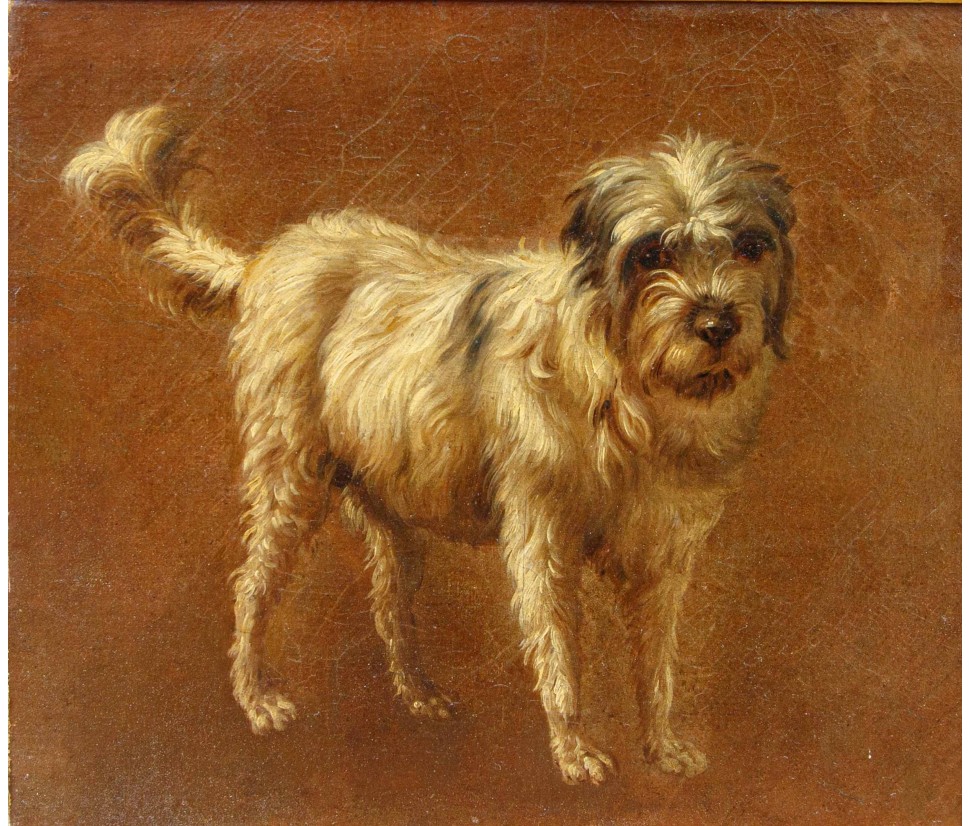
Portrait of a Small Dog
Oil on canvas, 30 x 40 cm
Framed, 45 x 49 cm
Francesco Londonio (Milan, 1723 – 1783)
Portrait of a Small Dog
Oil on canvas, 30 x 40 cm
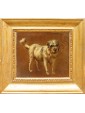
Framed, 45 x 49 cm
Francesco Londonio (Milan, 1723 – 1783)
Francesco Londonio (Milan, 1723 – 1783)
Portrait of a Small Dog
Oil on canvas, 30 x 40 cm
Framed, 45 x 49 cm
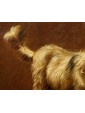
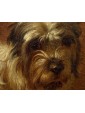
Francesco Londonio, born in Milan in 1723, was a prominent figure in the 18th-century Lombard artistic landscape, distinguished by his mastery in depicting pastoral scenes, landscapes, and, most notably, animals. His art, which fused naturalistic observation with Rococo taste and a Pre-Romantic sensibility, offers a fascinating insight into rural life and the culture of his time. Londonio’s artistic training was diverse and cosmopolitan. While sources do not always agree on the details of his early career—though he likely attended the workshop of the painter Ferdinando Porta in Milan—it is known that he spent a period in Rome during his youth. There, he studied the great masters of landscape painting and deepened his knowledge of classical art; this experience was fundamental to his stylistic development, enriching his work with new compositional and perspectival elements. During his formative years, he also stayed in Parma, where the works of Correggio left a profound impression, irreversibly shaping his visual vocabulary. In his youth, the artist also studied engraving alongside the acclaimed Lombard master Benigno Bossi, achieving significant results in this medium as well. Londonio’s first definitive work is a life drawing, A Bull and a Resting Cow, dated 1753 and held in the Biblioteca Ambrosiana in Milan. His first signed painting, Cattle Market, dates to 1756 and is currently in a private Milanese collection. Londonio focused primarily on animal painting and rural scenes, frequently depicting shepherds and livestock. What most distinguishes the Milanese painter’s output is his extraordinary ability to portray animals. Goats, sheep, cows, and donkeys, as well as dogs and birds, come to life on his canvases with surprising verisimilitude and vivacity. His style is characterized by a refined approach to pastoral subjects, drawing inspiration from the art of Giovan Battista Castiglione (known as Il Grechetto) and the Flemish masters active in Italy between the 17th and 18th centuries, including Philipp Peter Roos, primarily known as Rosa da Tivoli. Londonio did not limit himself to mere reproduction; he succeeded in capturing the essence and character of each species, often placing them in rural contexts that enhanced their presence. His pastoral scenes, frequently animated by shepherds, peasants, and travelers, reflect an idealized Arcadia that remains firmly anchored in the profound observation of the Lombard countryside. Many of his etchings reproduce animal studies or genre scenes, demonstrating his continuous research and attention to detail. Although primarily renowned for his animalier painting, Londonio also produced several still lifes and portraits of prominent figures in contemporary Lombardy. His work gained significant recognition, and he was appointed stage designer for the newly established Teatro alla Scala in Milan by Empress Maria Theresa of Austria, likely due to his celebrated work on the nativity scene (presepe) in the Church of San Marco. Londonio died in Milan on December 26, 1783, and was buried in his parish of Santa Eufemia. A series of his etchings featuring animal studies was published posthumously by Prince Alberico Barbiano di Belgioioso d'Este, ensuring his extraordinary critical and visual legacy in the period following his death. Although he did not lead a formal school, he had numerous imitators and followers, which occasionally leads to challenges in attribution. Londonio left a significant artistic legacy in Milan. Today, his works are preserved in major museums and private collections, particularly in Lombardy, where they remain a precious testament to 18th-century taste and culture. This painting, which aligns closely with Francesco Londonio’s production through its iconographic and stylistic characteristics, depicts a dog with long, wiry, light-colored fur and darker, almost black markings that create a variegated effect, particularly on the head and back. The dog is shown in full figure, in an upright and slightly frontal pose, with its gaze directed toward the viewer, suggesting an alert and lively expression. Its tail is high and bushy, curled over its back. The fur is rendered with great attention to detail, highlighting its voluminous and shaggy texture, typical of a terrier breed or a crossbreed with similar traits. The background is a uniform, dark, deep brown that emphasizes the dog’s light-colored figure. This type of neutral background is common in Londonio's work, as it allows focus to remain on the animal, the true protagonist of the scene. The lighting originates from the left, creating soft shadows and highlighting the three-dimensionality of the subject. The brushwork, while detailed in the rendering of the fur, retains a certain freedom typical of the 18th century and of Londonio’s manner, which favored a naturalistic rather than pedantic depiction of animals. Through its attention to zoological detail and its simple yet effective composition, the work aligns perfectly with the style and themes favored by Francesco Londonio, celebrated for his ability to capture the very essence and vitality of animals.
For Italy only: with Ars Antiqua it is possible to defer all amounts up to a maximum € 7,500 at ZERO RATE, for a total of 15 INSTALLMENTS.
Unpardoned. Vault. € 4,500 = Monthly instalment € 300 for 15 months.
Unpardoned. Vault. € 3,600 = Monthly instalment € 720 for 5 months.
For amounts greater than €7,500 or for a longer period of time (over 15 installments), we can provide a personalized payment.
Contact us directly to get the best quote.
LIVE TV
– SUNDAY 17.00 – 21.00 Dig.terr. 126 - Sky 824
– Streaming on our site www.arsantiquasrl.com and on our social networks Facebook and Youtube
All the works proposed by Ars Antiqua are sold accompanied by a certificate of authenticity in accordance with the law and an accurate in-depth sheet.
It is possible to see the works directly at the showroom gallery in Milan, in via Pisacane 55 and 57.
We personally organize transport and deliveries of the works, both for Italy and abroad.
