Bastiano da Sangallo, known as Aristotile (Florence, 1481–1551) (Also identified as the Master of the Scandicci Lamentation)
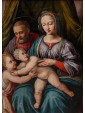
Holy Family with the Infant Saint John the Baptist
Oil on panel, 70 x 101 cm
Framed: 122 x 92 cm
Critical analysis by Prof. Alessandro Delpriori
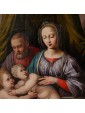
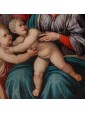
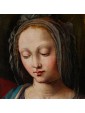
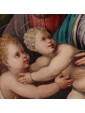
Set within an interior where spatial coordinates are defined solely by the drapery of a canopy, the Virgin holds the Christ Child in her lap; the young Saint John the Baptist is depicted embracing Christ while directing his gaze toward Mary.
This panel, a notable testament to Florentine artistic culture of the early sixteenth century (Cinquecento), benefits from a new attributional study conducted by Prof. Delpriori. In this study, for the first time, the Master of the Scandicci Lamentation is identified as Bastiano da Sangallo, known as Aristotile (Florence, 1481–1551), the Italian architect, scenographer, and painter.
Prior to this significant insight, this corpus of stylistically coherent works had been associated with an anonymous master active in Florence during the early 1500s, closely linked to Francesco Granacci and Ridolfo del Ghirlandaio. This hypothesis was first proposed in 1968 by Everett Fahy, who dubbed the artist the "Master of the Scandicci Lamentation." The name derived from a pivotal work in his oeuvre: a panel depicting the Lamentation over the Dead Christ executed for the church of San Bartolomeo in Tuto in Scandicci (Florence), the composition of which is partially derived from Pietro Perugino’s celebrated Lamentation now in the Galleria Palatina, Florence.
A nephew of the brothers Giuliano and Antonio da Sangallo, Bastiano was nicknamed "Aristotile" due to his serious demeanor. A scenographer and painter, he was a pupil of Perugino and later of Michelangelo. He worked in Rome alongside his brother Giovan Francesco, and from 1515 he was active in Florence, where he collaborated with Andrea del Sarto on the staging of Machiavelli’s The Mandrake. Bastiano da Sangallo’s work provided a fundamental contribution to the Renaissance rediscovery of classical theater through his scenographic innovations. As an architect, he oversaw several major projects, most notably the Rocca Paolina in Perugia (1543–1545), the Rocca of Civita Castellana (alongside his cousin Antonio da Sangallo the Younger), and the construction of Palazzo Pandolfini in Florence based on Raphael’s designs.
During the first decade of the sixteenth century, Aristotile da Sangallo—or the Master of the Scandicci Lamentation—came under the influence of Domenico Ghirlandaio’s followers, most notably his son, Ridolfo. In reality, the group of works ascribed to this Master reflects a diverse range of influences, from Raphael to the early works of Andrea del Sarto, revealing a dynamic personality deeply engaged with the various currents of Florentine painting until approximately 1515. The painting in question finds clear stylistic parallels not only with the Budapest panel but also with the tondo of the same subject in the Hermitage, St. Petersburg, and the Madonna and Child in the Museum of Fine Arts, Boston.
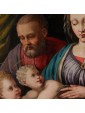
While the painter does not renounce the formal delicacy of the late Quattrocento, he demonstrates an awareness of the new relationship between figure and space introduced to Florence by Michelangelo’s celebrated Pitti and Doni tondos (as evidenced in the Hermitage panel). Furthermore, in other works, he adopts the spatial depth characteristic of Raphael’s early Madonnas—a model from which he also draws the perceptive portrait-like quality informing the figures in the present panel. The ovals of the three faces are here marked by a poignant line of shadow, suggesting a somber premonition of the Passion.