


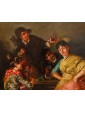


Tavern Scene
Oil on canvas, 155 x 120 cm
With frame, 166 x 133 cm
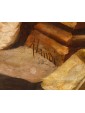
Signed and dated 1888 lower right
Cristòfor Alandi (Tarragona, 1856 – Barcelona, 1896)
Tavern Scene
Oil on canvas, 155 x 120 cm
With frame, 166 x 133 cm
Signed and dated 1888 lower right
Cristòfor Alandi (Tarragona, 1856 – Barcelona, 1896)
Cristòfor Alandi (Tarragona, 1856 – Barcelona, 1896)
Tavern Scene
Oil on canvas, 155 x 120 cm
With frame, 166 x 133 cm
Signed and dated 1888 lower right
The painting under examination stands as a living testament to 19th-century Spain, a century of profound political and social transformations and upheavals that were also reflected in artistic production, particularly in painting. The Spanish artists of this period had to reconcile traditional pictorial styles with new influences from Europe, giving rise to great experimentation. Specifically, Realism found fertile ground in the second half of the century, when artists began to focus more on the precise depiction of daily reality and its protagonists (peasants, shepherds, drinkers, gamblers, musicians, etc.), always adopting a critical and attentive eye for detail.
The majestic canvas presented here is the work of one of the main exponents of 19th-century Spanish painting, Cristòfor (or Cristobal) Alandi (Tarragona, 1856 – Barcelona, 1896), as attested by the signature in the lower right. Few biographical details are known about this artist, partly due to his premature death at the age of just forty. We do know that he trained at the Academy of Fine Arts in Barcelona under the guidance of Simò Gomez Polo, a Realist painter and engraver who had worked closely with the French artists Alexandre Cabanel and Tony Robert-Fleury, and who was deeply inspired by the masterpieces of Édouard Manet and Eugène Delacroix. At the age of eighteen, during a trip to Rome, Alandi had the opportunity to see and learn about the works of the master Marià Fortuny i Marsal (Reus, 1838 – Rome, 1874). Fortuny was the son-in-law of the director of the Prado Museum and an undisputed model for many Spanish artists of the second half of the 19th century. His art was characterized by lively, pragmatic scenes of everyday life (as the critic Théophile Gautier stated, "As an etcher, Fortuny equals Goya and approaches Rembrandt").
Alandi repeatedly adopted the master's models, so much so that in 1879 he sent a copy of The Battle of Tetuan and one of The Battle of Wad-Ras to Barcelona, which demonstrated his great technical skill. After returning to Spain and studying at the San Fernando Higher Academy of Painting in Madrid, his fame began to spread widely, thanks also to his frequent participation in international Salons that made him known to the general public: at the National Exhibition of Fine Arts in 1884 he presented the painting The Catalan Shepherdess; he subsequently participated in group exhibitions at Sala Parés in 1892 and May 1893; he exhibited at the Paris Salon in 1893; he participated in the Barcelona Exhibition of Fine Arts in 1894; in 1898, two years after his death, his work Dél el Tono (Giving the Tone) was published in the Album dei Salón.
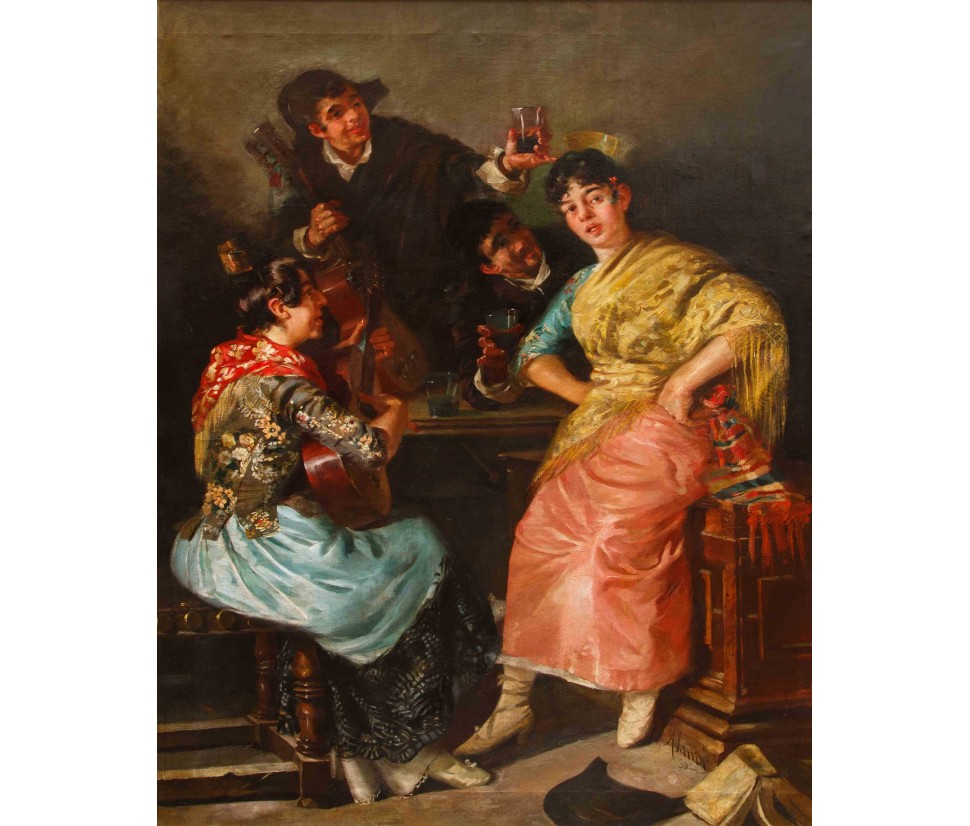
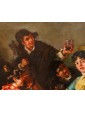
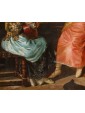
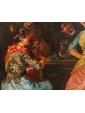
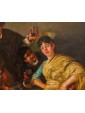
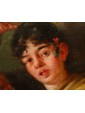
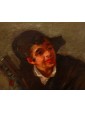
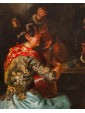
The canvas examined here, painted by Alandi in 1888 at the age of thirty-two, shows a Tavern Scene with two women in the foreground—one seated with her back to the viewer, playing a guitar, and the other facing the viewer with a fixed gaze—and two men in the background, one also with a musical instrument in hand, captivated by the women as they brandish their glasses of wine. Among the pioneers of Realist painting in Spain, Alandi distinguishes himself here with an extraordinary ability to capture the essence and expressiveness of his subjects through well-calibrated gazes and poses. The brushwork is rich, vibrant, and free, with an absolute ability to render the pictorial matter, but also intense and fluid, capable of simulating lively dynamism. The contrast between light and shadow becomes a key element for understanding the painting: the artist uses light to model forms and create a sense of depth and three-dimensionality, which is further accentuated by his color choices. From a dark, shadowy background dominated by earthy and brownish tones, the two women emerge in all their power, directly struck by a beam of light, their features recalling typical Hispanic traits. The two wonderful traditional Catalan dresses, a strong symbol of cultural identity, certainly do not go unnoticed, and Alandi concentrates all his attention on them: a colorful kaleidoscope of different fabrics, embroidery, lace, and trims that have become iconic in Iberian folklore. His portraits, therefore, are not simple physical representations, but true cultural and social investigations.
With Ars Antiqua it is possible to defer all amounts up to a maximum € 7,500 at ZERO RATE, for a total of 15 INSTALLMENTS.
Unpardoned. Vault. € 4,500 = Monthly instalment € 300 for 15 months.
Unpardoned. Vault. € 3,600 = Monthly instalment € 720 for 5 months.
For amounts greater than €7,500 or for a longer period of time (over 15 installments), we can provide a personalized payment.
Contact us directly to get the best quote.
LIVE TV
– SUNDAY 17.00 – 21.00 Dig.terr. 126 - Sky 824
– Streaming on our site www.arsantiquasrl.com and on our social networks Facebook and Youtube
All the works proposed by Ars Antiqua are sold accompanied by a certificate of authenticity in accordance with the law and an accurate in-depth sheet.
It is possible to see the works directly at the showroom gallery in Milan, in via Pisacane 55 and 57.
We personally organize transport and deliveries of the works, both for Italy and abroad.
