


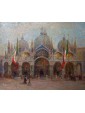
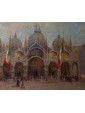
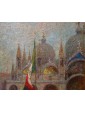
View of St. Mark's Square
Oil on canvas, 69 x 99 cm
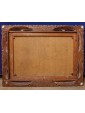
With frame, 92 x 119 cm
Signed lower right “Guarnieri”
Second Half of the 19th Century
View of St. Mark's Square
Oil on canvas, 69 x 99 cm
With frame, 92 x 119 cm
Signed lower right “Guarnieri”
Second Half of the 19th Century
Second Half of the 19th Century
View of St. Mark's Square
Oil on canvas, 69 x 99 cm
With frame, 92 x 119 cm
Signed lower right “Guarnieri”
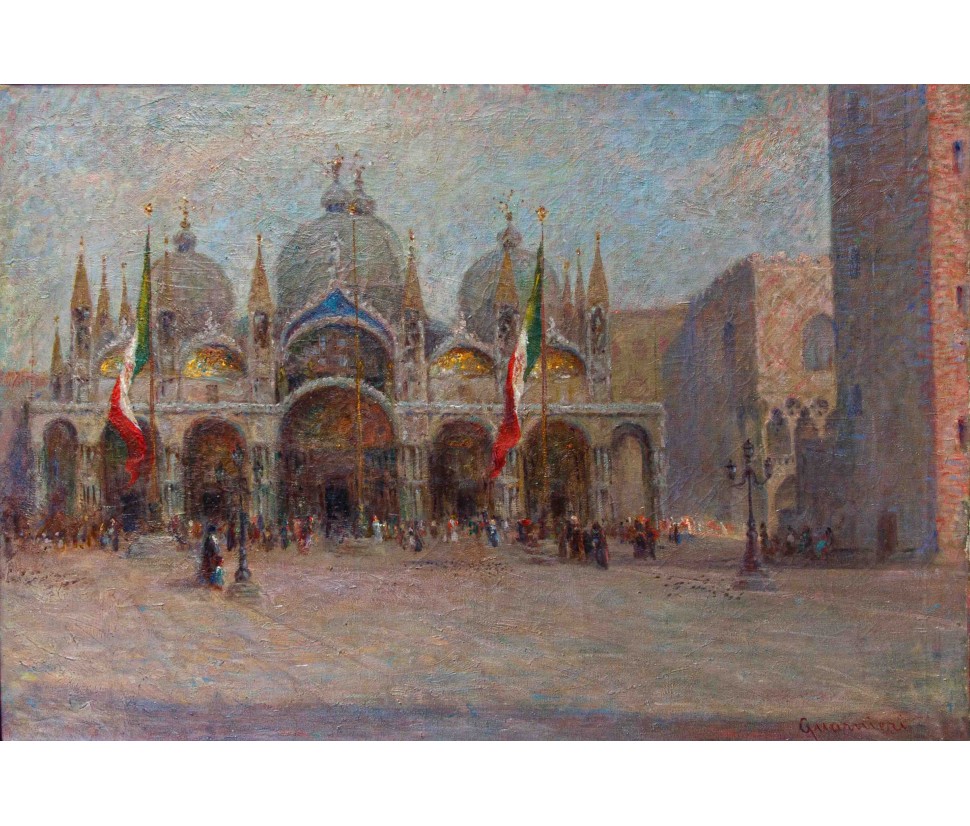
1866 was a crucial year in the history of Venice: the long period of Austrian rule ended, and the city became part of the Kingdom of Italy. From the first months of the year, the expectations of Venetian patriots for the new European political climate grew, as documented by a series of publications that, under a harmless appearance (Austrian censorship remained rigorous), alluded to the upcoming unification with the Kingdom of Italy. After the armistice of Cormons on August 12 and the peace signed in the Treaty of Vienna on October 3, popular joy erupted over the imminent liberation, which had seemed jeopardized after the heavy Italian defeats at Lissa and Custoza.
Finally free from censorship, the Venetian press went wild, flooding the city with a series of publications that addressed and debated the hottest topics of the moment: from the economic and moral damage caused to the city by the long Austrian rule to the abandonment of port activities and maritime trade in favor of Trieste, with the consequent economic and employment crisis; from the stagnation of industrial development due to a lack of public support and adequate infrastructure to the suffocating bureaucracy. Austrian depredations of important parts of the Venetian heritage (paintings, archival documents, manuscripts) were denounced, illustrated in detail by the Swiss consul Victor Ceresole and other Venetian intellectuals, in the hope of a rapid and complete implementation of the clauses of the Treaty of Vienna, which provided for the restitution of the stolen works of art and documents.
Once unification was complete, enthusiasm for the future was manifested in a notable production of projects and proposals presented to the new Italian administration for a grand-style relaunch of the city through the promotion of maritime trade, the containment of duties, the reactivation of the Arsenale, and the development of the railway network. To celebrate the unification, the construction of major works was proposed to Victor Emmanuel, including new bridges over the Grand Canal with a great visual impact—works that were never realized but testify to the intellectual fervor of the moment. The euphoria that spread through the city is evidenced by many celebratory compositions (popular choirs, songs, poems) that compensated for the mediocrity of the poetic level with the display of a vibrant civic passion.
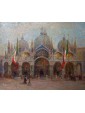
The scene depicted here could be set precisely in 1866: St. Mark's Square appears decorated with a series of Italian flags, meant to celebrate the liberation of Venice from long and painful Austrian rule. This subject is found with relative frequency in Venetian painting of the second half of the nineteenth and early twentieth centuries, as evidenced by the works of Vettore Zanetti, Cipriano Mannucci, and Jean Belliure. The work in question constitutes a very precious document for the reconstruction of a particularly relevant segment of the unitary parabola of the Kingdom of Italy. The painting's technique, which is characterized by quick and undefined brushstrokes, is certainly influenced by the great masters of French Impressionism, whose notions spread in Italy starting from the 1880s.
With Ars Antiqua it is possible to defer all amounts up to a maximum € 7,500 at ZERO RATE, for a total of 15 INSTALLMENTS.
Unpardoned. Vault. € 4,500 = Monthly instalment € 300 for 15 months.
Unpardoned. Vault. € 3,600 = Monthly instalment € 720 for 5 months.
For amounts greater than €7,500 or for a longer period of time (over 15 installments), we can provide a personalized payment.
Contact us directly to get the best quote.
LIVE TV
– SUNDAY 17.00 – 21.00 Dig.terr. 126 - Sky 824
– Streaming on our site www.arsantiquasrl.com and on our social networks Facebook and Youtube
All the works proposed by Ars Antiqua are sold accompanied by a certificate of authenticity in accordance with the law and an accurate in-depth sheet.
It is possible to see the works directly at the showroom gallery in Milan, in via Pisacane 55 and 57.
We personally organize transport and deliveries of the works, both for Italy and abroad.
