


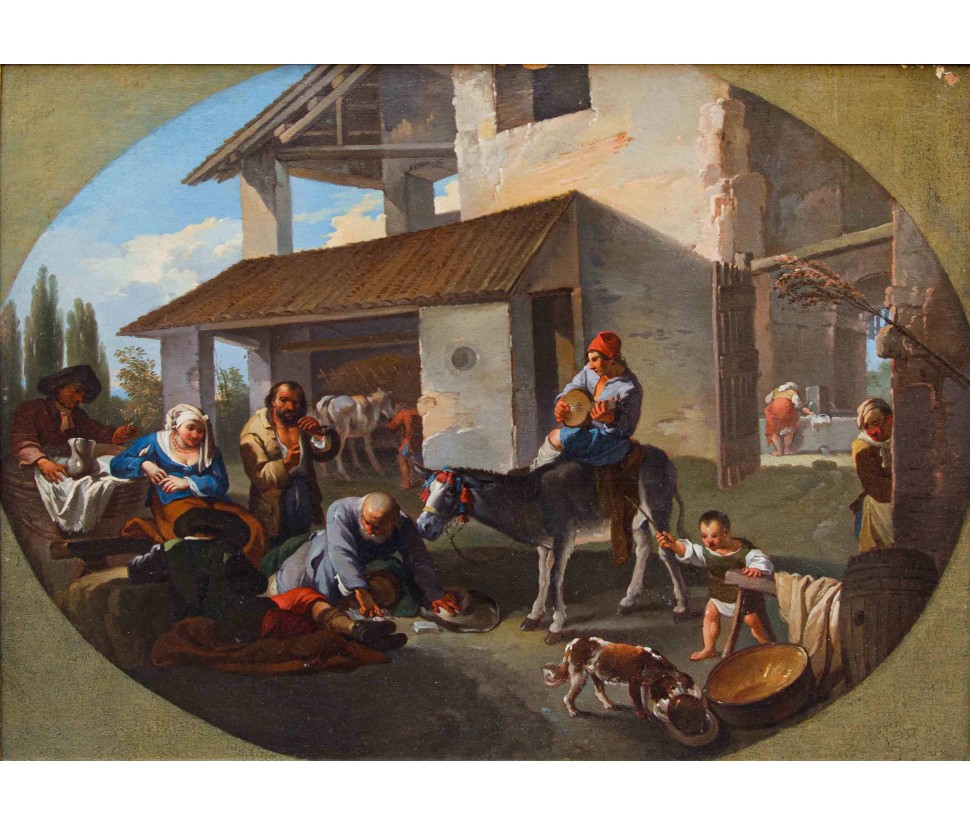
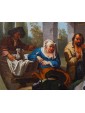
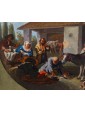
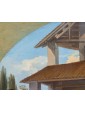
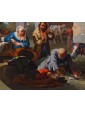
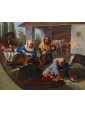
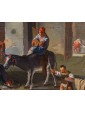
Genre scene
Oil on canvas, 50 x 63 cm
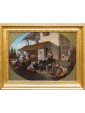
With frame, 65 x 80 cm
Paolo Monaldi (Rome, c. 1704 - post 1779)
Genre scene
Oil on canvas, 50 x 63 cm
With frame, 65 x 80 cm
Paolo Monaldi (Rome, c. 1704 - post 1779)
Paolo Monaldi (Rome, c. 1704 - post 1779)
Genre scene
Oil on canvas, 50 x 63 cm
With frame, 65 x 80 cm
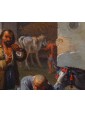
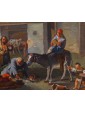
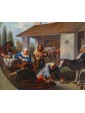
In the lively artistic panorama of eighteenth-century Rome, dominated by big names and far-reaching aesthetic trends, the figure of Paolo Monaldi emerges, a painter whose art offers a precious and fascinating insight into the daily life of the time. His canvases, populated by humble characters and set in recognizable settings of the Roman countryside or the most picturesque corners of the city, give us a vivid and frank image and an extremely precious document for reconstructing the dictates of the world that would otherwise have been swallowed up by oblivion. The biographical information on Paolo Monaldi is, unfortunately, fragmentary and not always detailed. He is known to have been active in Rome in the 18th century, but the precise dates of his birth and death are still a matter of debate among scholars. Even the references with respect to his training appear very limited: it is believed that he trained with Andrea Locatelli but there are no documents to support this thesis, postulated for the first time by Abbot Lanzi. Despite this gap, his artistic production speaks clearly, revealing a painter of notable technical ability and marked observational sensitivity. Monaldi dedicated himself mainly to the genre of genre painting, or "bambocciate", an artistic movement that found great success in Rome starting from the seventeenth century, thanks above all to the influence of the Nordic painters operating in the Eternal City. The so-called "Bamboccianti", due to their apparently crude style and predilection for popular subjects, contrasted themselves with academic historical and religious painting, choosing to represent scenes of common life, markets, taverns, popular festivals, bandits and travellers. Monaldi fits fully into this tradition, but with a personal touch that distinguishes it. What is striking about Monaldi is the ability to capture the essence of his subjects: the figures, although often falling into recurring types – the farmer, the washerwoman, the traveller, the musician – never appear stereotyped. Instead, they are rendered with a verve and vitality that suggests deep knowledge and empathy for ordinary people. Their faces, their gestures, their clothes, often worn but rendered with great attention to detail, tell us silent stories of effort, joy and everyday life. The settings are equally significant. Monaldi prefers open landscapes, often with ancient ruins as a backdrop, or glimpses of city life that evoke the Rome of his time. The light in his canvases is usually clear and diffused, helping to create a serene and at times idyllic atmosphere, even when the subjects are linked to situations of poverty or marginality. It is a light that enhances the earthy colours, the bright reds of the clothes, the greens of the fields, and which gives a sense of authenticity to the scenes. Among the most recurring subjects in his works we find market scenes, with stalls full of fruit and vegetables, and figures intent on bargaining or simply observing. Equally famous are his representations of taverns and taverns, where customers of all kinds meet to drink, eat and socialize, often accompanied by traveling musicians. There is no shortage of scenes of rural life, with shepherds and animals, or moments of rest along the roads leading to Rome. Despite his clear belonging to the bambocciata genre, Monaldi's art also shows a certain compositional elegance and attention to detail that bring him closer to more "academic" painters. His palette is rich and varied, and his brushstroke, while maintaining a typical freshness of the genre, reveals an expert and confident hand. Paolo Monaldi was a painter who was able to observe and describe the world around him with honesty and sensitivity: his works constitute an invaluable heritage for understanding the life, habits and customs of 18th century Rome. They remind us that art is not only a celebration of great events or illustrious figures, but can also be a powerful means of immortalizing the beauty and dignity of everyday life, even that of the humblest people. Among Monaldi's most refined works is the painting depicting the Aquiline Horse, formerly from the Rospigliosi collection, now preserved in the Museum of Rome in Palazzo Braschi, which in addition to the author's initials bears the date 1757. Beyond the numerous paintings with peasant scenes set in the Agro and passed through the Italian and international antiques market, mention should be made of the ovals depicting the Visit to the farm of the Musée des beaux-arts in Bordeaux and the Peasants' Dance of the Musée d'art et d'archéologie by Périgueux. However, the artist's best-known cycle remains the one created between 1766 and 1771 for the suburban villa of Cardinal Flavio Chigi, partly executed in collaboration with Paolo Anesi. Our painting represents an interesting testimony to Monaldi's bambocciante production: in fact, all the distinctive features of the painter's production can be read there. In the canvas, the rough realism, devoid of pietism, of the representation of popular figures and the choice of a serene and reassuring palette, distinctive of the Roman painter's corpus, stand out.
With Ars Antiqua it is possible to defer all amounts up to a maximum € 7,500 at ZERO RATE, for a total of 15 INSTALLMENTS.
Unpardoned. Vault. € 4,500 = Monthly instalment € 300 for 15 months.
Unpardoned. Vault. € 3,600 = Monthly instalment € 720 for 5 months.
For amounts greater than €7,500 or for a longer period of time (over 15 installments), we can provide a personalized payment.
Contact us directly to get the best quote.
LIVE TV
– SUNDAY 17.00 – 21.00 Dig.terr. 126 - Sky 824
– Streaming on our site www.arsantiquasrl.com and on our social networks Facebook and Youtube
All the works proposed by Ars Antiqua are sold accompanied by a certificate of authenticity in accordance with the law and an accurate in-depth sheet.
It is possible to see the works directly at the showroom gallery in Milan, in via Pisacane 55 and 57.
We personally organize transport and deliveries of the works, both for Italy and abroad.
