


Venus and Cupid spied on by a satyr
Oil on panel, 24 x 32 cm
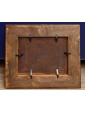
With frame, 41 x 49 cm
Workshop of Lambert Sustris (1515-1520 –circa 1584)
Venus and Cupid spied on by a satyr
Oil on panel, 24 x 32 cm
With frame, 41 x 49 cm
Workshop of Lambert Sustris (1515-1520 –circa 1584)
Workshop of Lambert Sustris (1515-1520 –circa 1584)
Venus and Cupid spied on by a satyr
Oil on panel, 24 x 32 cm
With frame, 41 x 49 cm
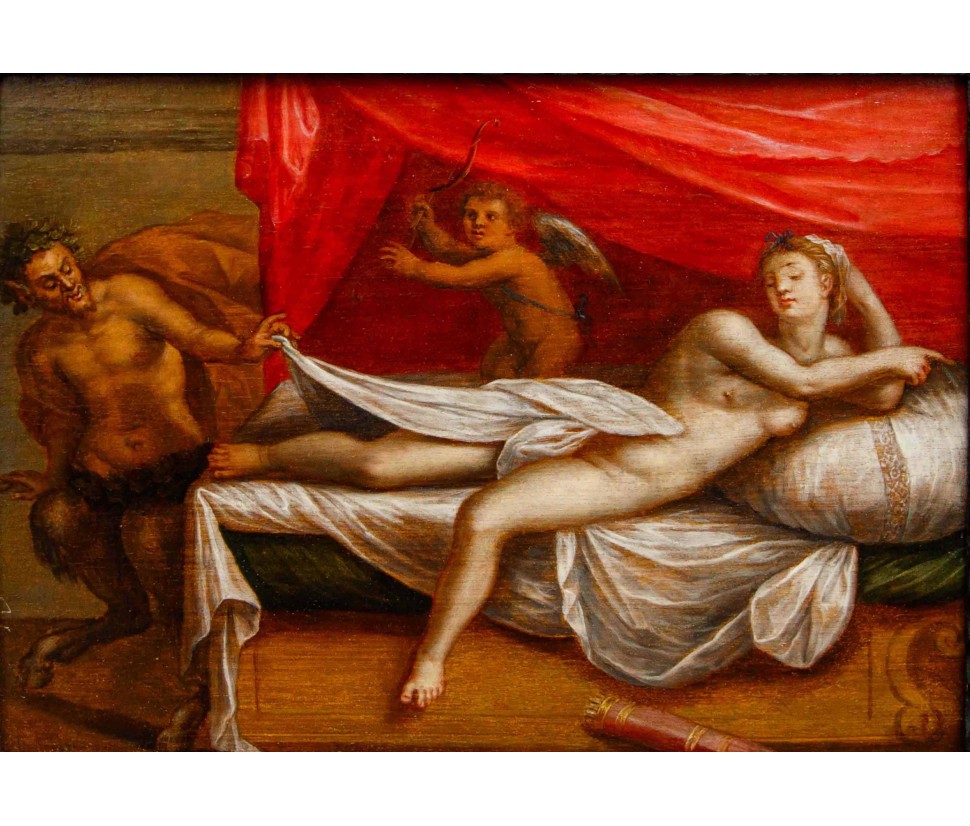
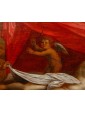
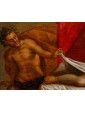
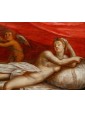
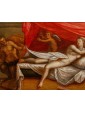
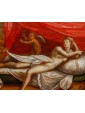
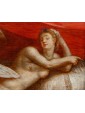
The tablet described here, attributable to the workshop of Lambert Sustris, portrays a subject of a mythological nature very dear to private clients of the 16th century, as the works created by contemporary artists for the collections and residences of noble and rich families both Italian and foreign. The protagonist figure is that of Venus, accompanied by her little son Cupid, both referable to the erotic and sensual universe, almost completely naked on a bed where they had dozed off; a satyr intervenes to disturb their sleep, perhaps the god Pan himself, who discreetly looks out beyond the red curtain and begins to pull the white sheet that covers the intimacy of the goddess. The atmosphere could be interpreted as a mythological representation of the pleasures of carnal love, although some parts of the work leave room for further reflection: the satyr's earthly and irrational desire seems to screen Cupid's action, thrown towards the Silenus to prevent him from pulling the curtain and the sheet further; furthermore, the god's love arrows are far away, resting next to the bed, and the goddess herself turns her gaze away from the unwanted visitor. This contrast between desire and modesty is one of the recurring themes among "chamber" paintings, intended for the strictly private environments of stately homes and often characterized by themes of erotic content, for the pleasure of the owner of the house. The painting highlights several mannerist characteristics: the elongated figures and complex poses, the attention to the human form, often idealized and sensual, bright and contrasting colors (the red of the canopy, the white of the sheet and the dark tones of the Satyr create a strong visual impact), dynamism and theatricality (the interaction between the figures and the surprise of the Satyr give the scene a sense of movement and drama).
Lambert Sustris (Amsterdam, circa 1515-1520 – Padua?, circa 1584) was a Dutch painter, father of Friedrich Sustris. He trained in Utrecht or Haarlem in the environment of Jan van Scorel or Maarten van Heemskerck. At a young age he visited Rome, as is confirmed by the discovery of his signature in the Domus Aurea, and Venice, where he entered Titian's atelier. As a member of the famous painter's entourage, he participated in the Diet of Augsburg in 1548 and 1550, where he returned in 1542 and had the opportunity to portray numerous Swabian nobles, such as those of the Vohlin family. Starting from 1543 he painted the cycle of frescoes in the Villa dei Vescovi in Luvigliano di Torreglia. Between 1548 and 1553 he went to Augsburg several times; The numerous portraits painted for nobles and clergy date back to this period. In the sixties he settled in Padua, where he probably died in an unspecified year after 1568.
His particular fusion between Dutch and Italian styles was a decisive model for the development of the ideal landscapes of the 17th century.
With Ars Antiqua it is possible to defer all amounts up to a maximum € 7,500 at ZERO RATE, for a total of 15 INSTALLMENTS.
Unpardoned. Vault. € 4,500 = Monthly instalment € 300 for 15 months.
Unpardoned. Vault. € 3,600 = Monthly instalment € 720 for 5 months.
For amounts greater than €7,500 or for a longer period of time (over 15 installments), we can provide a personalized payment.
Contact us directly to get the best quote.
LIVE TV
– SUNDAY 17.00 – 21.00 Dig.terr. 126 - Sky 824
– Streaming on our site www.arsantiquasrl.com and on our social networks Facebook and Youtube
All the works proposed by Ars Antiqua are sold accompanied by a certificate of authenticity in accordance with the law and an accurate in-depth sheet.
It is possible to see the works directly at the showroom gallery in Milan, in via Pisacane 55 and 57.
We personally organize transport and deliveries of the works, both for Italy and abroad.
