


Nativity
Oil on panel, 89 x 59 cm
With frame, 99 x 69 cm
Circle of Rodrigo de Osona the Elder (Valencia, 1440 – 1518)
Nativity
Oil on panel, 89 x 59 cm
With frame, 99 x 69 cm
Circle of Rodrigo de Osona the Elder (Valencia, 1440 – 1518)
Circle of Rodrigo de Osona the Elder (Valencia, 1440 – 1518)
Nativity
Oil on panel, 89 x 59 cm
With frame, 99 x 69 cm
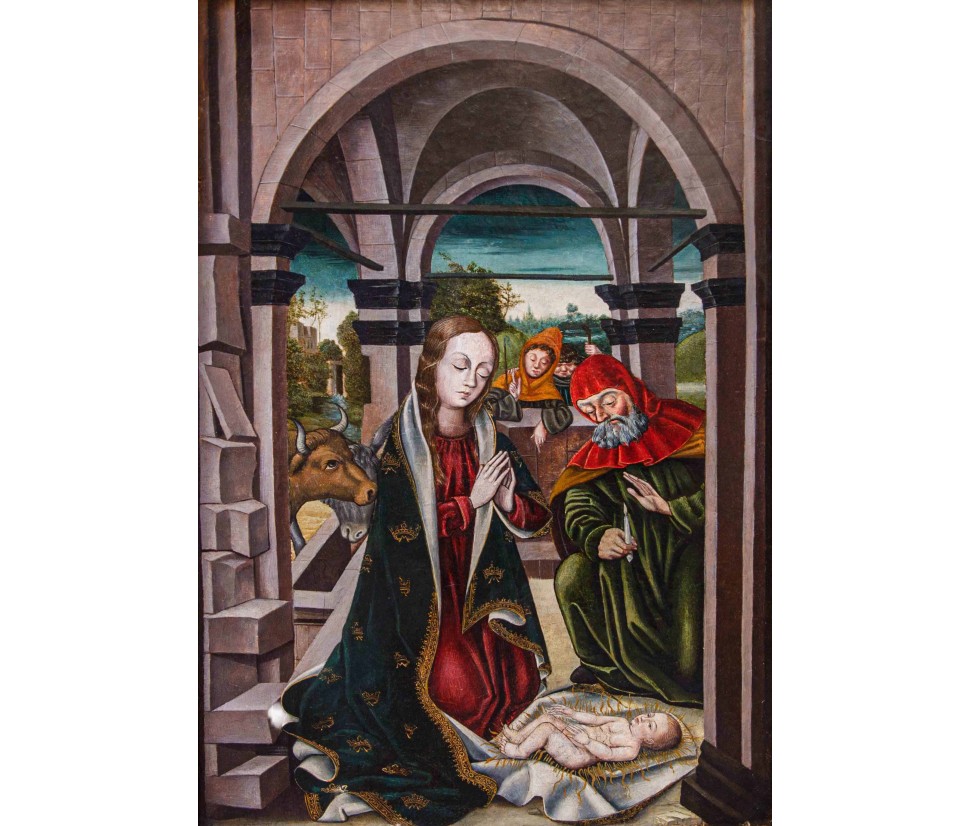
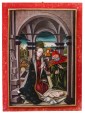
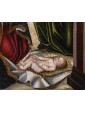
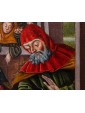
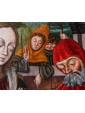
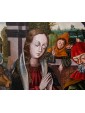
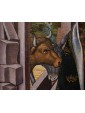
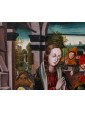
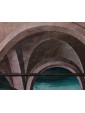
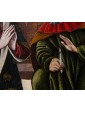
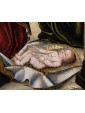
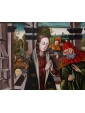
In a suggestive setting, protected by an imposing Renaissance loggia of clear Italian inspiration which opens onto a green landscape, the Virgin Mary and Saint Joseph kneel in prayer in front of the Child lying on the ground. Behind them, two shepherds observe the scene: one of them points out the Child to his companion, while a donkey and an ox watch from the left arch. The presence of Saint Joseph holding a lit candle alludes to the visions of Saint Bridget of Sweden, according to which the divine light emanating from the Child tried to extinguish the candle's flame. With the exception of the Virgin and Child, depicted with exquisite elegance and delicacy, the other figures present more marked and realistic features, in line with their social condition. This approach reflects the Nordic influences prevalent in Valencian workshops at the end of the 15th century, also evident in the way the heavy drapery with its broken folds is treated. The panel in question, in fact, can be referred to the circle of the Valencian painter Rodrigo de Osona the Elder (Valencia, 1440 – 1518), active in the Spanish city between 1464 and, presumably, 1518. Considered among the most important supporters of the Renaissance in Spain, his name is often associated and confused with that of his son Francesco de Osona (Valencia, 1465 – 1514), who died before him, with whom he worked closely in his workshop (therefore the works are often attributed to both). His artistic training, in particular the acquisition of Flemish models, most likely took place in his hometown itself, given the presence of a renowned family of painters from Bruges: Louis Alincbrot, founder of this family, was active in Valencia from 1439 until his death, which occurred between 1460 and 1463.He was succeeded by his son Jordi Alincbrot, also trained in Bruges, documented in Valencia between 1463 and 1481. During the years in which Rodrigo de Osona had to complete his apprenticeship, the famous Spanish painter Bartolomé Bermejo settled in the city, particularly influencing his pictorial style. Their collaboration is attested in 1485, when Bermejo returned to Valencia after his Aragonese period. On that occasion, the Osona laboratory took care of the two side panels and the grisaille of the reverses of the Triptych of the Virgin of Montserrat in the cathedral of Acqui Terme, in the province of Alessandria.
In addition to Flemish influence, Rodrigo de Osona was also permeated by the models of Italian Renaissance painters who had settled in Valencia since 1472, such as Paolo de San Leocadio known as Paolo da Reggio and Francesco Pagano. Proof of this is the early integration of Renaissance decorative elements into his works, as visible in the clear example of the predella of the Altarpiece of the Crucifixion, created in 1476 for the church of San Nicola in Valencia. Rodrigo de Osona was among the first to be fascinated by the innovations of the Italian Renaissance style, expertly combined with the realism of Flemish art, which was widespread in the Iberian peninsula at the time. His paintings reveal a predilection for representations that emphasize devotion, manifested through aspects of kindness and sweetness, rather than adhering to a perception of reality marked by rigor and sobriety. Nonetheless, meticulous care emerges in defining the natural and architectural backgrounds, highlighting a superb mastery in the use of oil painting.A comparison with The Nativity or The Adoration of the Child by Rodrigo and his son Francisco, preserved in the Prado Museum in Madrid, supports the attribution of this panel to a member of the painter's circle, who had had the opportunity to directly see the innovations adopted by the master in his works.
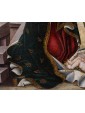
Another interesting element that increases the value and charm of this panel is the presence of the monogram “M” on the Virgin's cloak: it could be suggested, in fact, that the motif of the crown accompanied by the letter "M" actually indicates a provenance of the panel from the convent of the Poor Clares of Santa Chiara in Valencia. This institution was transferred from Gandia to Valencia in 1458 at the behest of Queen Maria of Castile (1401-1458), consort of Alfonso V, King of Aragon and Valencia, often indicated with the Marian monogram “M” surmounted by the crown.
With Ars Antiqua it is possible to defer all amounts up to a maximum € 7,500 at ZERO RATE, for a total of 15 INSTALLMENTS.
Unpardoned. Vault. € 4,500 = Monthly instalment € 300 for 15 months.
Unpardoned. Vault. € 3,600 = Monthly instalment € 720 for 5 months.
For amounts greater than €7,500 or for a longer period of time (over 15 installments), we can provide a personalized payment.
Contact us directly to get the best quote.
LIVE TV
– SUNDAY 17.00 – 21.00 Dig.terr. 126 - Sky 824
– Streaming on our site www.arsantiquasrl.com and on our social networks Facebook and Youtube
All the works proposed by Ars Antiqua are sold accompanied by a certificate of authenticity in accordance with the law and an accurate in-depth sheet.
It is possible to see the works directly at the showroom gallery in Milan, in via Pisacane 55 and 57.
We personally organize transport and deliveries of the works, both for Italy and abroad.
