


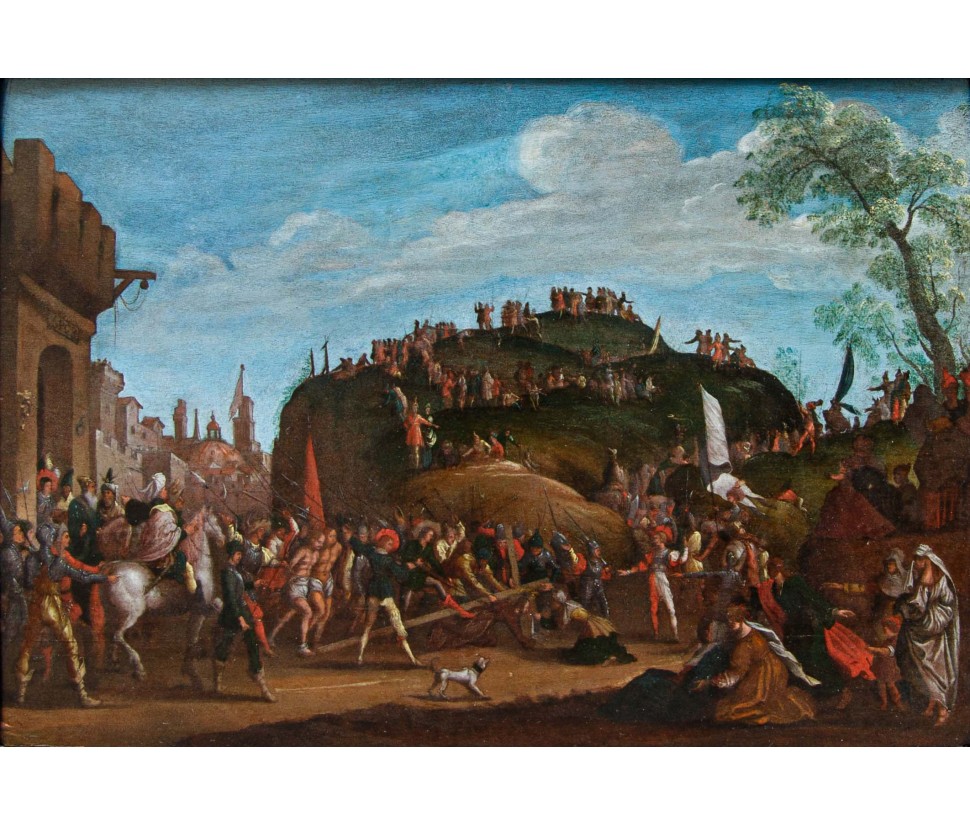
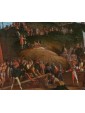
Climb to ordeal
Oil on oak panel, 33 x 48 cm
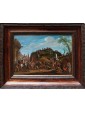
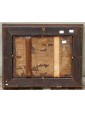
With Frame, 54 x 67 cm
Follower of Jacques Caillot, first half of the 18th century
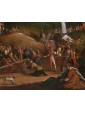
Climb to ordeal
Oil on oak panel, 33 x 48 cm
With Frame, 54 x 67 cm
Follower of Jacques Caillot, first half of the 18th century
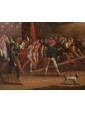
Follower of Jacques Caillot, first half of the 18th century
Climb to ordeal
Oil on oak panel, 33 x 48 cm
With Frame, 54 x 67 cm
Legend tells of a young man of noble spirit, Jacques Callot, who, animated by an irrepressible passion for the figurative arts, disdained the comforts of a wealthy home to pursue the dream of Rome, cradle of the muses. Twice, challenging his father's authority, he moved away from his native roof to go to the court of the Duke of Lorraine, where the expectation of an existence more suited to his artistic ideals enticed him. Callot's career is divided into an Italian period (c. 1609 - 21) and a Lorraine period (France) (1621 until his death). In 1608 he was in Rome, under the expert guidance of the engraver Philippe Thomassin; here the young Callot began to refine his technique, dedicating himself to the reproof of majestic works, jealously guarded in the sacred homes of the Eternal City. With an almost painstaking acumen, he immersed himself in the study of Flemish masters and refined mannerists, absorbing their style and mastery. His artistic career experienced an unexpected splendor in 1612, when he was welcomed with enthusiasm at the sophisticated Medici court in Florence. In that environment of exquisite elegance, Callot's talent found fertile ground. With an incisive line and unparalleled wit, he gave life to a work rich in nuances, portraying scenes of everyday life with surprising truthfulness: exuberant fairs, opulent parties, representations of commedia dell'arte, grotesque figures and beggars, vain courtiers and hunchbacks with twisted faces. After the death of Duke Cosimo II in 1621, Callot returned to Nancy, where, in the service of the Lorraine court, he continued to paint and engrave, giving shape to imaginative visions and scenes of daily life. Unfortunately, most of his pictorial works have been lost, leaving us only an echo of his extraordinary abilities. In Nancy, the artist deepened his artistic research, tackling more challenging and mature themes. Alongside representations of worldly life, he dedicated himself to religious subjects, compositions that portrayed the horrors of war and landscapes of poignant beauty. In 1633, deeply shaken by the war events that shocked Europe and by the invasion of Lorraine by Cardinal Richelieu, Callot created a series of engravings that forcefully denounced the atrocities of the war called Les Grandes Misères de la guerre, composed of 18 prints published in 1633. His works, full of raw and painful realism, anticipate Goya's famous "Disasters of War" by almost two centuries, revealing a sensitivity and capacity for psychological analysis that place him among the greatest artists of his time. Caillot was able to develop a naturalistic style while preserving the artificiality of the occasion, organizing a composition as if it were a stage and reducing the figures to a tiny scale, each indicated by the smallest number of shots possible. This required a very fine engraving technique. His breadth of observation, his lively style of figure, and his skill in gathering a large moving crowd ensured for his engravings a lasting popular influence throughout Europe. The splendid panel presented here is the most faithful version of the engraving made by Jacques Caillot of the same subject. Each element is faithfully imaged with skill and skill.
With Ars Antiqua it is possible to defer all amounts up to a maximum € 7,500 at ZERO RATE, for a total of 15 INSTALLMENTS.
Unpardoned. Vault. € 4,500 = Monthly instalment € 300 for 15 months.
Unpardoned. Vault. € 3,600 = Monthly instalment € 720 for 5 months.
For amounts greater than €7,500 or for a longer period of time (over 15 installments), we can provide a personalized payment.
Contact us directly to get the best quote.
LIVE TV
– SUNDAY 17.00 – 21.00 Dig.terr. 126 - Sky 824
– Streaming on our site www.arsantiquasrl.com and on our social networks Facebook and Youtube
All the works proposed by Ars Antiqua are sold accompanied by a certificate of authenticity in accordance with the law and an accurate in-depth sheet.
It is possible to see the works directly at the showroom gallery in Milan, in via Pisacane 55 and 57.
We personally organize transport and deliveries of the works, both for Italy and abroad.
