






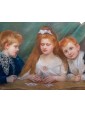

Three brothers
Pastel on paper, 77 x 108 cm
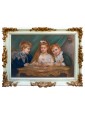
With frame, 101 x 134 cm
Signed and dated lower right “Ducreux 1903”
French school, 20th century
Three brothers
Pastel on paper, 77 x 108 cm
With frame, 101 x 134 cm
Signed and dated lower right “Ducreux 1903”
French school, 20th century
French school, 20th century
Three brothers
Pastel on paper, cm 77 x 108
With frame, cm 101 x 134
Signed and dated in the bottom right "Ducreux 1903"
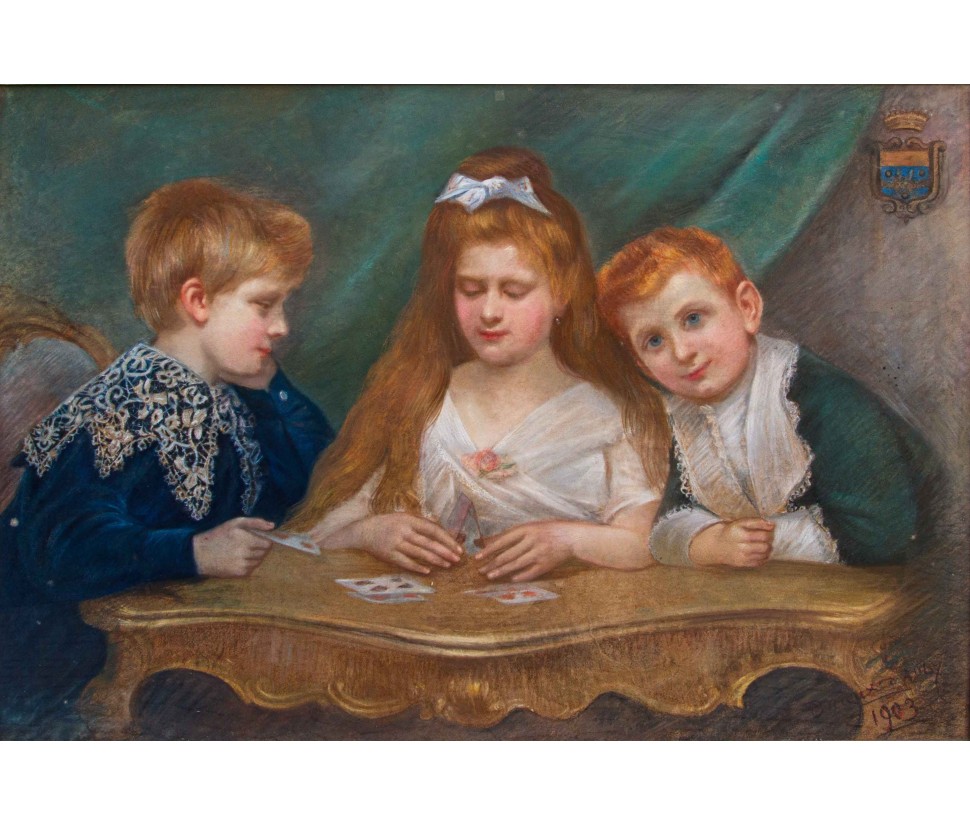
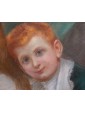
The pastel in question depicts three children around a table, playing cards. In the center, a girl with long red hair and a white bow, wears a light dress with an elegant floral decoration at chest height. On her left, a red-haired boy dressed in a dark dress and an elaborate lace collar looks at her in profile. To his right, another child with fawn hair, in a dark dress and a light collar, looks at the observer with a light, tender smile.
The pastel, made in 1903 in the French area by the painter Ducreux, of which we have no biographical information, shows several similarities with the late production of various members of the Impressionist circle, recalling in particular the mature activity of Pierre-Auguste Renoir. Renoir, emblematic figure of Impressionism, is universally recognized for his oil paintings, in particular his vibrant portraits and scenes of Parisian life. However, the painter, especially regarding the second segment of his career, also explored with remarkable skill the technique of pastel, a medium that offered him unique and complementary expressive possibilities to his oil painting. Renoir’s interest in pastel developed from the mid-1880s, a period when other impressionist artists such as Manet and Degas were already experimenting with this technique. Unlike his drawings, which he rarely exhibited, Renoir considered his pastels an essential part of his artistic production and frequently showed them to the public. The pastel, by its nature, allows a great speed of execution. Renoir used this quality to capture the vividness of expressions, the "rapidity of intelligence" and the "fleeting manifestations of emotion" of his subjects, often friends, family members and especially young women and children. This immediacy was perfectly aligned with the impressionist aesthetic, which aimed to seize the fleeting moment. The pastels, with their powdery nature and pure colors, also allowed to obtain light effects and delicacy difficult to replicate with oil. He was particularly adept at making the transparency of youthful complexions and the softness of textures. The pastel offers a bridge between drawing and painting. Renoir used this feature to combine the strength of the line with the richness of the color, creating works that combined the precision of the contour with suggestive chromatic nuances.
Many of the characteristics of Renoir’s pastel works can be found in this paper: colored pencils allow the painter to better render the details of the portraits, the brightness of their complexions
With Ars Antiqua it is possible to defer all amounts up to a maximum of € 7,500 at ZERO RATE, for a total of 15 INSTALLMENTS.
Ex. Tot. € 4.500 = Monthly instalment € 300 for 15 months.
Ex. Tot. € 3.600 = Monthly instalment € 720 for 5 months.
For amounts over € 7,500 or for a longer delay in time (more than 15 installments), we can provide a personalized payment.
Contact us directly to get the best quote.
LIVE TV
- SUNDAY 17.00 - 21.00 Dig.terr. 126 - Sky 824
- Streaming on our website www.arsantiquasrl.com and on our social networks Facebook and Youtube
We personally organize transport and delivery of the works, both for Italy and abroad.
All the works proposed by Ars Antiqua are sold with a certificate of authenticity in accordance with the law and a detailed information sheet.
You can see the works directly at the gallery showroom in Milan, in via Pisacane 55 and 57.
