


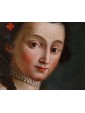
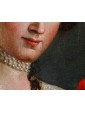

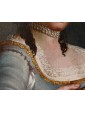

Girl with basket of flowers
Oil on canvas, 52 x 70 cm
With frame, cm 62 x 80
18th century, circle of Pietro Antonio Rotari (Verona, 30 September 1707 - Saint Petersburg, 31 August 1762)
Girl with basket of flowers
Oil on canvas, 52 x 70 cm
With frame, cm 62 x 80
18th century, circle of Pietro Antonio Rotari (Verona, 30 September 1707 - Saint Petersburg, 31 August 1762)
18th century, circle of Pietro Antonio Rotari (Verona, 30 September 1707 - Saint Petersburg, 31 August 1762)
Girl with basket of flowers
Oil on canvas, 52 x 70 cm
With frame, cm 62 x 80
Pietro Antonio Rotari was an Italian painter born in Verona on 30 September 1707. The son of Sebastiano, a physician and naturalist, from an early age he showed a strong inclination for painting. His artistic training began in Verona, where he was a pupil of Antonio Balestra until the age of 18. Between 1725 and 1727 he moved to Venice. Later, between 1728 and 1732, he went to Rome, entering the studio of Francesco Trevisani. In Rome, in 1730, he also went to Grottaferrata to study the works of Domenichino, consolidating his distinctly classicist orientation. From 1731 to 1734, he worked with Francesco Solimena in Naples. Back in Verona, he opened his own studio: during this period, he made mainly works of sacred character, such as the San Francesco Borgia that obtained from Pope Paul III the confirmation of the exercises of St. Spirit for Bergamo in 1740, and L'elemosina di s. Ludovico da Tolosa per i francescani della basilica di S. Antonio in 1741. The Jesuits were among his most assiduous admirers, and in 1743 he sent to Reggio Emilia S. Giorgio attempted to sacrifice to idols for the church of the same name. In 1749 he was made a count. In 1750 he moved to Vienna, and in 1756 was invited to Russia by the court of Tsarina Elizabeth I. In Saint Petersburg, he became a court painter and also dedicated himself to portraying Russian villages and peasants. He was in great demand as a portrait painter, painting royal families in Dresden and St Petersburg. Many of his works were initially preserved at the Russian Academy of Art and Catherine II’s Peterhof Palace. Rotari is particularly known for his character heads and wonderful female portraits, called "passions", with marked and languid expressiveness, oil and pastel paintings, which contributed significantly to his fame. As a testimony to the immense success of Rotari on Russian soil it is necessary to remember how Catherine II bought 340 of her paintings to exhibit them in the so-called "cabinet of fashion and grace" of the luxurious palace of Peterhof, partly designed by Bartolomeo Rastrelli near Saint Petersburg. Rotari died suddenly in Saint Petersburg on 31 August 1762 and received a solemn funeral.
The painting in question is linked to the production of female portraits by the Veronese artist Rotari. A richly and lavishly dressed lady looks unscrupulously at the viewer, holding in her hands a basket of multicolored field flowers: the work is close to Rotari’s passions, particularly appreciated by the tsarina Catherine of Russia, both with regard to the iconographic scope and as regards the technical-executive details: the painting is a valuable testimony of the great visual fortune of Rotari’s production in Italy and Europe already from the middle of the eighteenth century.
With Ars Antiqua it is possible to defer all amounts up to a maximum of € 7,500 at ZERO RATE, for a total of 15 INSTALLMENTS.
Ex. Tot. € 4.500 = Monthly instalment € 300 for 15 months.
Ex. Tot. € 3.600 = Monthly instalment € 720 for 5 months.
For amounts over € 7,500 or for a longer delay in time (more than 15 installments), we can provide a personalized payment.
Contact us directly to get the best quote.
LIVE TV
- SUNDAY 17.00 - 21.00 Dig.terr. 126 - Sky 824
- Streaming on our website www.arsantiquasrl.com and on our social networks Facebook and Youtube
All the works proposed by Ars Antiqua are sold with a certificate of authenticity in accordance with the law and a detailed information sheet.
You can see the works directly at the gallery showroom in Milan, in via Pisacane 55 and 57.
We personally organize transport and delivery of works, both for Italy and abroad.
