


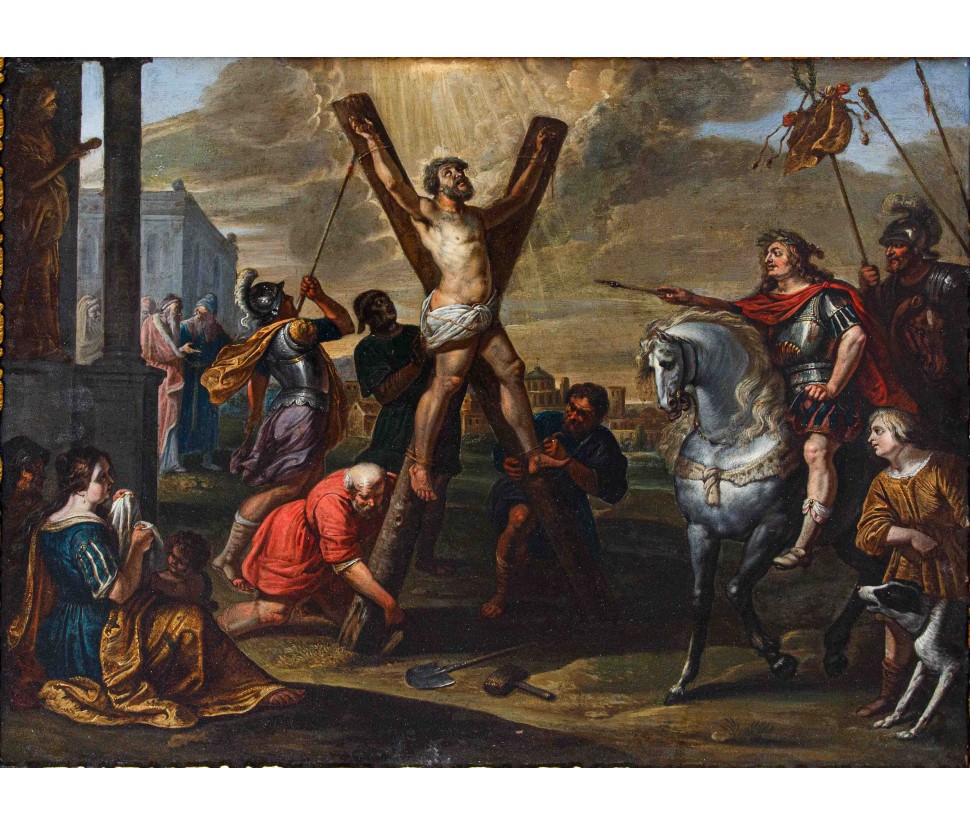
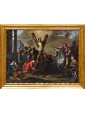
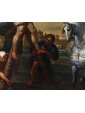
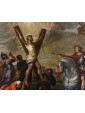
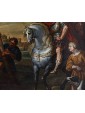
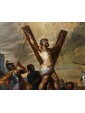
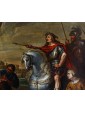
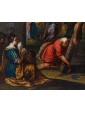
The crucifixion of St. Andrew
Oil on board, cm 51x68
With frame, cm 57x74
Critical sheet Prof. Alberto Crispo
Vincent Malò (Cambrai 1602/06-Rome 1644)
The crucifixion of St. Andrew
Oil on board, cm 51x68
With frame, cm 57x74
Critical sheet Prof. Alberto Crispo
Vincent Malò (Cambrai 1602/06-Rome 1644)
Vincent Malò (Cambrai 1602/06-Rome 1644)
The crucifixion of St. Andrew
Oil on board, cm 51x68
With frame, cm 59x76
Critical sheet Prof. Alberto Crispo
Vincent Malò was born in Cambrai, in the heart of the region of French Flanders, probably between 1602 and 1606. From 1623 to 1634, Malò was a pupil of the two most prominent painters at the flourishing Antwerp: initially he worked in the workshop of Pieter Paul Rubens, from whom he inherited the marked chiaroscuro contrast of Caravaggio’s matrix, and later with David Teniers the Elder, from which he resumed the marked characterization of the figures that animate genre scenes and works of religious subject. During this period, he became a member of the Corporazione di San Luca in Antwerp. After 1634, Malo moved to Italy and settled in Genoa. There he lived and collaborated with another Flemish painter, Cornelis de Wael, who played an important role in the Flemish artistic community in Genoa and contributed to the spread of the dictates of Nordic lenticular culture in the north of the peninsula. The port city of Genoa offered a rich environment for potential buyers and collectors. Malò received several commissions for local churches and palaces. During his stay in Genoa, he had as student Antonio Maria Vassallo, who, together with his son Vincent Malò II, was his most famous successor. Among the works executed by the Flemish painter for Genoa there is the Vision of Sant'Ampelio of the Genoese church of Santo Stefano: the work was performed around 1637, when the relics of the Saint were found: the data is of particular importance for the location of Malò in Liguria in the thirties of the seventeenth century. Malò, during his ten-year stay in Italy, also settled in Florence and Rome, where he died on 14 April 1644.His family returned to Antwerp and in 1652 his son was admitted into the Guild of Saint Luke as the son of a teacher. Vincent Malo painted genre scenes, religious and mythological subjects, and occasionally portraits. His early works still show mannerist traits, while the mature works reveal a Baroque style close to that of Rubens and van Dyck. As a testimony of his remarkable critical fortune it is necessary to remember how his brief biographical and artistic profile was already outlined in the second half of the seventeenth century by Raffaele Soprani, who wrote: "The years spent in Genoa by Vincenzo Malò of Cambrai Pittor were vaguely coloured, and his brushes received such applause that they did not consider those cabinets to be well adorned, nor what kind of table could not be worked by his hands. Haveva who in his early years learned the art of painting in Antwerp under the care of David Tener [Teniers] Pittor very esteemed: but, then infaghitosi of the beautiful way that in painting kept Peter Paul Rubens brought into the house of that, & there some time stopping waiting with quietness of mind to perfect himself in his craft; it is true that in his works always gave way to the dissecting, and therefore much more than the great ones were always liked his small canvases, and especially in Genoa where he colored a large quantity, Often taking advantage of the dissignes of Cornelio de Vael [de Wael], which are therefore held in high esteem by amateurs of the profession. In the Oratory of SS. Peter, & Paul are of his the table of the high altar, & a very large Cenacle made from it in very few days, & in S. Stephen there is the table of S. Ampegli consoled in his infirmary by the visit of the Angel: nor his other fatigue is seen in public, being the others all kept by many Citizens in their own homes, and frà these is very beautiful a Santa Maria Madalena, which is next to Mr. Thu: Nicolò Cavana. Wanting to see Florence, Vincenzo went there with his whole family, and after having resided there for some time, he wanted to visit the city of Rome where very tough falling sick for his way of life unregulated ended his days in age 45. in about, e seco si spense la buona speranza, che s'haveva della sua felice riuscita" (R. Soprani, Le vite de pittori scoltori, et architetti genovesi, Genoa 1674, p. 330).
Our table can be easily associated with the work of Malò, as shown by comparisons with other pictorial evidence of the Flemish painter student of Rubens and Teniers. See, for example, the Camillo and the school teacher of Falerii already by Pandolfini in Florence, 14 November 2017, lot 12, where we find stylistic characters completely similar, from the features to the way of outlining the clothes, but also observe the Triumph of David presented by Il Ponte a Milano, 26-27 October 2016, lot 563, in which we see warriors with armor and crest very close to those drawn in our table and especially a graceful steed almost superimposed to ours, if not for the different inclination of the head. In the composition are visible two unusual characters regarding the classic iconography of the crucifixion of Saint Andrew: on one side is the centurion Egea, who imposes the crucifixion of the saint, while opposite is the presence of his wife Maximilia, that she had been healed precisely by the saint, who weeps in pain for his martyrdom.
With Ars Antiqua it is possible to defer all amounts up to a maximum of € 7,500 at ZERO RATE, for a total of 15 INSTALLMENTS.
Ex. Tot. € 4.500 = Monthly instalment € 300 for 15 months.
Ex. Tot. € 3.600 = Monthly instalment € 720 for 5 months.
For amounts over € 7,500 or for a longer delay in time (more than 15 installments), we can provide a personalized payment.
Contact us directly to get the best quote.
LIVE TV
- SUNDAY 17.00 - 21.00 Dig.terr. 126 - Sky 824
- Streaming on our website www.arsantiquasrl.com and on our social networks Facebook and Youtube
All the works proposed by Ars Antiqua are sold with a certificate of authenticity in accordance with the law and a detailed information sheet.
You can see the works directly at the gallery showroom in Milan, in via Pisacane 55 and 57.
We personally organize transport and delivery of works, both for Italy and abroad.
