


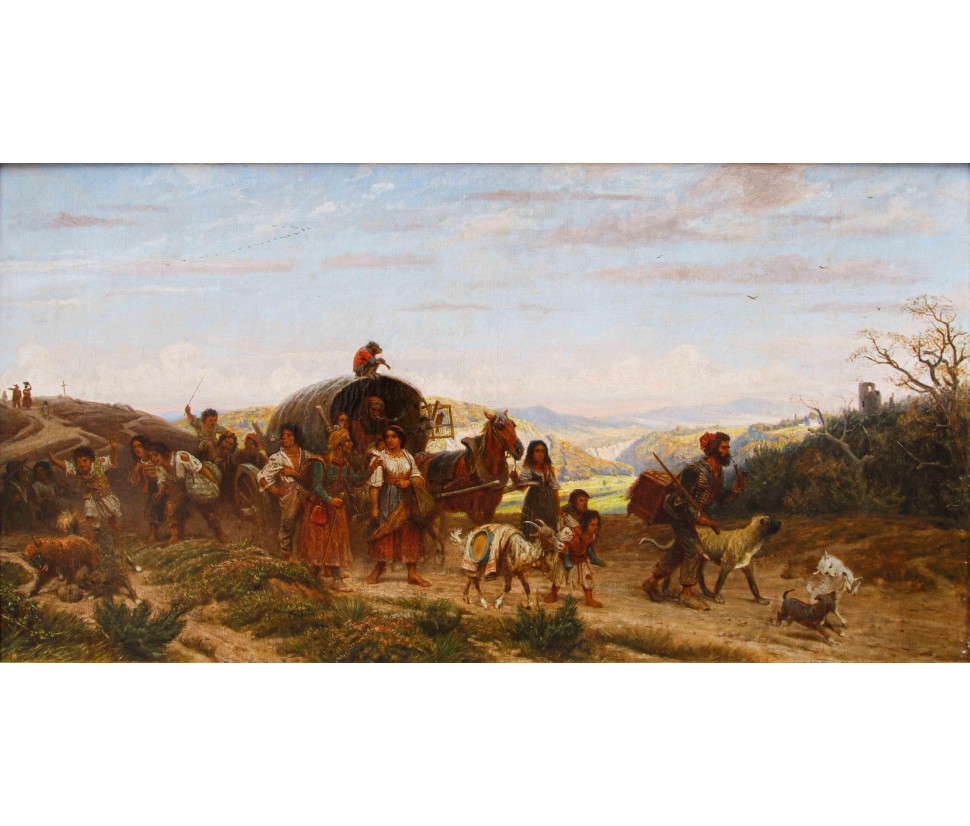
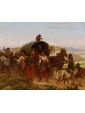
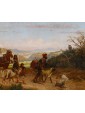
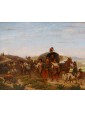
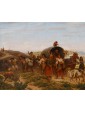
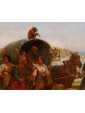
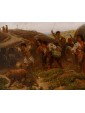
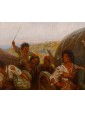
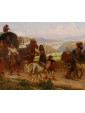
Caravan on the road
Oil on canvas, 70 x 124 cm
With cornice, cm 80 x 138
Signed "Adolf Northen Düsseldorf."
Adolf Northen (Münden, 6 novembre 1828 - Düsseldorf, 28 maggio 1876)
Caravan on the road
Oil on canvas, 70 x 124 cm
With cornice, cm 80 x 138
Signed "Adolf Northen Düsseldorf."
Adolf Northen (Münden, 6 novembre 1828 - Düsseldorf, 28 maggio 1876)
Adolf Northen (Münden, 6 November 1828 - Düsseldorf, 28 May 1876)
Caravan on the road
Oil on canvas, 70 x 124 cm
With frame, cm 80 x 138
Signed "Adolf Northen Düsseldorf."
Adolph Northen, born in 1828 in Münden in Germany, was a painter whose art has mainly immortalized vibrant battle scenes, insidious journeys of nutritious caravans and suggestive winter landscapes, Often animated by human figures made with great skill and technical expertise. His artistic career took place mainly in Düsseldorf, an important centre for German art of the 19th century, where he died in 1876. Despite the relative scarcity of detailed biographical information on his personal life, his work speaks eloquently of his technical skill and predilection for specific subjects. Northen was particularly well known for his military paintings, which often depicted episodes of the Napoleonic wars. These works are distinguished by their attention to detail, dynamic composition and ability to convey the turmoil and drama of conflict. His depiction of the battles was not merely documentary, but imbued with a sense of narrative and pathos, able to capture emotions and perfectly describe the actions of soldiers at crucial moments in history. In addition to the battle scenes, Northen was equally skilled at winter landscapes. These paintings reveal a different sensibility, focusing on the quietness and beauty of snow-covered nature. He often included small human figures in these scenes, which added a sense of scale and narrative, suggesting daily life and activities carried out in a cold but fascinating environment. Its ability to make the light dim of winter and the texture of snow shows a remarkable mastery of color and perspective.Another subject that attracts the attention of the German artist is that of the gypsy caravans in motion. The depiction of gypsies is actually very common in the north of the Alps throughout the nineteenth century: In the nineteenth century, the representation of Roma and Sinti in painting was deeply influenced by Romanticism and Orientalism, two currents that shaped the European imagination of the time. These peoples, perceived as nomads, mysterious and far from social conventions, became fascinating subjects for artists looking for the exotic, the picturesque and the "different". Often the Gypsies were depicted in scenes that emphasized their alleged "wild" and "free" life: camping outdoors, presented as involved fiery dances or traveling in caravans. The artists focused on their colorful clothes, faces with marked traits and intense expressions, often idealizing an "exotic" and sensual beauty, especially in female figures. However, these representations were rarely based on in-depth knowledge or genuine interaction with the Gypsy communities. They were, rather, the product of stereotypes and prejudices rooted in society. The Gypsies were seen as intrinsically linked to nature, music and magic, but also associated with concepts of deviance, marginality and an alleged lack of morality or industriousness. Artists such as Eugène Delacroix, with his fascination for the Orient and "other" cultures, included figures that recalled the Gypsies in their landscapes and genre scenes, although not always explicitly identified as such. In Italy, and other European countries, interest in folklore and local traditions led to paintings depicting the Gypsies as part of a rural landscape or scenes of costume, often with a more folkloristic than documentary tone. In this case, the artist chooses to represent a fundamental trait in the Roma and Sinti culture, that of travel, perceived as the very essence of a life in perennial change. The works of Adolph Northen are found in several museum collections, a testimony to his recognition in the artistic scene of his time. His extensive production offers a significant cross-section of 19th century German genre and landscape painting, ensuring him a prominent place among the painters of his time.
With Ars Antiqua it is possible to defer all amounts up to a maximum of € 7,500 at ZERO RATE, for a total of 15 RATES.
Ex. Tot. € 4.500 = Monthly instalment € 300 for 15 months.
Ex. Tot. € 3.600 = Monthly instalment € 720 for 5 months.
For amounts over € 7,500 or for a longer delay in time (more than 15 installments), we can provide a personalized payment.
Contact us directly to get the best quote.
LIVE TV
- SUNDAY 17.00 - 21.00 Dig.terr. 126 - Sky 824
- Streaming on our website www.arsantiquasrl.com and on our social networks Facebook and Youtube
All the works proposed by Ars Antiqua are sold with a certificate of authenticity according to law and an accurate detailed information sheet.
You can see the works at the gallery showroom in Milan, in via Pisacane 55 and 57.
We personally organize transport and delivery of works, both for Italy and abroad.
