










Rocky landscape with tower and figures
Oil on canvas, cm 293 x 106,5
With frame, cm 304,5 x 120
French School of the 18th century, Circle of Charles François Grenier de Lacroix (Marseille, 1700 - Berlin 1779)
Rocky landscape with tower and figures
Oil on canvas, cm 293 x 106,5
With frame, cm 304,5 x 120
French School of the 18th century, Circle of Charles François Grenier de Lacroix (Marseille, 1700 - Berlin 1779)
French school of the 18th century
Circle of Charles François Grenier de Lacroix
(Marseille, 1700 - Berlin 1779)
Rocky landscape with tower and figures
Oil on canvas, cm 293 x 106,5
With frame, cm 304,5 x 120
Charles François Grenier de Lacroix, better known as Charles François Lacroix de Marseille, was an 18th-century French painter born in Marseilles around 1700 and died in Berlin between 1779 and 1782. His fame is mainly linked to its marinas and landscapes, often characterized by suggestive atmospheres and views of Mediterranean ports, which have made him an appreciated emulator and student of Joseph Vernet. Lacroix’s artistic training is not fully documented, but his first known works, two Italian Marines dated 1743, already show a clear influence of Vernet. His interest in Italy led him to stay in Rome in 1750 and then in 1754, where he continued to perfect his style, enriching his views with classical elements and ancient ruins, in a whim of real and imaginary architectural elements. During his stay in Italy, in 1757, he was in Naples, although it is attested that he returned to Rome in 1759. In 1780, he published an advertisement in Paris to welcome students into his studio, a sign of his willingness to pass on his art. Some of his paintings were engraved by artists such as Jean Jacques Le Veau and Noël Le Mire, contributing to the spread of his work and the great visual fortune of his production in an international context. In the last years of his life, Charles François Lacroix moved to Berlin, where he worked for the King of Prussia until his death in 1779. His works are now in numerous public collections, including fine art museums in Bordeaux, Dijon, Lille, Marseille and Rouen in France, and the Dallas Museum of Art in the USA,a testament to his lasting impact on the artistic landscape of his time. His ability to capture the light and different weather conditions in its marine and landscapes makes him a significant figure for genre painting of the eighteenth century.
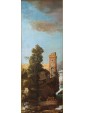
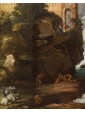
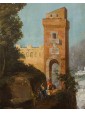
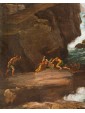
Various characteristics similar to the production of the prolific workshop of Charles François Lacroix de Marseille are found in this fascinating landscape. The painting shows a dramatic and suggestive coastal landscape, in which natural elements and curious architecture coexist harmoniously. The scene is dominated by a rocky cliff that rises over the rough sea on the right, where the waves crash against the shore. In the foreground, on the left, you can see human and animal figures in a rocky area, with cows lying flat resting. In the centre, the cliff is surmounted by a solid wall, probably part of a fortification or a wall, which extends horizontally. A large leafy tree grows on the top of the cliff, with its dense foliage protruding against the sky. On the right, emerges a massive tower of reddish color, with a large arch at the base and an upper structure that suggests a sighting or defense function. At the tower and along the road that climbs up the cliff, there are some human figures on horseback and on foot, suggesting a passing or travel activity. The sky is stormy and dramatic, with dark clouds thickening at the top and a fainter glow towards the horizon, giving the scene an intense and almost melancholic atmosphere. On the right, in the distance, you can see a profile of a city or a coastal settlement, with houses and structures descending towards the sea. The style of the painting, with its attention to light, atmospheric variations and dramatic composition, is characteristic of French artists of the eighteenth century who were influenced by Italian landscaping, in particular the Roman tradition, First of all Lacroix de Marseille. The presence of classical or pseudo-classical architecture and the representation of grandiose natural elements recall the teachings of Joseph Vernet and the interpretation given by Lacroix de Marseille, whose marine and coastal landscapes were a great success and were taken as models by many painters of the period.
With Ars Antiqua it is possible to defer all amounts up to a maximum of € 7,500 at ZERO RATE, for a total of 15 RATES.
Ex. Tot. € 4.500 = Monthly instalment € 300 for 15 months.
Ex. Tot. € 3.600 = Monthly instalment € 720 for 5 months.
For amounts over € 7,500 or for a longer delay in time (more than 15 installments), we can provide a personalized payment.
Contact us directly to get the best quote.
LIVE TV
- SUNDAY 17.00 - 21.00 Dig.terr. 126 - Sky 824
- Streaming on our website www.arsantiquasrl.com and on our social networks Facebook and Youtube
All the works proposed by Ars Antiqua are sold with a certificate of authenticity according to law and an accurate detailed information sheet.
You can see the works at the gallery showroom in Milan, in via Pisacane 55 and 57.
We personally organize transport and delivery of works, both for Italy and abroad.
