


Dead Christ and angels
Oil on canvas, cm 92 x 70
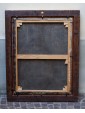
With frame, cm 110 x 88
Expert report by Prof. Alberto Crispo
Giuseppe Cesari known as the Cavalier d'Arpino (Arpino 1568 - Rome 1640)
Dead Christ and angels
Oil on canvas, cm 92 x 70
With frame, cm 110 x 88
Expert report by Prof. Alberto Crispo
Giuseppe Cesari known as the Cavalier d'Arpino (Arpino 1568 - Rome 1640)
Giuseppe Cesari known as the Cavalier d'Arpino (Arpino 1568 - Rome 1640)
Dead Christ and angels
Oil on canvas, cm 92 x 70
With frame, cm 110 x 88
Expert report by Prof. Alberto Crispo
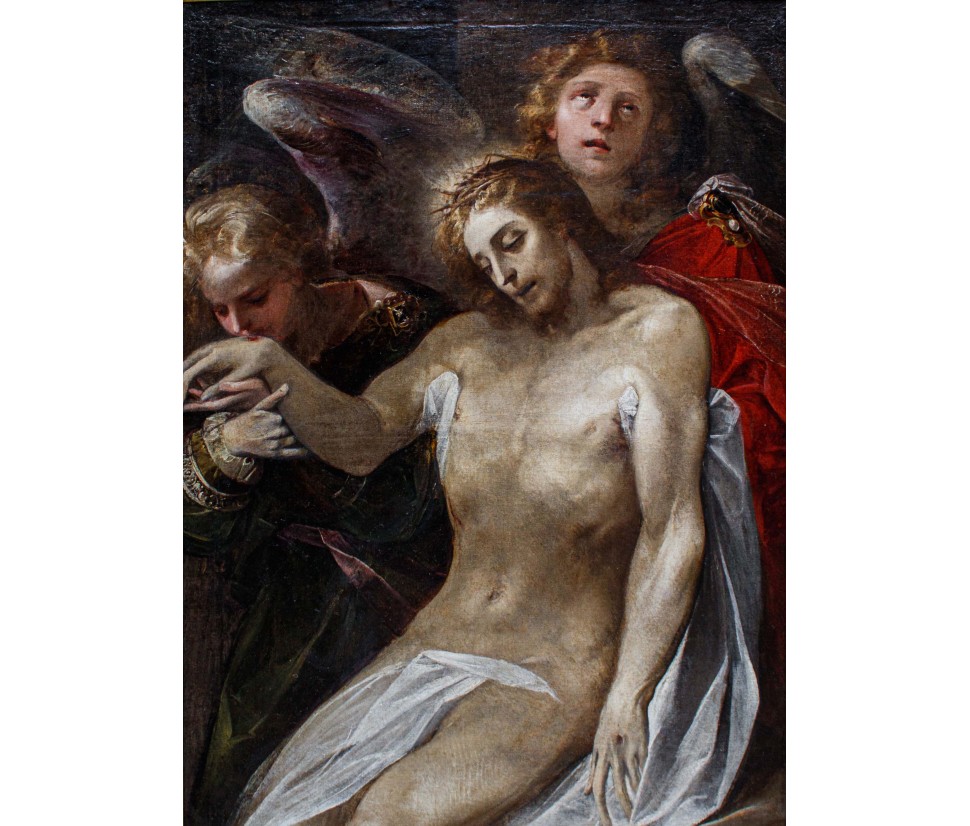
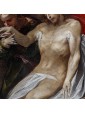
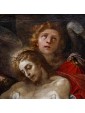
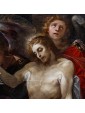
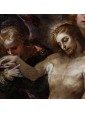
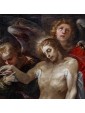
The compositional and stylistic references link the present canvas depicting the Dead Christ supported by angels to the production of the painter Giuseppe Cesari known mainly as Cavalier d'Arpino (Arpino 1568 - Rome 1640).
The unusual subject of the Christ weeping from the angels, although it does not appear in the biblical texts, falls into the devotional tradition of the Pietà in which the body of the lifeless Christ is held with a bust erected by angels or sorrows. This is an iconography typical of the fertile second decade of the seventeenth century, in the midst of the Counter-Reformation. The pathetic theme of Christ’s death perfectly corresponds, in its emotional potential, to the aims of the post-Trident Church. The typology of the dead Christ supported by angels is configured, compared to the Renaissance examples, as a thematic novelty that dates back to Taddeo Zuccaro, destined to become very popular in the seventeenth century. It is no longer men but the angels of Heaven who weep and worship the Son of God sacrificed for humanity; there are neither the Virgin nor the pious women nor Joseph of Arimathea, as if only Heaven could mourn her death worthy.
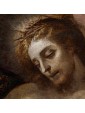
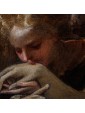
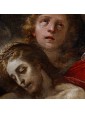
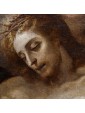
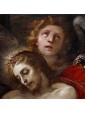
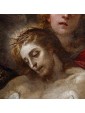
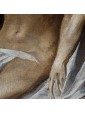
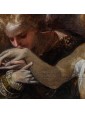
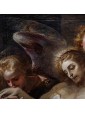
In the present the centerpiece of the composition is the bruised body of the Savior, still wrapped by the shroud and with the head completely abandoned, supported by two angels wearing precious tunics; Of particular value are his pins adorned with precious gems and the subtle embroidery placed on the sleeve of the angel on the left. One of them kisses the hand of the redeemer while the other turns his eyes to heaven.
As written above the present painting is, as stated by Prof. Alberto Crispo, to be attributed to the hand of Giuseppe Cesari known as the Cavalier d'Arpino, one of the most esteemed and famous artists of 17th century Rome. Born in Arpino in February 1568 to his father Munzio, also a painter, he moved to Rome with his mother in 1582. Under the direction of Niccolo Circignani, his first Roman master, he worked on the decoration of the Vatican Lodges, the old Swiss room and that of the Palafrenieri. It was in this context that the young Cesari, not yet a knight, was noted for his creativity and skill so much that already in 1583 he joined the Academy of San Luca and in 1586 was welcomed among the Virtuosi del Pantheon. Following these prestigious accessions he obtained numerous commissions working for the church of Trinità dei Monti, in palazzo Santori, in Sant'Anastasio dei Greci. In Naples he was commissioned to decorate the Sancta Sanctorum of the Charterhouse of San Martino. With the advent of the pontificate of Clement VIII Aldobrandini, Cesari was finally able to consecrate his professional affirmation, becoming one of the most known and demanded painters in Rome, especially for the great decorative enterprises. Overburdened by the many commissions was accompanied by a workshop based in Torretta, considered one of the most prestigious in Rome; it is here that in the spring of 1596 arrived Michelangelo Merisi called Caravaggio, before the aversion between the two took over. 1599 is the year in which Cesari was elected prince of the Academy of San Luca and obtained the very important commission of the frescoes of the transept of San Giovanni in Laterano. The economic and social position of Cesari was now largely consolidated, and so he could finally buy a building in via del Corso, as well as build his own residence in the native Arpino, still partially existing; among the customers of Cesari, In addition to the rich Capitoline aristocracy, there were also the emperor Rudolf II and the kings of Spain and France.
