


Odalisques
Oil on board, cm 25 x 30.5
With frame, cm 36,5 x 42
French school, first quarter of the 19th century
Odalisques
Oil on board, cm 25 x 30.5
With frame, cm 36,5 x 42
French school, first quarter of the 19th century
French school, first quarter of the 19th century
Odalisques
Oil on board, cm 25 x 30.5
With frame, cm 36,5 x 42
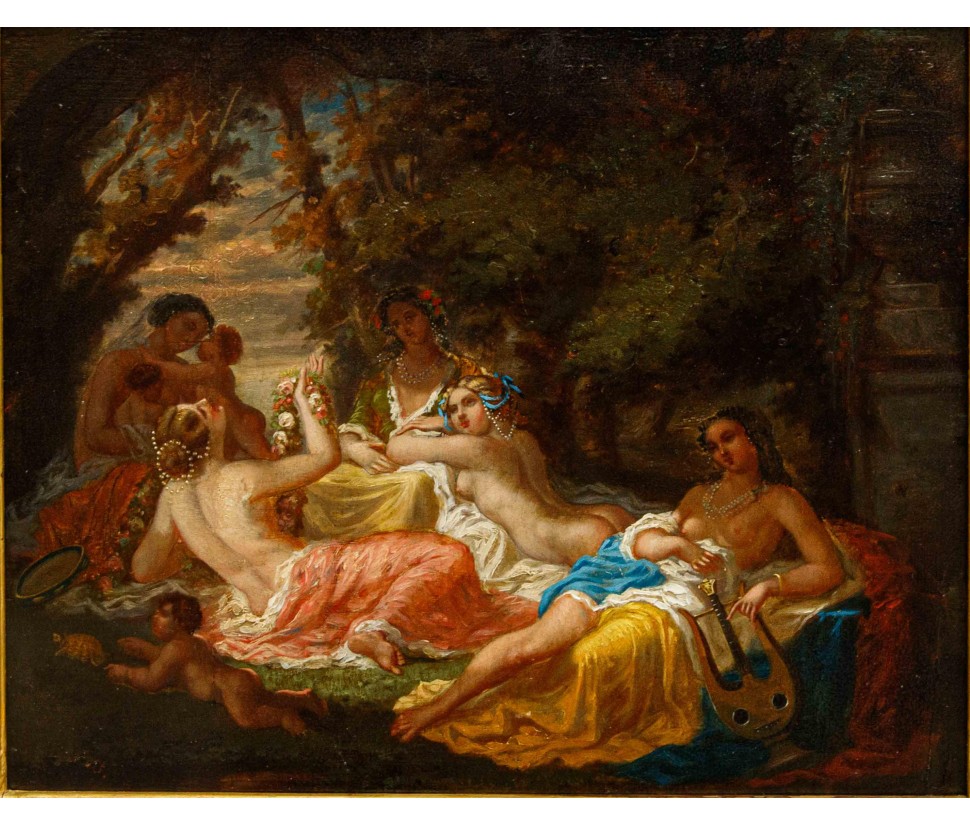
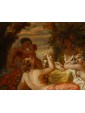
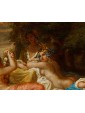
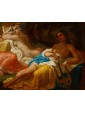
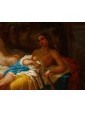
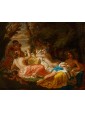
This painting depicts a bucolic and sensual scene immersed in a wooded landscape. At the centre of the composition, several half-naked or slightly draped female figures rest in an atmosphere of idleness and abandonment. A woman in the foreground, with a yellow and blue drape partially covering her legs, is lying on a blue cushion and holds a musical instrument similar to a lute or guitar. His gaze is directed towards the viewer, with a serene and slightly melancholy expression. Another female figure, lying on her back with a pink drape that wraps around her hips, has her arms raised and woven with garlands of flowers. His pose is languid and sensual. A small putto is depicted in the lower left, adding a mythological or allegorical element to the scene. The background is a lush vegetation, with leafy trees and a clear sky visible between the leaves. The light that filters through the trees creates a warm and golden atmosphere, accentuating the softness of the figures and the richness of the colors. The work, which echoes the production of the great French masters of the late eighteenth century, first of all Boucher, but also the visual culture of the first two decades of the nineteenth century, evokes a sense of pleasure, sensuality and harmony with nature, Recurring themes in genre painting and representations of mythological or pastoral scenes. The representation of odalisques has been a fascinating and nuanced theme in French painting since the second half of the eighteenth century. Their representation is a true mirror of the cultural, artistic and even colonial dynamics of the time. In the 19th century, with the orientalist movement, odalisques appeared in the visual imagination of artists from across the Alps as exotic and sensual figures. Painters such as Jean-Auguste-Dominique Ingres with his famous Grande Odalisque (1814) and Eugène Delacroix with La mort de Sardanapalo (1827) portrayed her in pose as a guide, Often semi-naked, immersed in luxurious and mysterious atmospheres that evoked the imagination of the Ottoman harem or within lush natural landscapes. These works, despite their formal beauty, reflected a European vision of the East, often idealized and charged with stereotypes. The odalisque became a symbol of passive sensuality and of a world perceived as exotic and "other".
With Ars Antiqua it is possible to defer all amounts up to a maximum of € 7,500 at ZERO RATE, for a total of 15 RATES.
Ex. Tot. € 4.500 = Monthly instalment € 300 for 15 months.
Ex. Tot. € 3.600 = Monthly instalment € 720 for 5 months.
For amounts over € 7,500 or for a longer delay in time (more than 15 installments), we can provide a personalized payment.
Contact us directly to get the best quote.
LIVE TV
- SUNDAY 17.00 - 21.00 Dig.terr. 126 - Sky 824
- Streaming on our website www.arsantiquasrl.com and on our social networks Facebook and Youtube
All the works proposed by Ars Antiqua are sold with a certificate of authenticity according to law and an accurate detailed information sheet.
You can see the works at the gallery showroom in Milan, in via Pisacane 55 and 57.
We personally organize transport and delivery of works, both for Italy and abroad.
