





Allegory of Venice
Oil on canvas, cm 50,5 x 40
With frame cm 65,5 x 53,5
Giacomo Casa (Conegliano, 1827 - Rome, 1887)
Allegory of Venice
Oil on canvas, cm 50,5 x 40
With frame cm 65,5 x 53,5
Giacomo Casa (Conegliano, 1827 - Rome, 1887)
Giacomo Casa (Conegliano, 1827 - Rome, 1887)
Allegory of Venice
Oil on canvas, cm 50,5 x 40
With frame cm 65,5 x 53,5
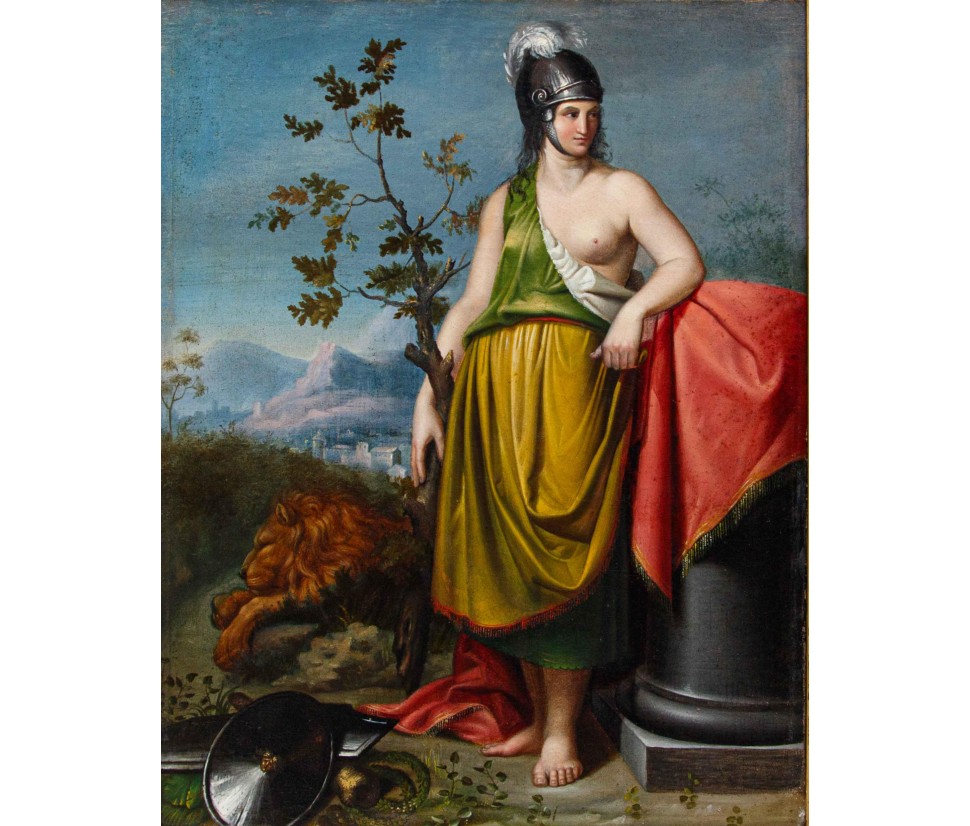
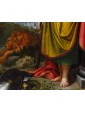
The unification of Italy and its historical and political path fed the production of specific works of art, which evoke war scenes, political and popular episodes, but also complex allegorical representations. Typical of this illustrative vein is the painting under consideration, recognized to Giacomo Casa (1827-1887) given the stylistic and compositional consonances with his typical pictorial production, as well as for the direct relationship, given the iconographic scheme and the elegant decorative figure, with the allegorical work depicting Republican Venice resurrected to freedom and art, with the tricolor flag, executed in 1848 by the Casa and now kept at the Museum of the Risorgimento and the Resistance of Vicenza.
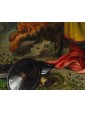
Painted with a strong patriotic meaning, it shows in the centre a female figure, to be identified with the Allegory of Venice: the setting in a rural landscape is different from that of the port and the sea which can be found in the painting of Vicenza but would indicate the Venetian power extended in the hinterland of Veneto and Lombardy during the history of the maritime republic; The presence of a lion must also be interpreted as a clear reference to the main symbol of the lagoon city, represented together with the usual attributes of the weapons, depicted at his feet and next to the laurel wreaths, which refer to military glories. Another patriotic reference is the depiction of the woman with bare breasts, alluding in this way to her function as a mother, while the combination of colors of the dress and the drape resting on the broken column refer to the Tricolor, national flag adopted since 1797 with the Cispadana Republic until becoming one of the most important symbols of the Risorgimento and the Unity of Italy.The warrior holds in her right hand an oak branch, a reference to the military value that the nation is ready to employ for its ransom, while the broken column recalls the fallen for the Fatherland. In the background there is a typical Veneto landscape, which recalls the lagoon tradition in the shaded and clear and smoky skies of the Bellini and Titian, exhibiting a remarkable formal elegance and a refined chromy of sixteenth-century Veneto taste. The definition of this subject, which interprets in a Risorgimento key the allegorical figure of Venice, came from the movements of 1848, in which the city had the brief but intense experience of the Republic of San Marco, formed by Daniele Manin in anti-Austrian function and later approached the annexation to the Kingdom of Sardinia, which took place after the Third War of Independence with the plebiscite of 1866. In these years the Casa elaborates lithographs and engravings, now preserved at the Institute for the History of the Italian Risorgimento in Rome, in order to praise the heroes and patriotic martyrs who fought to obtain independence from the Habsburgs and the annexation to the Savoy kingdom, In this way, he succeeded in reworking the Venetian symbols with a view to patriotism and fusion with the future Kingdom of Italy.
His artistic and non-artistic experiences helped to consolidate the ideas of the Casa: as a painter he trained at the Accademia di Venezia, Giacomo Casa was a student of Molmenti, who contributed to the development of his rare talent and strong personality. At the age of twenty, he took part in the revolutionary movements in Venice between 1848 and 1850. He visited Padua, Naples, Rome, Pompeii, Catania and had experiences abroad, in the East, in Paris and London, where he stayed for some years. In 1883 he returned to Italy and settled in Rome. His creations were immediately appreciated, as evidenced by his participation in numerous exhibitions: after the '48 movements took part in the Venetian exhibitions, in 1861 he presented Episodio dei Promessi Sposi while in 1862 he proposed the Diluvio Universale and La beneficenza. At the First Italian Exhibition of Florence in 1861 he exhibited his best known work: Michelangelo who directs the fortification works in Florence.
The House was also skilled and required frescoes, remember his works performed during the '50s in Venice alongside L. Cadorin (Caffè delle Nazioni, 1857; Caffè Florian, 1858; Caffè Quadri, 1859; Palazzina Foscari; Palazzina Gattei Nardi, 1864; interventions in the Palazzo Reale and in the Palazzo Papadopoli in Santa Marina). In 1884 he was entrusted with the decoration of the Verdi theatre in Padua, where he worked in the ceilings of different environments with allegorical representations. He worked at the church of the Filippini in Chioggia; he was active as well as for the Venetian churches of San Moisè and Santa Maria Formosa, for the halls of the Teatro La Fenice in Venice.
In the easel painting he also dealt with orientalist themes that contributed to his fame (Mercato orientale, 1885, Venice, Galleria d'Arte Moderna di Ca' Pesaro). His works, mostly genre paintings and historical subjects, for example Venice welcomes Vittorio Emanuele II, are kept in the Museums of Udine, Padova, Bassano and at the Museum of Modern Art in Venice.
With Ars Antiqua it is possible to defer all amounts up to a maximum of € 7,500 at ZERO RATE, for a total of 15 INSTALLMENTS.
Ex. Tot. € 4.500 = Monthly instalment € 300 for 15 months.
Ex. Tot. € 3.600 = Monthly instalment € 720 for 5 months.
For amounts over € 7,500 or for a longer delay in time (more than 15 installments), we can provide a personalized payment.
Contact us directly to get the best quote.
LIVE TV
- SUNDAY 17.00 - 21.00 Dig.terr. 126 - Sky 824
- Streaming on our website www.arsantiquasrl.com and on our social networks Facebook and Youtube
All the works proposed by Ars Antiqua are sold with a certificate of authenticity according to law and an accurate detailed information sheet.
You can see the works at the gallery showroom in Milan, in via Pisacane 55 and 57.
We personally organize transport and delivery of works, both for Italy and abroad.
