


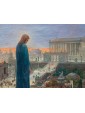

Jesus attends the triumph of Constantine
Oil on canvas, cm 88 x 148
With frame, cm 114 x 180
Signed in the lower right
Domingo Motta (1872 - 1962)
Jesus attends the triumph of Constantine
Oil on canvas, cm 88 x 148
With frame, cm 114 x 180
Signed in the lower right
Domingo Motta (1872 - 1962)
Domingo Motta (1872 - 1962)
View of ancient Rome - Jesus attends the triumph of Constantine
Oil on canvas, cm 88 x 148
With frame, cm 114 x 180
Signed in the lower right
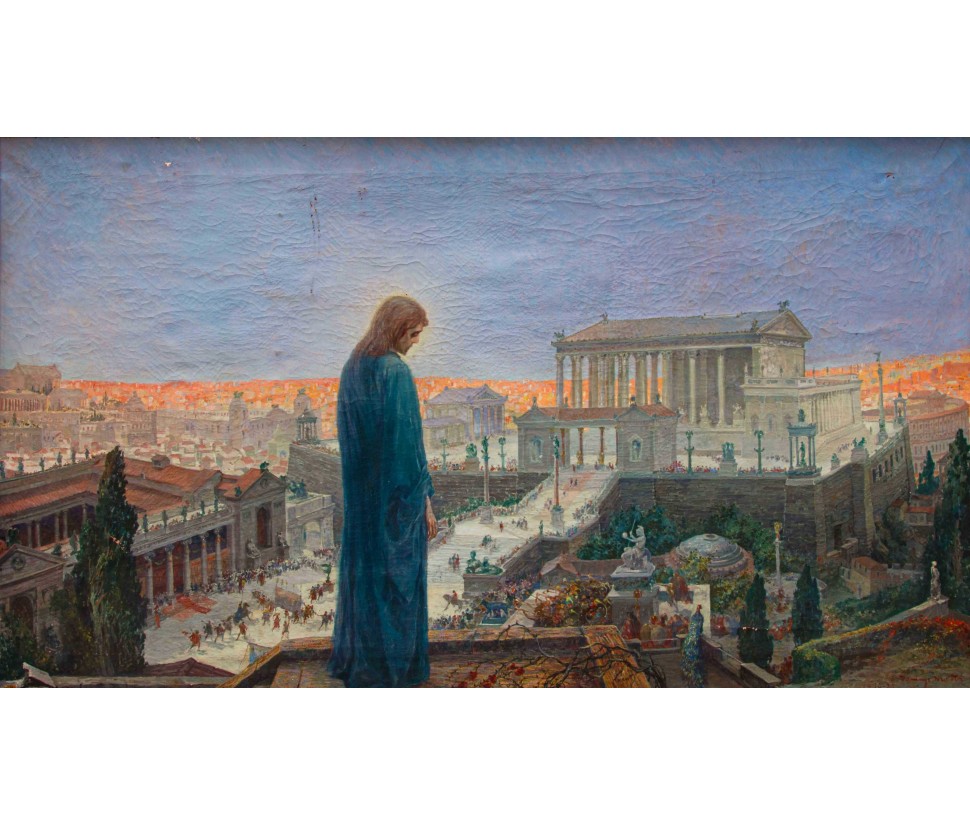
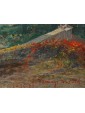
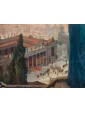
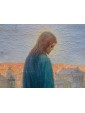
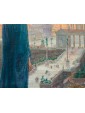
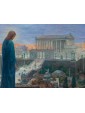
The Ligurian painter Domingo Motta returns in this painting a deep reflection on the origins of Christianity as we know it, as well as mentioning an important work of historical reconstruction of ancient Rome.
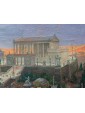
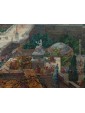
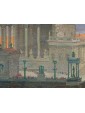
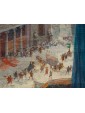
In fact, the panorama pictured is a view of ancient Rome at the time of the triumph of the emperor Constantine in 312 d.c. The clever quote refers to a famous work by Joseph Bühlmann (1844 to 1921) and Alexander Wagner (1838 - 1919): the "Das Alte Rom mit dem Triumphzuge Kaiser Constantins im Jahre 312" or, better, Ancient Rome with the triumph of the emperor Constantine in 312 published in Monaco in 1892. This is a reconstruction project of the times of ancient Rome made on a laporello (book or booklet that opens to accordion) originally 1.76 cm long (composed of 22 sheets and 8 photographs) Now no longer visible in original but whose children are preserved original projects in the library of the University of Munich. Pictured is the great temple of Giova Capitolino with behind it the theater of Marcello. The building on the right was the entrance to the Tabularium. All in the distance are the buildings of the forum.
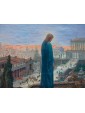
Here Motta reelaborates with some finesse the Roman view by adding the central figure of Christ observing the panorama and a peacock, symbol of immortality and of Christ himself. The complicated reading of the work seems to be a reflection on the future rivalry of Christianity; it was Constantine in 313 with the Edict of Milan to guarantee all citizens, then also to Christians, the freedom to venerate their own divinities. And why not read in the peacock also the symbol of immortality of Rome, eternal city.Domingo Motta was born in Genoa, in 1872, he studied classics at the Liceo Ginnasio Doria, and then enrolled at the Accademia Ligustica di Belle Arti. Later he attended the studio of the landscape painter and portrait painter Vittorio Cavalleri, and also that of the Ligurian painter Cesare Viazzi, at Palazzo Doria del Principe. He completed his studies by enrolling at the Academy of Fine Arts in Rome. His first works are, however, related to the field of scenography for the Teatro Carlo Felice in Genoa, and other companies. His debut as a painter dates back to 1896 when, at the Promoter Society of Fine Arts, he presented the work Black Foam. Around 1899 he began his Parisian experience which proved to be particularly important. Before that he participated assiduously in the regional exhibitions of Liguria and, since 1896, joined the Ligurian Artistic Family, about twenty-five artists including painters, sculptors and architects: Bardinero, G.B. Bassano, Angelo Costa, Calderara, Figari, Pennasilico, Sacheri, Guido Mejneri, Cesare Viazzi and others.
In 1898 he executed the famous painting "The Ripper", of verist inspiration, linked to a new social realism, anti-bourgeois. In 1899 the portrait entitled lris (homage to the work of the composer from Livorno Pietro Mascagni), with a postimpressionist taste linked to floral symbolist themes. Returning to his Parisian experience, Motta follows with particular attention the study of colors and new techniques, to mention the important painting Studio per un ritratto della Signora Pia Porta Crespi dated 1900, in which he demonstrates that he has learned the new artistic theories of the time. In Paris, he exhibited paintings and numerous engravings at the Galerie Georges Petit. He began exhibiting at the Parisian Salons, achieving considerable success. Pierrefor, from Paris, and Lebau, from Germany, publish his engravings and in the meantime organise numerous exhibitions at European level. Around 1906, enriched by such important experiences, he returned to Genoa.
Resumes to exhibit regularly at the Promoter Society of Fine Arts where in 1907 presents the following works: The garden; Portrait of a lady; The mist; The tree. Together with De Albertis he frequents Plinio Nomellini, in Torre del Lago, thus approaching divisionism. In 1918 he took part in the exhibition "La giovane Liguria" in Viareggio; he created the first Municipal Cabinet of Engraving and from 1930 to 1934 he directed the Schools of Engraving of the Ligustica Academy. Painter, engraver, scenographer, follows a varied artistic path.Sensitive portraitist, initially linked to liberty-symbolist atmospheres, interprets the divisionism and arrives at the experience of the second futurism, remains however bound to realism and decorativism.
With Ars Antiqua it is possible to defer all amounts up to a maximum of € 7,500 at ZERO RATE, for a total of 15 INSTALLMENTS.
Ex. Tot. € 4.500 = Monthly instalment € 300 for 15 months.
Ex. Tot. € 3.600 = Monthly instalment € 720 for 5 months.
For amounts over € 7,500 or for a longer delay in time (more than 15 installments), we can provide a personalized payment.
Contact us directly to get the best quote.
LIVE TV
- SUNDAY 17.00 - 21.00 Dig.terr. 126 - Sky 824
- Streaming on our website www.arsantiquasrl.com and on our social networks Facebook and Youtube
All the works proposed by Ars Antiqua are sold with a certificate of authenticity according to law and an accurate detailed information sheet.
You can see the works at the gallery showroom in Milan, in via Pisacane 55 and 57.
We personally organize transport and delivery of works, both for Italy and abroad.
