


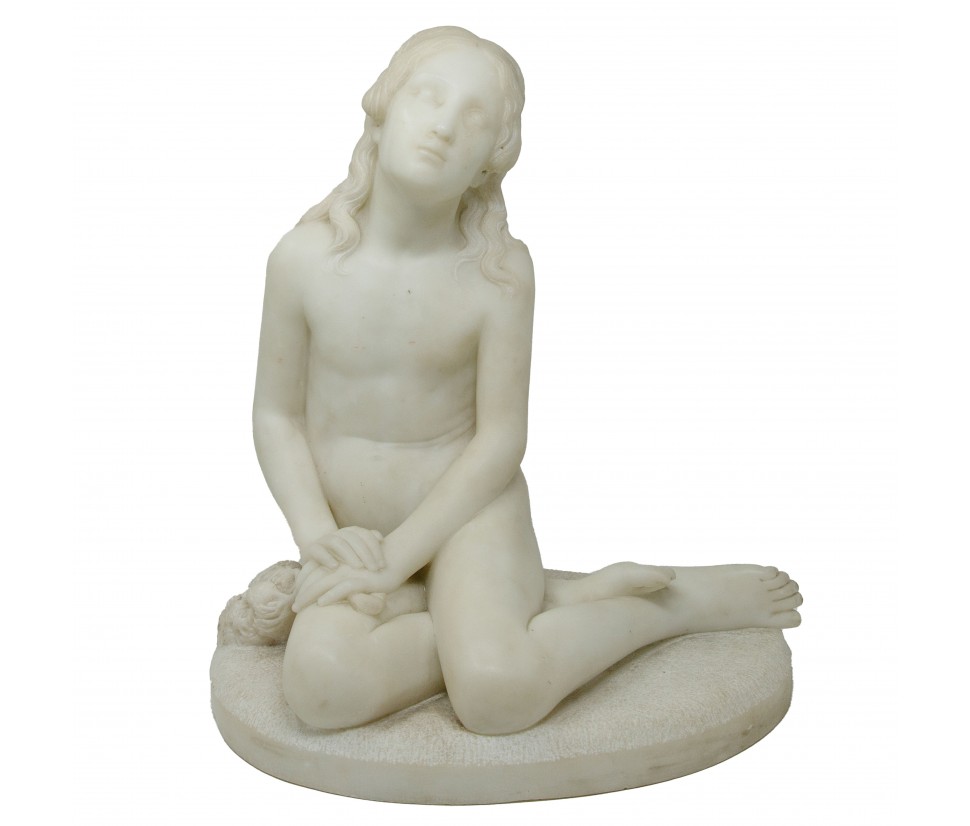






Maiden
Marble, cm 37 x 33 x 26
Luigi Pampaloni (Florence, 1791 - 1847)
Maiden
Marble, cm 37 x 33 x 26
Luigi Pampaloni (Florence, 1791 - 1847)
Luigi Pampaloni (Florence, 1791 - 1847)
Maiden
Marble, cm 37 x 33 x 26
The work in question, a pretty maiden in white marble stretched out with her hands joined in contemplation, is to be counted in the vast artistic corpus of the Florentine sculptor Luigi Pampaloni (Florence, 1791 - 1847), nicknamed the "Anacreon of sculpture" because of the extreme ductility demonstrated in knowing how to alternate a grave and severe register, more appropriate to a monumental style, to that graceful and gentle, suitable for subjects of less commitment.
Around 1810, after completing an apprenticeship in Pisa at the workshop of his brother Francesco, a sculptor and expert in the processing of alabaster, the artist continued his training at the Academy of Fine Arts of Carrara, characterized at the time by a lively environment supported by the patronage of Elisa Baciocchi: here he attended the courses of sculpture held by the famous Lorenzo Bartolini and the drawing lessons of the French Fréderic Jean-Baptiste Desmarais, taking part in competitions in both disciplines in 1811. The artist, still a pupil of Bartolini, began his career with important decorative commissions in Florence: he worked at the villa of Poggio Imperiale (1817 and 1822) and at Palazzo Pitti (circa 1820), making bas-reliefs and plastic decorations in neoquattrocentesco style. In 1826 he achieved notoriety with a funerary sculptural group, depicting a child in prayer and a girl lying down, receiving in the same year the assignment for three Naiads destined to the fountain of piazza Farinata degli Uberti in Empoli. In December 1826 the Opera di Santa Maria del Fiore entrusted him with the task of decorating the two niches on the facade of the new Palazzo dei Canonici, placed along the southern side of the cathedral, with the statues of Arnolfo di Cambio and Filippo Brunelleschi, already planned both sessions: the critics praised the sculptor «for having been able to grasp the character of the two architects», adapting it to the different epochs in which they lived. Also as part of the celebratory sculpture, he was entrusted with the execution of the Monument to Pietro Leopoldo in Piazza S. Caterina in Pisa, and from 1836 had taken part in the decoration of the loggia of the Uffizi, creating the statue of Leonardo da Vinci.
In the period of full maturity he devoted himself to themes of religious inspiration and morally edifying subjects, linked to the philanthropic climate of the Restoration in Tuscany. It was in this context that in 1838, Pampaloni received from the patron and philanthropist Pistoiese Niccolò Puccini the commission of a statue that should have represented a girl in prayer. Soon, however, the project was enriched and a second figure was added, a praying child (for which the artist reused a model made in 1826), both then placed on a rocky peak at the top of which was placed a cross. The work took the name of Orphans on the cliff that, as Puccini himself wrote in his testament "abandoned by the greed of men on the cliff of misery" received comfort from faith in the Cross, which "gives to the needy what was denied them by the world", assigning the sculpture group to his death in the chapel of the Oratory of the former Conservatory of the Orphans of Pistoia, where it is still preserved.In July 1840 the only model of the Maiden was exhibited at the annual exhibition in the halls of the Academy of Fine Arts, while the entire marble complex was completed and delivered in 1842, exposed to the first "Feast of Ears" held in the park of Villa Puccini, and then placed in the large room on the first floor. The artist, in fact, made several versions of the Maiden of various sizes and materials, among which are worthy of note that kept at the Galleria dell'Accademia in Florence and the terracotta model owned by Puccini himself, today placed in the Palace of San Gregorio in Pistoia.
Looking at the sculpture presented here, emerge the fundamental characteristics of Pampaloni’s model, praised in his time for «kindness, truth and expression». Able to combine the neoclassical tradition of Canova inspiration, with a romantic sensitivity and an attention to realism, his works demonstrate delicate executive refinement and a deep psychological investigation of subjects.
With Ars Antiqua it is possible to defer all amounts up to a maximum of € 7,500 at ZERO RATE, for a total of 15 INSTALLMENTS.
Ex. Tot. € 4.500 = Monthly instalment € 300 for 15 months.
Ex. Tot. € 3.600 = Monthly instalment € 720 for 5 months.
For amounts over € 7,500 or for a longer delay in time (more than 15 installments), we can provide a personalized payment.
Contact us directly to get the best quote.
LIVE TV
- SUNDAY 17.00 - 21.00 Dig.terr. 126 - Sky 824
- Streaming on our website www.arsantiquasrl.com and on our social networks Facebook and Youtube
All the works proposed by Ars Antiqua are sold with a certificate of authenticity according to law and an accurate detailed information sheet.
You can see the works at the gallery showroom in Milan, in via Pisacane 55 and 57.
We personally organize transport and delivery of works, both for Italy and abroad.
