


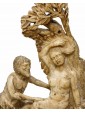
Satyros and Menads
Alabaster, cm 42 x 31
Sicilian school, 17th century
Satyros and Menads
Alabaster, cm 42 x 31
Sicilian school, 17th century
Sicilian school, 17th century
Satyros and Menades
Alabaster, cm 42 x 31
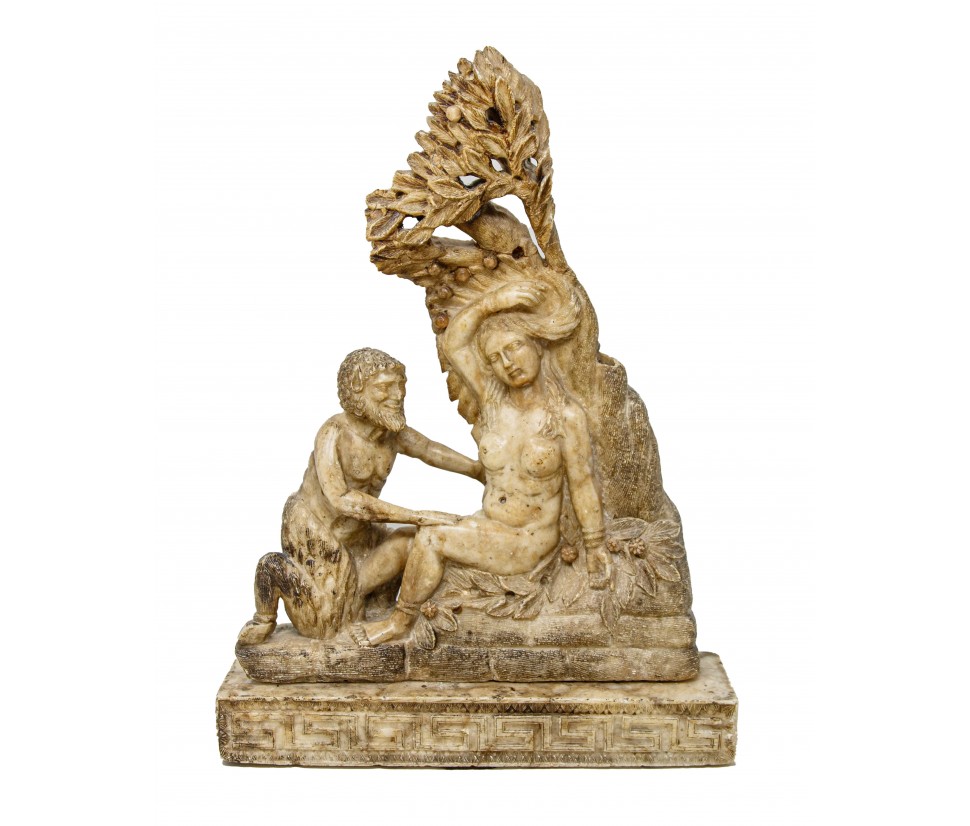
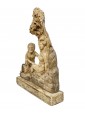
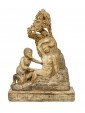
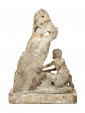
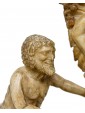
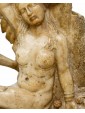
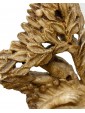
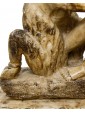
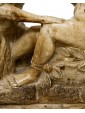
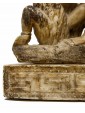
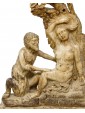
This small alabaster is structured in two parts: the base, decorated with a meander frieze between two frames of plant motifs, and the two figures of the satyr and the menade above. In ancient mythology these two figures were closely related to the god Dionysus: the menads were women invaded by the life force of the god of intoxication, of which they were precisely followers, Whereas the satyr was a minor deity linked to the forest universe and usually associated with Dionysus or the god Pan. The animal aspect of the latter is immediately noticeable by observing the clogs, the fleece of the legs up to the goat’s ears. Its ferino appearance contrasts with the beauty of the menade, lying under the leaves of a tree from whose leaves it has made a temporary bed; the relaxed lasciviousness with which it gently abandons itself on the trunk is perfectly highlighted in the gesture of adjusting the crown as well as in the left arm loosely resting on the leaves. The variety in surface treatment is surprising: thinly grooved in bricks and trunk, more prominent in the details of hair and hair and extraordinarily smooth along the contours of the bodies. We must also note the small details of the flowers and fruits masterfully set into the composition so as to appear part of the same fragment of alabaster. The material lends itself well to this variety and enhances the work in all its details, both through the bright, shimmering reflection like a pictorial chiaroscuro, and through the different natural shades of stone. Being in seventeenth century Sicily, probably in the area of Trapani, it is natural to think about the names of the great artists of the Sicilian baroque style developed parallel to the Roman one so that many architects, sculptors and painters of the island were trained in Rome. The artisan tradition and the decorative vein of the Sicilian shops were associated very well with the baroque architecture, for its nature richly decorated by sculptures, stuccos, friezes and reliefs. Francesco Ferrigno (1686 -1766), originally from Trapani, the members of the Serpotta family or Ignazio Francesco Marabitti (1719 -1797) are just some of the sculptors who can be mentioned for having coordinates regarding the kind of production in which to make the work.
The object is in good condition
With Ars Antiqua it is possible to defer all amounts up to a maximum of € 7,500 at ZERO RATE, for a total of 15 INSTALLMENTS.
Ex. Tot. € 4.500 = Monthly instalment € 300 for 15 months.
Ex. Tot. € 3.600 = Monthly payment € 720 for 5 months.
For amounts over € 7,500 or for a longer delay in time (over 15 instalments), we can provide a personalized payment.
Contact us directly to get the best quote.
TV Direct
- SUNDAY 17.00 - 21.00 Dig.terr. 126
- Streaming on our website www.arsantiquasrl.com and on our social networks Facebook and Youtube
All the works proposed by Ars Antiqua are sold with a certificate of authenticity according to law and an accurate detailed information sheet.
You can see the works at the gallery showroom in Milan, in via Pisacane 55 and 57.
We personally organize transport and delivery of works, both for Italy and abroad.
