




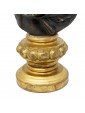
Genoese sculptor of the school of Pierre Puget (1620 - 1694), 17th century
Two manly figures
Cast and patinated bronze, cm 13,5 x 13 and cm 14 x 13
Genoese sculptor of the school of Pierre Puget (1620 - 1694), 17th century
Two manly figures
Cast and patinated bronze, cm 13,5 x 13 and cm 14 x 13
Genoese sculptor of the school of Pierre Puget (1620 - 1694), 17th century
Two manly figures
Cast and patinated bronze, cm 13,5 x 13 and cm 14 x 13
Among the sculptural production of Pierre Puget (Marseille 1620 - Marseille, 1694), one finds small terracotta busts whose animated forms and expressive faces recall the pair of bronzes examined here. In particular, the most punctual references can be found in the terracotta depicting King David conserved in the collections of the Musée Granet or in the portrait of the Emperor Marcus Aurelius conserved in the same museum, as well as in the Shepherd of the Musée du Viezx Toulon and in the model for the statue of Bato Alexander Sauli conserved in the Cleveland Museum of Art.
The sculptor is belonging to the Genoese school that developed after Puget's stay in the city around the sixth decade of the 17th century. In fact, the Marseille-born Puget soon moved to Rome where, in 1640, he became assistant to Pietro da Cortona, where he worked on the painting of the sumptuous ceilings of the Palazzo Barberini in Rome and the Palazzo Pitti in Florence. Then he returned to France, to Toulon, where he executed paintings and altarpieces for religious confraternities, parish churches and convents. In the year 1655 there was his first important sculpture, The Mighty Atlases supporting the balconies of the Hotel de Ville in Toulon.
In 1660, he received an even more important commission from Nicolas Fouquet, the king's finance minister, to create sculptures for Fouquet's new garden at Vaux-le-Vicomte, including a statue of Hercules. The sculptor went to the marble caves of Carrara, where he selected the marble he wanted, selected a Genoese sailor as a model and in Genoa made the statue that became known as Hercules of Gaul (Paris, Louvre). However, the disgrace of his patron convinced Puget to stay in Italy, so he decided to move to Genoa with his family. Puget stayed in the city for about a decade from 1661 to 1668, bringing the latest innovations of the Roman Baroque to the city. During this period, he completed numerous projects and became the owner of a prolific workshop where numerous sculptors were trained, such as Daniello Solaro and Honoré Pellé. In 1663 Francesco Maria Sauli commissioned the sculptor to complete the Basilica of Santa Maria Assunta in Carignano, inspired by Bernini's work in St. Peter's, which was however never realised. Other works from his Genoese period include the Immaculate Conception, for the Albergo dei poveri, on the high altar of the Basilica of San Siro and the Rape of Helen for the terrace of Palazzo Pantaleo Spinola. On his return to France, he produced one of his most monumental works, the Milone da Crotone now in the Louvre in Paris. He died in Marseilles on 2 December 1694.
