


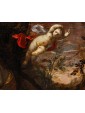
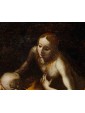
Maddalena penitente
Oil on panel, cm 34 x 45
With frame, cm 44 x 57
Provenance: Collection Giancarlo Sestieri
Giovanni Stefano Danedi, known as il Montalto (Treviglio, 1612 - Milano, 1690)
Maddalena penitente
Oil on panel, cm 34 x 45
With frame, cm 44 x 57
Provenance: Collection Giancarlo Sestieri
Giovanni Stefano Danedi, known as il Montalto (Treviglio, 1612 - Milano, 1690)
Giovanni Stefano Danedi, known as il Montalto (Treviglio, 1612 - Milano, 1690)
Maddalena penitente
Oil on panel, cm 34 x 45
With frame, cm 44 x 57
Provenance: Collection Giancarlo Sestieri
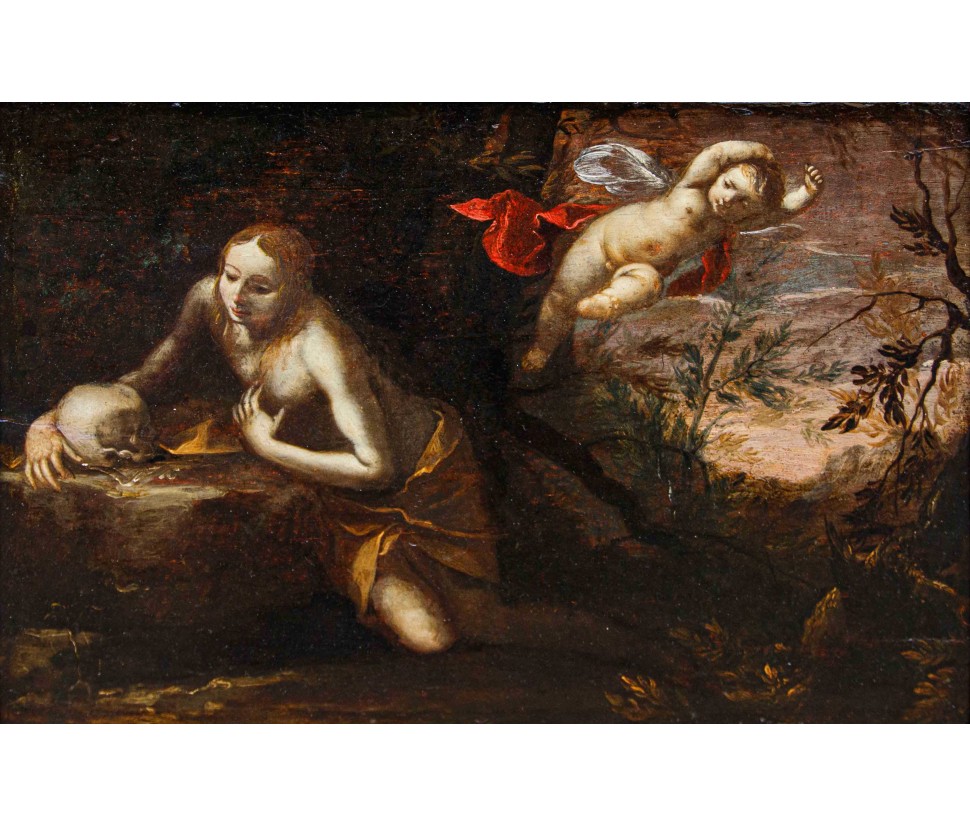
The intense depiction of Mary Magdalene in this object is attributed to the hand of Giovanni Stefano Danedi, son of Giovanni Antonio and elder brother of Giuseppe. Born in Treviglio in 1612, Giovanni Stefano Danedi is the most important member of a family of artists that includes, among others, his brother Giuseppe, three years older and also known by the nickname of Montalto, along with whom he performed several works. His artistic training took place within the cultural fabric of Milan in those years, from which he drew the figurative influence of the greatest artists of the early seventeenth century: the Morazzone, the Cerano, Giulio Cesare and Camillo Procaccini, Carlo Francesco Nuvolone. In the Lamentation on Christ, today at the Museum of Castelvecchio in Verona, it is clear that his artistic beginnings are linked to the influence of Morazzone and the youthful style of Francesco Cairo, evident especially in the paintings depicting Herodiade with the head of the Baptist (Milan, Civiche Collezioni d'arte del Castello Sforzesco) and the Miracle of the mule (1645) in the basilica of Treviglio. Between 1641 and 1648 both brothers stayed in Rome, where they learned to appreciate new languages and pictorial suggestions, coming into contact with the works of Pietro da Cortona. Montalto updated his artistic language in a decidedly baroque sense as documented by the frescoes executed that same year in the presbytery of the Cathedral of Monza. He will stick to the new baroque language more and more in the following years, as shown for example by the frescoes of the sixth and seventh chapel on the right in the Carthusian Monastery of Pavia (1671-1688) and the decoration of the 17th chapel and dome of the Sanctuary of the Sacro Monte di Varallo.It is not surprising, therefore, that this work presents an evocative and powerful subject such as the penitent Magdalene in the desert, conceived here in a airy composition. As a solitary penitent in the desert, Maddalena achieved in the 17th century a formidable fortune and is often associated with Gerolamo, the other saint who retired to the hermit life. Both express the way of asceticism, the removal of worldly pleasures and the sacrifice necessary for salvation. They are figures of redemption from the vanity of human life in view of eternity. This is the meaning of the skull, symbol of death and redemption, which is located at the foot of Maddalena. Leaning against a raised boulder, Maddalena is covered with a yellow mantle, which leaves her bust uncovered. Behind it opens a landscape reminiscent of the painter’s wild openings and an angel, the only other presence.The attribution of the small table to the Lombard artist is confirmed by the stylistic analysis, which leads to highlight the quality that is proper to him when compared with works such as the Angelica and Medoro of the Gianfranco Luzzetti Collection Museum, the Apollo and Marsia and the Abandoned Didone of the Pinacoteca del Castello Sforzesco. In these latter, the scenes, set outside in an untamed and wild landscape, are all developed on the left of the canvas, often rectangular. The light and dark effects and the colour stamp made of neutral colours interspersed with the colour variations of red and yellow clearly recall the production of Montalto.Another comparison can be made with the figure of the angel that appears at the top of our painting. The angelic figures are a constant in the production of Danedi, putti fleshy and playful faces framed by soft curls are present in works such as Christ with the symbols of the Passion of the Picture Gallery of the Castello Sforzesco, Milan, the Multiplication of the Monza Cathedral’s Bread and the Flight to Egypt by the Milanese Diocese Collection
With Ars Antiqua it is possible to defer all amounts up to a maximum of € 7,500 at ZERO RATE, for a total of 15 RATES.
Ex. Tot. € 4.500 = monthly instalment € 300 for 15 months.
Ex. Tot. € 3.600 = Monthly payment € 720 for 5 months.
For amounts over € 7,500 or for a longer delay in time (over 15 instalments), we can provide a personalized payment.
Contact us directly to get the best quote.
TV Direct
- SUNDAY 17.00 - 21.00 Dig.terr. 126 + 809 SKY
- THURSDAY 21.00 - 24.00 Dig.terr. 125 + 809 SKY
- Streaming on our website www.arsantiquasrl.com and on our social networks Facebook and Youtube
All the works proposed by Ars Antiqua are sold with a certificate of authenticity according to law and an accurate detailed information sheet.
You can see the works at the gallery showroom in Milan, in via Pisacane 55 and 57.
We personally organize transport and delivery of works, both for Italy and abroad.
