


Saint Ursula in glory
Oil on canvas, cm 135 x 88
Martino Altomonte (Naples, 1657 - Vienna, 1745), attr.
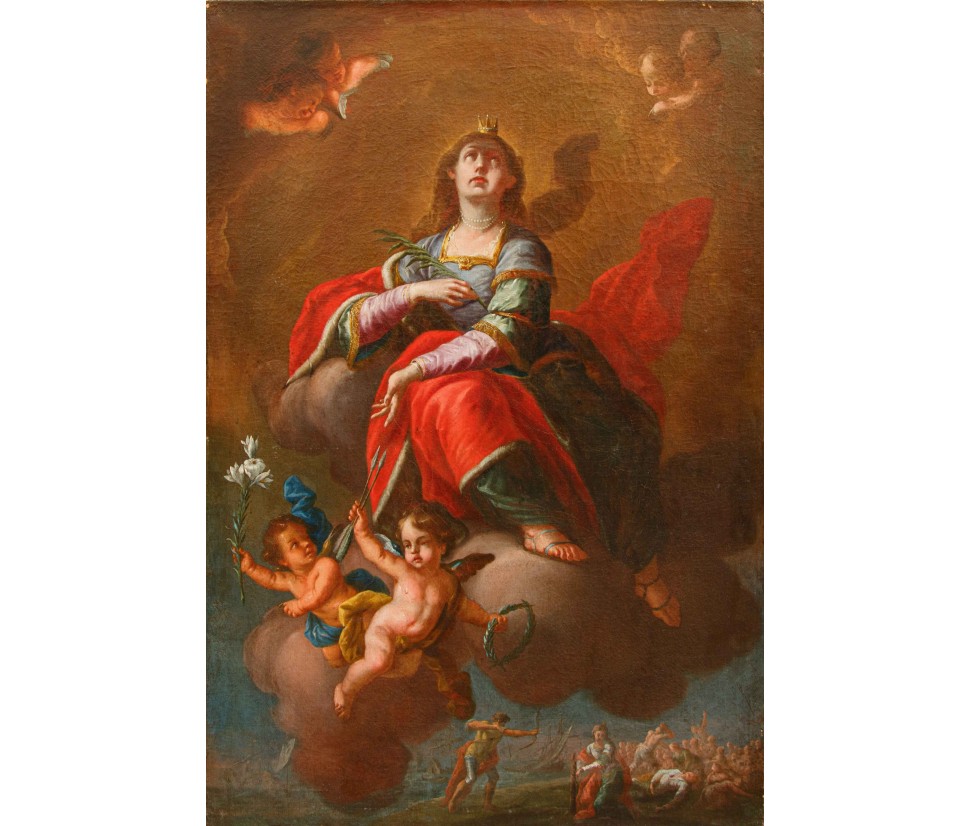
Saint Ursula in glory
Oil on canvas, cm 135 x 88
Martino Altomonte (Naples, 1657 - Vienna, 1745), attr.
Martino Altomonte (Naples, 1657 - Vienna, 1745), attr.
Saint Ursula in glory
Oil on canvas, cm 135 x 88
The first records of Saint Ursula’s life date back to the 9th century, when the relics of many young women were found in a crypt near Cologne. These relics were associated with a local legend that related to a British princess named Orsola and her eleven thousand virgins, martyred by the Huns.
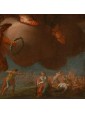
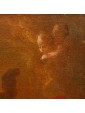
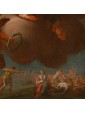
According to tradition, Orsola, the bride of a Hun prince, refused to marry and dedicated herself to religious life. Together with thousands of virgins, he embarked on a ship to Rome to make a pilgrimage and receive baptism. Upon their return, they found Cologne besieged by the Huns. Rather than renouncing their faith, the virgins were killed by barbarians. Orsola, in particular, was pierced by an arrow. And it is the moment before death that is depicted on the background of the painting: Orsola tied to some shackles is about to be hit by the arrow already cocked by the soldier, in the distance a tangle of bodies testify to the brutal episode.
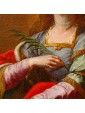
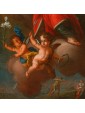
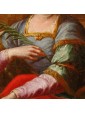
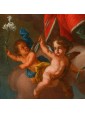
At the centre of the composition, the figure of the saint is raised to heaven in a whirlwind of clouds and divine light. His clothing is refined and rich: the golden profiles of the robes, the pearls at the neck, the crown and the coat made of ermine underline his royal descent. In his hands he holds the palm symbol of martyrdom while two angels at his feet hold arrows, as a reference to his cruel death, the lily, which alludes to his purity and virginity and the crown of laurel, symbol of victory and triumph.
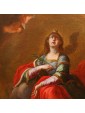
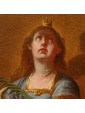
The composition of the painting, especially in the treatment of the face of the saint with eyes turned upwards in a deep divine ecstasy allow us to connect the present painting to the production of Martino Altomonte (Naples, 1657 - Vienna, 1745). Some works by the master are cited to prove the attribution, such as the canvas of the altar of Saint Bernard at the Abbey of Lilienfeld; in it the strong chiaroscuro contrasts of the face and the general warm tone of the composition are all recalled in our painting. The same careful use of shadows, especially in the description of faces, is also found in other paintings such as the Resurrection of the son of the widow of Naím in the Church of Saint Charles Borromeo, Vienna, or the Crucifixion with Mary Magdalene of the Kunsthistorisches Museum. Martino Altomonte was born in 1657 in Naples, the city where his father, a native of Tyrol, had emigrated. His real name is Johann Martin Hohenberg. Altomonte was trained as an apprentice by Baciccia and then by Giacinto Brandi and Carlo Maratta. After a long artistic career in 1684 he became the court painter of John III Sobieski, king of Poland and for the occasion changed his name to Altomonte.
Commissioned by the king, he executed among other things two depictions of John III’s victories over the Turks, The Siege of Vienna and the Battle of Parkany (now in the parish church of Zòlkiew, province of Leopoli). He then decorated the residence of Sobieski in Wilanow near Warsaw (mythological scenes can be attributed to him) and made many portraits. Among these, the portrait of Queen Maria Casimira with her children is particularly noteworthy, a complicated allegorical composition inspired by examples of French court painting. After the death of the king (1696), the Altomonte passed to the service of various Polish aristocratic families: the Wodzicki, the marshal Stanislaw Jan Jablonowski, Jan Dobrogost Bonawentura Krasinski. The works of this period have all been destroyed.The invasion of Poland by Charles XII forced the Altomonte to leave the state for Vienna, where he moved in 1703. In 1707 he was admitted to the Academy of Painting and appointed assistant to its director, Peter von Strude. In the years 1703-1720 he was mainly engaged, on commission from the imperial family, in decoration works such as at the Mirabell palace in Salzburg (1718), or in biblical and mythological compositions (Susanna and the Old, 1709, now in the Belvedere Museum in Vienna). The best known work of this period is the ceiling (1716) of the Lower Belvedere Marble Hall with the Apotheosis of Prince Eugene, a large allegorical fresco typical of the Austrian baroque of the early eighteenth century. In 1720 he moved to Linz, and there, alternating stays in the Cistercian monastery of Heiligenkreuz, he remained until his death. In this last period he devoted himself mainly to the painting of religious subjects, performing numerous paintings for Austrian churches (Heiligenkreuz, Herzogenburg, St. Polten, Linz, Wilhering, Kremsmùnster, etc.),
Altomonte developed a mixed Neapolitan-Venetian style which would long become the standard for Viennese baroque painting. In his paintings he was able to introduce the pastel tones typical of Venetian painting among the elements of the dramatic Neapolitan chiaroscuro.
The object is in good condition
With Ars Antiqua it is possible to defer all amounts up to a maximum of € 7,500 at ZERO RATE, for a total of 15 RATES.
Ex. Tot. € 4.500 = Monthly instalment € 300 for 15 months.
Ex. Tot. € 3.600 = Monthly payment € 720 for 5 months.
For amounts over € 7,500 or for a longer delay in time (more than 15 installments), we can provide a personalized payment.
Contact us directly to get the best quote.
TV Direct
- SUNDAY 17.00 - 21.00 Dig.terr. 126 + 809 SKY
- THURSDAY 21.00 - 24.00 Dig.terr. 125 + 809 SKY
- Streaming on our website www.arsantiquasrl.com and on our social networks Facebook and Youtube
All the works proposed by Ars Antiqua are sold with a certificate of authenticity according to law and an accurate detailed information sheet.
You can see the works at the gallery showroom in Milan, in via Pisacane 55 and 57.
We personally organize transport and delivery of works, both for Italy and abroad.
