


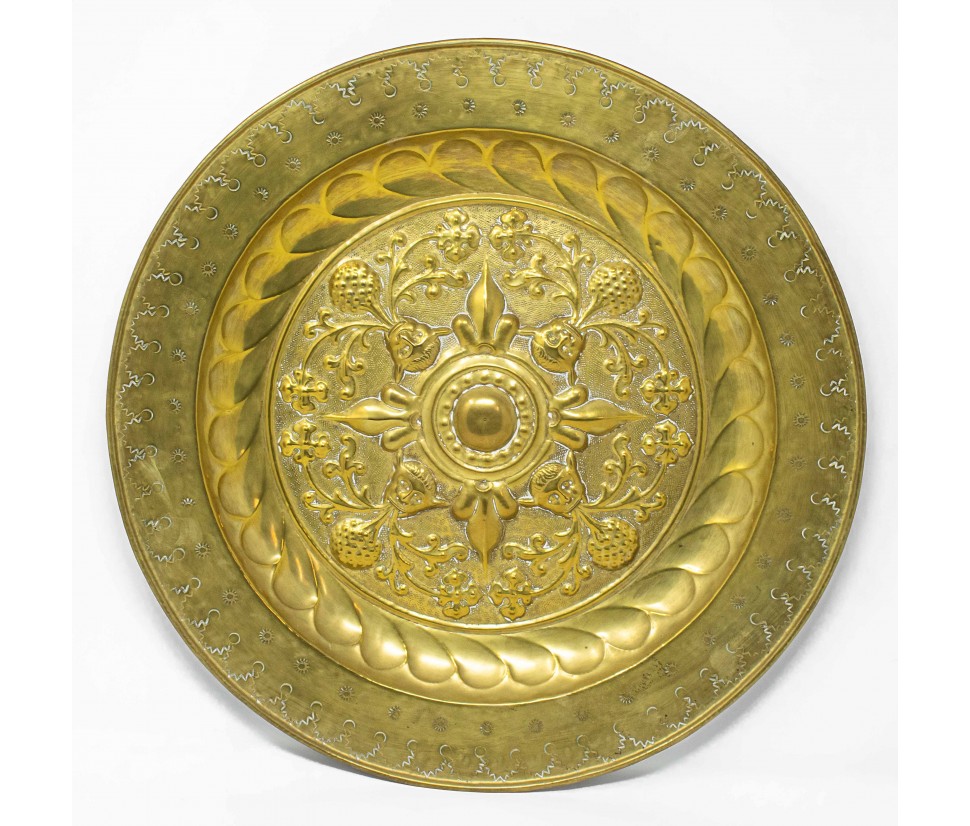
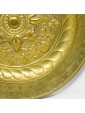
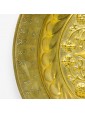
Mendicant’s plate
Brass, cm diameter 42
XVIII century
Mendicant’s plate
Brass, cm diameter 42
XVIII century
XVIII century
Mendicant’s plate
Brass, cm diameter 42
The alms plate, properly called "alms plate", is a container usually decorated in the form of a large bacille or plate for the collection of offerings for the Church; generally made of metal such as bronze, brass, silver and gold. Constant is the presence of central decorations fitomorph or girandola or with subjects taken from the bible, can also present in the center a support to fix an iconographic element (a statuette) or even a candle holder or compartments for the subdivision of alms.
The almen’s plate is an artisan object present and documented in all southern Europe since the Middle Ages, from the second half of the 15th century until the mid 18th century and beyond; of initial Flemish production (area of Mechelen/Malines) and German (area of Nuremberg) and as regional production expands.
It is so called because in the churches of Germany of the early fifteenth century (about 60 years before Martin Luther) during the masses it was used to collect the offerings in plates, cubs and bowls of brass, said precisely for this alms. Once only the sacristan handled them, passing among the faithful during religious services in the church and were used for that purpose until the late nineteenth century; then replaced by almoner cloth with slit opening, most likely for confidentiality.
The craft shops of Nuremberg began to build in quantity and with more and more valuable specimens, especially after, from the middle of the fifteenth century, spread among private individuals the fashion of hanging various types and manufacture at home. These dishes are often presented in a series of standardized performances due to a massive production of proto-industrial type spread especially in the areas of Catholic influence (southern Germany, France, Italy, Spain and Flanders).
In Italy, the alms plate is also used on Good Friday to support the nails and the crown of thorns during the ceremony of the deposition of Christ from the cross while in Sardinia it makes a particular use, becomes musical instrument used to accompany the Sardinian dance.
The almoner plate examined, in brass, has a series of concentric surfaces decorated with plant motifs and in the center a right-hand winder, decoration that can be found in many examples, including the one painted in the Apparition di Gregorio Magno a Santa Fina by Domenico Ghirlandaio in the collegiate church of San Giminiano.
The motif of the girandola is used with reference to life and the sun and are almost always right-handed: formed by stylized leaves with a central rib from which start the "petals" of a flower from the central round. This Christian symbol has very ancient roots and is connected to the right-handed swastika that evokes the sacred tantric symbol of auspicious shakti.
The object is in good condition
With Ars Antiqua it is possible to defer all amounts up to a maximum of € 7,500 at ZERO RATE, for a total of 15 INSTALLMENTS.
Ex. Tot. € 4.500 = Monthly instalment € 300 for 15 months.
Ex. Tot. € 3.600 = Monthly instalment € 720 for 5 months.
For amounts over € 7,500 or for a longer delay in time (more than 15 installments), we can provide a personalized payment.
Contact us directly to get the best quote.
LIVE TV
- SUNDAY 17.00 - 21.00 Dig.terr. 126 + 809 SKY
- THURSDAY 21.00 - 24.00 Dig.terr. 134 + 809 SKY
- Streaming on our website www.arsantiquasrl.com and on our social networks Facebook and Youtube
All the works proposed by Ars Antiqua are sold with a certificate of authenticity in accordance with the law and a detailed information sheet.
You can see the works directly at the gallery showroom in Milan, in via Pisacane 55 and 57.
We personally organize transport and delivery of the works, both for Italy and abroad.
