


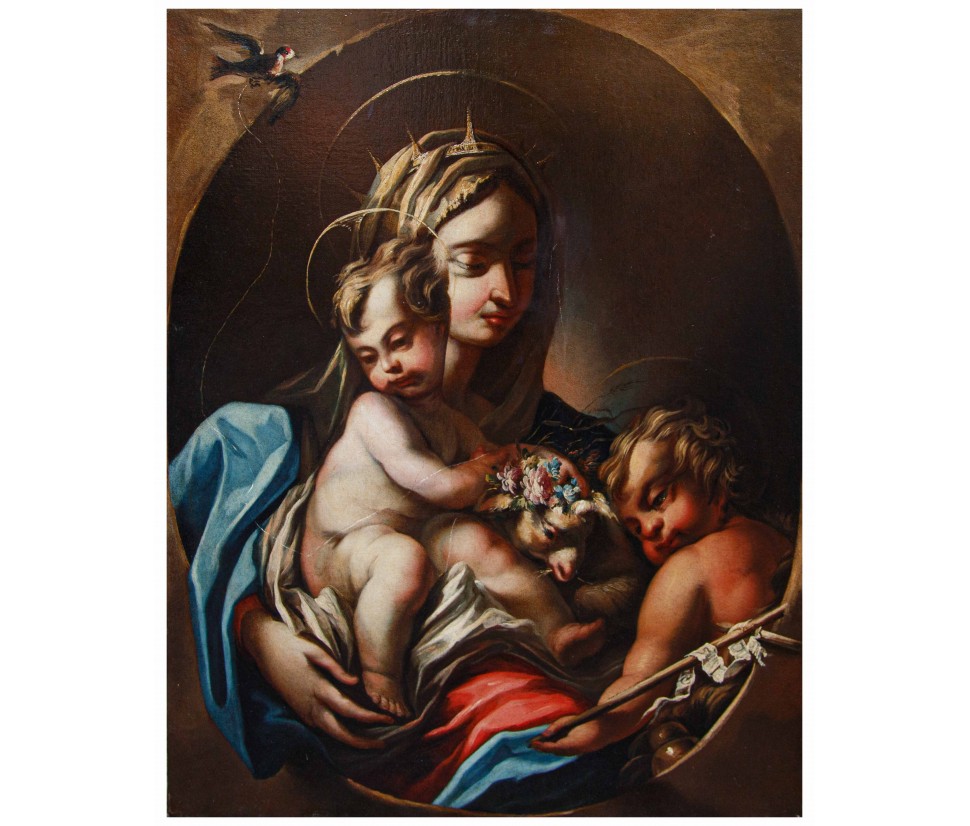
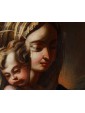
Madonna with Child
Oil on canvas, cm 97,5 x 73
Genoese school, 17th century
Madonna with Child
Oil on canvas, cm 97,5 x 73
Genoese school, 17th century
Genoese school, 17th century
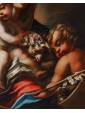
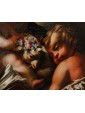
Madonna with Child, Saint John and goldfinch
Oil on canvas, cm 97,5 x 73
The Genoese school of the seventeenth century was able to realize in an excellent way the movements of mind and the intimacy of religion. Supporters of an innovative academicism, free from any classicism but ready, despite the dictates of the Counter-Reformation, to internalize through colors the most hidden mysticism, the genoese made school thanks to the historical opening of the city port towards the international market. With the end of French rule over the city at the time of Andrea Doria, the new pro-Spanish change allowed Genoa to be placed among the main European artistic centres.
After the mannerisms of the foreign painters hosted by Doria, denounced by the brushes of Domenico Beccafumi and Pordenone, the new Flemish figuratives accompanied the Genoese painting with lively arrogance, delivering it to the embrace of the Baroque. It is no coincidence that the champion of the seventeenth century was the eclectic Bernardo Strozzi, who had been at the workshop of the Sienese Sorri.
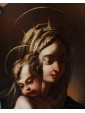
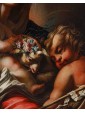
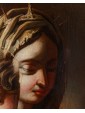
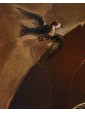
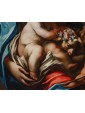
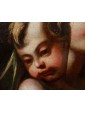
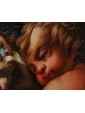
In this painting the Madonna, supporting the Child and in the company of the Infant Baptist, stops within an oval, escaping illusionistically through a soft fold of the mantle. The group portrayed is on fire symbolically and concretely: the ardor of divine love shines through the turned bodies and the reddish joints of the retracted, elongated eyes like strands of hair trembling in the air and the color of the grain. Light also glides over the silky robes of the Virgin, reflecting with dazzling light. Delicate as a hair, the cord that holds the Child holds the happy smoothing of the wings of the goldfinch, symbol of the future Passion of Christ: medieval tradition wanted a goldfinch, in an attempt to extract the thorns from the crown of Jesus' thistle, was stained with His blood. Even the sweet lamb surrounded by a wreath of flowers, tenderly intent on chewing one, is a living Christian symbol of sacrifice and Resurrection.
The painting enucleates the main characteristic features of the triumphant Genoese school. While it is possible to understand a luminism at Valerio Castello (1642-1659), on the other hand the typical formalism of Giovanni Battista Paggi is softened in the containment of emotions, manifested with a real modesty by those present. It is possible to compare, except for the backgrounds built by Paggi, the little faces of children, as happens in the Cupid of Rinaldo and Armida and in Jesus and in the angels of the Mystical Wedding of Saint Catherine or in the Madonna and Child, Saint John and Saint Stephen receiving the palm of martyrdom, all in private collection. Bartolomeo Guidobono (1654-1709) will collect this tradition, by lightening the rendering of his paintings, caressed by a darkness equal to the present, which delicately brings out the characters' incarnations: this is how it happens in the Maga in private collection.
With Ars Antiqua you can defer all amounts up to a maximum of € 7,500 at ZERO RATE, for a total of 15 INSTALLMENTS.
Ex. Tot. € 4,500 = Monthly installment € 300 for 15 months.
Ex. Tot. € 3,600 = Monthly installment € 720 for 5 months.
For amounts over €7,500 or for a longer grace period (over 15 installments), we can provide a custom payment.
Contact us directly to get the best quote.
LIVE TV
- SUNDAY 17.00 - 21.00 Dig.terr. 126 + 809 SKY
- THURSDAY 21.00 - 23.00 Dig.terr. 134 + 809 SKY
- Streaming on our website www.arsantiquasrl.com and on our social networks Facebook and Youtube
All the works proposed by Ars Antiqua are sold accompanied by a certificate of authenticity in accordance with the law and accurate fact sheet.
You can see the works directly at the showroom gallery in Milan, in via Pisacane 55 and 57.
We personally organize transport and deliveries of the works, both for Italy and abroad.
